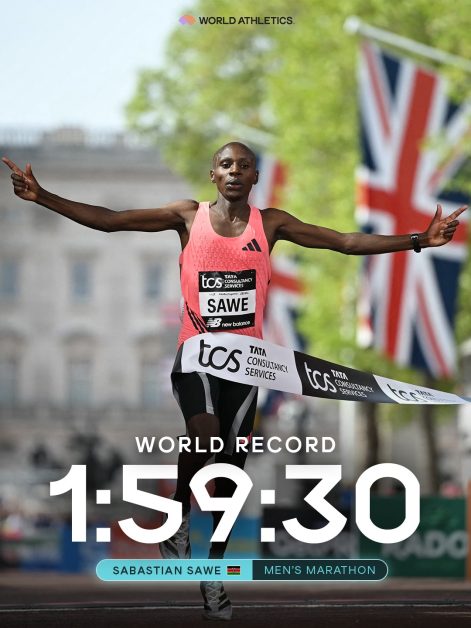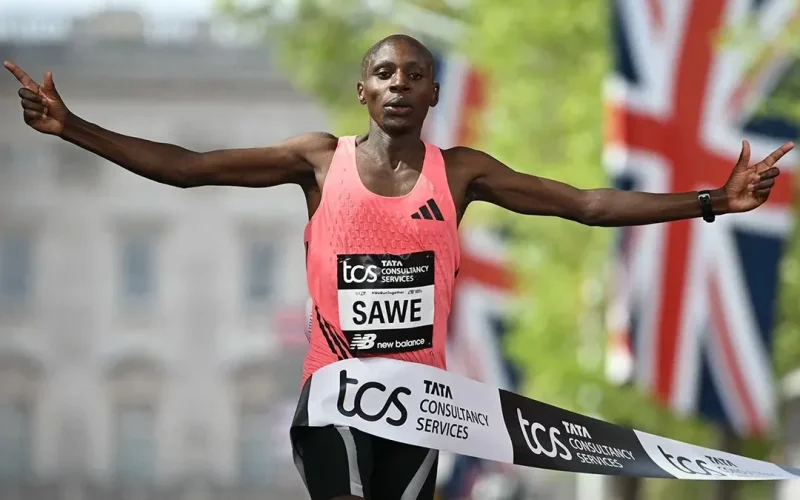
THERE are moments in sport that do not merely rewrite record books – they reorder the universe of what human beings believe is possible. Sunday on the Mall in London was such a moment. Sabastian Sawe of Kenya crossed the finish line of the London Marathon in 1 hour, 59 minutes and 30 seconds, becoming the first person in history to break the two-hour barrier in an official, competitive marathon race. He did not sneak under it. He smashed it by 65 seconds.
The crowd lining the route through one of the world’s great capitals did not merely witness a race. They witnessed the end of an era – the era in which the two-hour marathon existed as sport’s last great unconquered frontier.
| “What comes today is not for me alone — but for all of us today in London.” — Sabastian Sawe |
Sawe understood the enormity of what he had done. “What comes today is not for me alone,” he said in the breathless aftermath, “but for all of us today in London.” He was, in that sentence, not speaking only of the tens of thousands who packed the streets of the British capital. He was speaking of Kenya. Of Africa. Of every young child who has risen before dawn on a dirt road from Iten to Eldoret to train by the light of stars.
This was an African triumph of the highest order, and the leaderboard confirmed it in spectacular fashion. In second place, Ethiopia’s Yomif Kejelcha – running his first-ever marathon – also broke the two-hour mark, finishing in 1:59:41. The achievement was jaw-dropping in its own right; that it was rendered a silver medal tells you everything about the altitude of Sunday’s performance.
Uganda’s Jacob Kiplimo, third across the line in 2:00:28, broke the previous world record – set by Kenya’s Kelvin Kiptum at the 2023 Chicago Marathon – by seven seconds. In any other era, Kiplimo would have been the greatest marathon runner alive. On Sunday, he finished third.
| Three men from East Africa. Three sub-world-record times. One afternoon in London that changed sport forever. |
The context matters. In 2019, the great Eliud Kipchoge became the first human to run a sub-two-hour marathon in the Breaking2 project in Vienna – a feat arranged under controlled conditions, with rotating pacemakers, on a closed circuit, and backed by British billionaire Jim Ratcliffe’s resources. Historic as it was, it fell outside the rules of official competition and was never ratified. Sawe surpassed even Kipchoge’s celebrated 1:59:40 by ten seconds – in a legitimate race, on the open streets of London.
The 29-year-old, who retained the London title he won the previous year, described the day simply as one “to remember for me.” But credit where it is generously due – he paid tribute to the roaring crowds who refused to let him slow. “I think they help a lot,” he said. “Because if it was not for them you don’t feel like you are so loved… with them calling, you feel so happy and strong.” He then backed those words with numbers: his second half of the race – 59 minutes and 1 second – was faster than his first.
He ran the race the way Africa has always run: patient, powerful, purposeful. He let the field come with him, pulling clear with Kejelcha at the 30-kilometre mark before making his decisive solo break in the final two kilometres – sprinting down the Mall with the roar of history at his back.
The records in this event have told a consistent story for a quarter-century. In 1999, Morocco’s Khalid Khannouchi set the benchmark at 2:05:42 in Chicago. He broke his own mark in London in 2002. Then came the roll-call of African greatness — Ethiopia’s Haile Gebrselassie, Kenya’s Wilson Kipsang, the incomparable Kipchoge, and the tragically short-lived Kiptum, whose 2023 Chicago record had stood until Sunday. The marathon’s history is, in large measure, African history.
Paula Radcliffe, herself a London Marathon legend, captured the moment with characteristic clarity during BBC commentary. “The goalposts,” she said, “have literally just moved for marathon running.” She was not wrong. Not by a step.
| ATHLETE | COUNTRY | FINISH TIME |
| Sabastian Sawe | Kenya 🇰🇪 | 1:59:30 WR |
| Yomif Kejelcha | Ethiopia 🇪🇹 | 1:59:41 |
| Jacob Kiplimo | Uganda 🇺🇬 | 2:00:28 |
Beyond the men’s race, Sunday in London offered its own broader canvas of excellence. Ethiopia’s Tigst Assefa won the women’s marathon in 2:15:41 – the fastest time ever recorded in a women’s-only race – though still 16 seconds shy of Radcliffe’s mixed-race course record set in 2003. In the wheelchair events, Switzerland’s Marcel Hug claimed a sixth consecutive men’s title, his eighth in total, while Catherine Debrunner defended her crown.
But this day belonged to East Africa. More precisely, it belonged to a young Kenyan from a continent too often defined by its struggles, standing at the finish line of history with nothing left in his lungs and everything to give to the world.
Sabastian Sawe ran 42.195 kilometres through London in under two hours. In doing so, he carried a continent on his shoulders – and made it look like wings.