SIXTY-THREE years after thirty-two newly independent nations gathered in this Ethiopian capital to sign the founding charter of the Organisation of African Unity, the African Union is marking Africa Day 2026 with three days of ceremony, sport, culture and hard continental conversation – and with a theme that cuts to the bone of what development actually means for ordinary people.
This year, the AU has framed its anniversary around water. The theme adopted at the 39th Ordinary Session of the Assembly of Heads of State and Government in February — “Assuring Sustainable Water Availability and Safe Sanitation Systems to Achieve the Goals of Agenda 2063” – is not an abstraction. It is a stark acknowledgement that across a continent of 1.4 billion people, hundreds of millions still lack reliable access to clean water and basic sanitation: the most foundational right of all.
“The year 2026 must be a turning point — the moment we move decisively from diagnosis to delivery.”
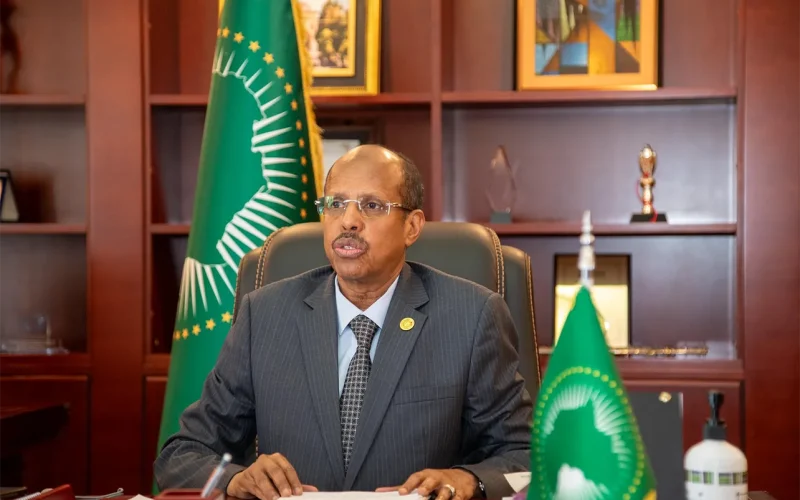
H.E. Mahmoud Ali Youssouf, Chairperson, African Union Commission
In an opinion piece circulated ahead of the commemorations, AUC Chairperson Mahmoud Ali Youssouf put it with unusual bluntness. When Africa’s heads of state gathered in February, he wrote, they made a deliberate political choice to place “the most fundamental, life-sustaining and strategic resource our continent possesses” at the centre of the agenda. His message to member states was unambiguous: water touches every sector – agriculture, health, energy, industry, and education – and the continent’s response must be equally integrated.
ADDIS ABABA: THE HEARTBEAT OF THE CONTINENT
The official three-day commemoration of the 63rd anniversary of the OAU-AU at the organisation’s Addis Ababa headquarters runs from Saturday 23 to Monday 25 May 2026, under the celebratory theme: ‘Sixty-three Years of Unity, Integration and Development, let’s celebrate together.’ Over the weekend, AU staff, diplomats, member state representatives and civil society gathered for football, tennis and chess tournaments, an AU departmental exhibition bazaar, and a family cultural festival. The centrepiece – an official ceremony on Africa Day itself – features formal addresses by the AU Chairperson, a representative of the Federal Democratic Republic of Ethiopia, the Dean of the Diplomatic Corps, and the President of the AU Staff Association, followed by cultural showcases and the now-traditional continental group photograph.
It is, as always, both a celebration and an accountability moment. Sixty-three years into the pan-African project, the gap between the founding vision and present reality remains the continent’s most persistent editorial subject.
BRAZZAVILLE: WHERE FINANCE MEETS FESTIVITY
This year’s Africa Day coincides with a major continental economic event: the African Development Bank Group’s 2026 Annual Meetings, hosted by the Republic of the Congo in Brazzaville. The AfDB and the government of President Denis Sassou Nguesso, in partnership with the AU Commission, are hosting a dedicated Africa Day celebration at the Kintélé International Conference Centre – bringing together heads of state, bank governors, executive directors, development partners and civil society in what promises to be the continent’s most high-profile intersection of commemoration and capital.
“Africa Day brings together participants to showcase Africa’s cultural richness, contemporary creativity, and enduring sense of identity.”
African Development Bank Group
The celebrations at the Mfoa Plenary Hall will centre on the African Cultural Heritage Show – a deliberately emotive centrepiece designed, in the Bank’s own framing, to ‘deepen appreciation for African arts through powerful visual and emotional expression.’ Participants from across headquarters, regional offices and Annual Meeting delegations have been invited to attend in African attire. The symbolism is pointed: in a hall full of central bankers and finance ministers, Africa insists on being more than a set of macroeconomic indicators.
WEST AFRICA: NKRUMAH’S LEGACY LIVES ON
In West Africa, Africa Day is marked with enormous energy. Ghana – as the intellectual cradle of modern pan-Africanism and the nation that hosted the 1958 All-African Peoples’ Conference under Kwame Nkrumah – holds the commemoration in particularly high regard. Cultural processions through Accra feature elaborate kente cloth displays, traditional drumming and performances by the national dance company. Nigeria and Senegal host major outdoor concerts where Afrobeats, highlife and Afropop fill city squares from Lagos to Dakar. These are not mere pageants: in the year of Nigeria’s continued Afrobeats global dominance and Senegal’s ongoing resource sovereignty push under Prime Minister Ousmane Sonko, West African street celebrations carry unmistakable political resonance.
EAST AFRICA: WHERE THE CHARTER WAS BORN
In East Africa, the day carries the particular weight of geography. Addis Ababa is, of course, the continent’s political nerve centre – but Nairobi, Dar es Salaam and Kampala each host vibrant combinations of official ceremony and community festival. The region’s strong literary and intellectual tradition comes to the fore on Africa Day, with book fairs, public lectures and pan-Africanist forums marking the date alongside state ceremonies. Kenya’s President William Ruto, who serves as the AU Champion on Institutional Reform, is expected to use the day’s platform to advance the reform agenda he inherited from Rwanda’s Paul Kagame.
THE DIASPORA JOINS THE CHORUS
Across the world, African diaspora communities are asserting that Africa Day belongs to them too. In Dublin, Ireland’s Africa Day programme – long one of the most organised diaspora commemorations globally – features South African vocal ensemble The African Queens alongside Ghanaian percussionist Dr John Nutekpor. In New York, The Africa Center hosts its annual public celebration on 30 May. In New Zealand, the Africa Day Aotearoa gathering brings together communities from West, East, Central and Southern Africa. The continental festival has become, unmistakably, a global one.
UNITY’S UNFINISHED BUSINESS
But Africa Day 2026 arrives in a complex continental moment. The AU’s own high-level retreat on peace, security and stability — held just days before the commemoration under the theme ‘Powering Ceasefire, National Dialogue and Reconciliation for Durable Peace’ — is a reminder that the continent’s founding vision of collective security remains work in progress. The DRC crisis, Sudan’s catastrophic civil war, the Sahel’s security collapse, and persistent governance deficits in several member states shadow the bunting and the drumming.
AUC Chairperson Youssouf, in his pre-commemoration address, underscored what he called ‘the imperative of renewed multilateral solidarity’ in responding to the continent’s evolving peace and security challenges. The India-Africa Forum Summit, convening immediately after Africa Day from 28 May in Addis Ababa, adds another layer: Africa’s place in a reshaping global order — between East and West, between old donors and new partners — is one of the defining questions of this decade.
AUC Chairperson Mahmoud Ali Youssouf
“Achieving water security will require sustained collaboration among member states, regional organisations, civil society, the private sector — and African communities themselves.”
What Africa Day ultimately asks – sixty-three years on – is not whether the continent has arrived, but whether it is moving in the right direction, at the right speed, on its own terms. The water theme is instructive: it is both the humblest and most urgent of all development goals, and choosing it as this year’s continental lens is an act of honesty. No amount of celebration papers over the fact that a continent with more freshwater resources than any other still cannot guarantee a safe glass of water to every one of its citizens.
That reckoning – held simultaneously with joy, pride, music and defiance – is what makes Africa Day unlike any other commemoration on the global calendar. It is a birthday party and a board meeting; a homecoming and a call to account. Sixty-three years into the project, Africa is still, stubbornly and magnificently, becoming.