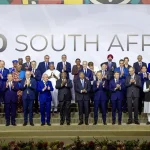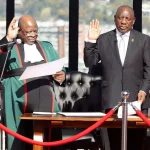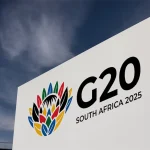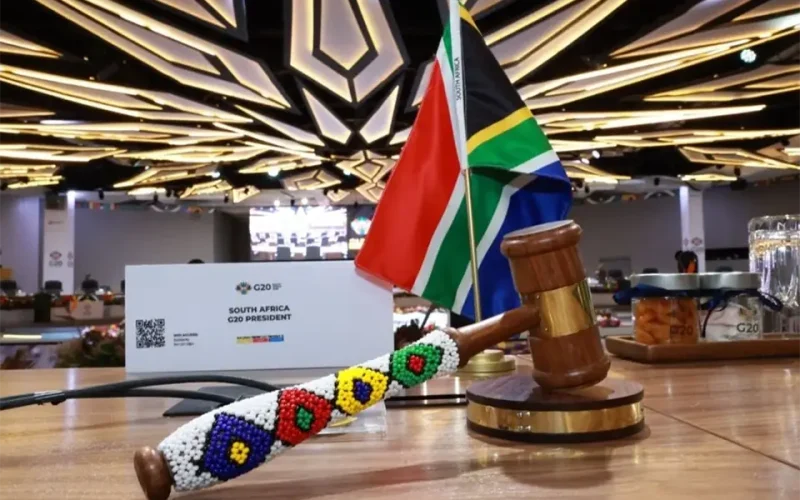
SOUTH Africa successfully concluded the first-ever G20 summit on African soil Sunday, securing a landmark 122-point declaration despite a US boycott and delivering what President Cyril Ramaphosa called a “renewed commitment to multilateral cooperation.”
The historic gathering at Johannesburg’s Nasrec Expo Centre saw global leaders refuse to allow the conspicuous absence of US President Donald Trump to derail proceedings, instead forging ahead with an ambitious agenda that placed Africa’s development priorities firmly at the heart of international economic cooperation.
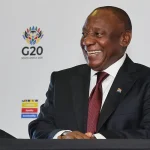
“Our shared goals outweigh our differences,” Ramaphosa declared at the summit’s closing ceremony, following a weekend that saw intensive diplomatic engagement and dozens of bilateral meetings strengthen ties among participating nations.
In an unprecedented move designed to preempt potential backsliding, South Africa secured adoption of the leaders’ declaration on the opening day of talks Saturday – breaking with the longstanding G20 tradition of issuing such statements at the conclusion of summits.
The declaration, agreed to by an overwhelming majority of G20 members with only Argentina dissenting, addresses critical challenges facing developing nations: debt sustainability, climate finance, inclusive industrialisation, food security, and disaster resilience.
“This declaration is important, not only because it comes from African soil, but because it’s a declaration that prioritises the interests of Africa and the developing world,” said Minister in the Presidency Khumbudzo Ntshavheni.
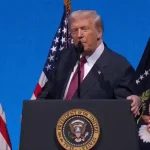
Trump boycotted the summit based on widely discredited allegations that South Africa’s government persecutes its white minority, calling the country’s hosting “a total disgrace.” The Trump administration had also made clear its opposition to South Africa’s G20 agenda, focusing on climate change and global wealth inequality.
Yet world leaders pressed forward. “I do regret it, but it should not block us,” French President Emmanuel Macron said of Trump’s absence.
German Chancellor Friedrich Merz observed that the United States was mentioned only in passing at the summit. “It wasn’t a good decision for the American government to be absent. But that’s something the American government has to decide for itself,” he stated.
Canadian Prime Minister Mark Carney was more emphatic: “The world can move on without the United States.” He emphasised that countries representing three-quarters of the world’s population, two-thirds of global GDP, and three-quarters of world trade participated even without American presence.
Beyond the unanimous declaration, the summit witnessed a flurry of bilateral diplomacy as leaders leveraged the gathering to advance their own strategic partnerships.
Indian Prime Minister Narendra Modi held meetings with South African President Ramaphosa, UK Prime Minister Keir Starmer, French President Emmanuel Macron, South Korean President Lee Jae-myung, Brazilian President Luiz Inacio Lula da Silva, German Chancellor Friedrich Merz, and UN Secretary-General António Guterres, among others. Modi and Ramaphosa discussed expanding cooperation in commerce, technology, artificial intelligence, critical minerals and investment.
European leaders conducted separate discussions on the sidelines regarding developments in Ukraine, while Australian Prime Minister Anthony Albanese scheduled bilateral meetings with EU, Indian and German leaders.
The intensive diplomatic activity underscored the summit’s value as a platform for strengthening international relationships, even as geopolitical tensions simmer in the background.
Africa Takes Centre Stage
Under the theme “Solidarity, Equality, Sustainability,” South Africa used its presidency to elevate African concerns to the highest levels of global economic governance.
The declaration commits major economies to tackling global inequality, reforming international financial institutions to ease debt pressures on developing countries, and boosting inclusive growth with a strong focus on Africa and the broader Global South. It emphasises climate action, renewable energy transitions, and strengthened multilateral cooperation.
“South Africa has used this presidency to place the priorities of Africa and the Global South firmly at the heart of the G20 agenda,” Ramaphosa said in his closing remarks, visibly emotional as fellow leaders embraced him. In a hot-mic moment not meant for broadcast, he was heard saying: “It was not easy.”
Minister of International Relations Ronald Lamola declared the summit “a great success for our country,” noting that South Africa had proven itself a capable platform for hosting international events and shaping global geopolitics.
Successful G20 Review Adds Legitimacy
South Africa’s G20 presidency was further validated by its initiation of a comprehensive review of the bloc’s work to date — a move praised by participating nations as bringing greater coherence and purpose to the forum’s activities.
UN Secretary-General António Guterres commended Ramaphosa’s leadership, saying he “has put on the table all the issues that matter in relation to the needs – the financial and economic needs – of the developing countries in general and African countries in particular.”
Brazilian President Lula da Silva, whose country preceded South Africa in the G20 presidency, said both the Johannesburg summit and the recent COP30 climate talks in Brazil demonstrated that “multilateralism was very much alive.”
A Shift in Global Power Dynamics
The summit marks what analysts describe as a significant turning point in geopolitics, with approximately one-third of G20 leaders absent yet unable to prevent consensus among those present.
Chinese Premier Li Qiang attended in place of President Xi Jinping, while Russian President Vladimir Putin stayed away due to an International Criminal Court arrest warrant. Argentina’s President Javier Milei, a Trump ally, also boycotted, sending Foreign Minister Pablo Quirno instead.
Despite these absences, 42 countries and organisations were represented, with delegations from 18 of the world’s richest and top developing economies present for substantive negotiations.
The diplomatic row between South Africa and the United States extended to the summit’s conclusion, with no formal handover of the G20 presidency occurring. Ramaphosa simply declared that the presidency had moved on to the US, which will host the 2026 summit at Trump’s golf club in Doral, Florida.
“We remain open,” Foreign Minister Lamola said regarding future communication with Washington. “It’s up to them.”
Looking Forward
As world leaders departed Johannesburg, the question remained whether the ambitious commitments in the declaration would translate into concrete action. Yet the summit’s success in achieving consensus despite significant diplomatic challenges sent a clear message about the evolving nature of global governance.
“Multilateralism is the biggest winner today. Global cooperation is the biggest winner today,” said Presidency spokesperson Vincent Magwenya.
For Africa, the Johannesburg summit represented a watershed moment — the continent not merely at the table, but setting the agenda for discussions that will shape global economic policy for years to come.