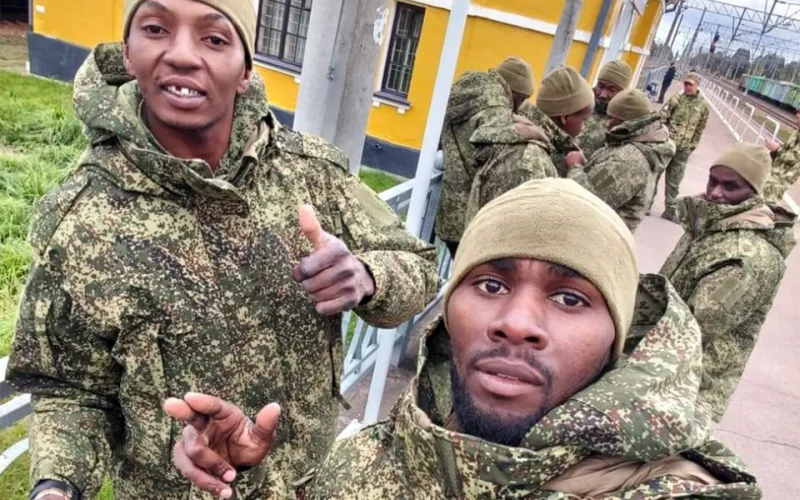
ON the second anniversary of Russia’s full-scale invasion of Ukraine, African governments are engaged in a desperate diplomatic scramble to retrieve hundreds of their citizens who were lured – under false pretences – into one of the world’s most brutal war zones. South Africa has secured the return of 17 men. Kenya is still counting its dead.
The scale of the crisis is only now coming into sharp relief, and what is emerging is a continent-wide pattern of organised deception, exploitation, and tragedy.
South Africa: A Presidential Rescue, But the Investigation Deepens
President Cyril Ramaphosa marked the milestone with relief on Tuesday, welcoming the return of South African men he described as having been “lured into the battle lines between Russia and Ukraine by South African elements that remain under investigation.”
The breakthrough came through direct presidential diplomacy. On February 10, Ramaphosa called Russian President Vladimir Putin, who pledged his support. The result: a safe-passage agreement for 17 South African nationals aged between 20 and 39 years, who had issued distressed calls for help from the frontlines.
The numbers, however, tell a sobering story. Of the 17, only four have landed on South African soil. Eleven more are expected home shortly. One remains hospitalised in Moscow, too injured to travel. Another is still being processed. The South African embassy in Moscow has been tasked with monitoring the hospitalised man until he recovers sufficiently to make the journey home.
Ramaphosa expressed gratitude to Putin, but Pretoria has been unequivocal that the recruitment of South African citizens into mercenary activities is a criminal matter. Investigations into the networks responsible are ongoing, and no arrests have been publicly announced.
Kenya: Grief, Shock, and a Government Scrambling for Answers
Kenya’s situation is grimmer. At least 200 Kenyans are believed to have been trafficked to Russia under the promise of legitimate employment, according to Kenya’s foreign ministry — and some have already paid with their lives.
Martin Mburu was 38 years old, a minibus driver from Nairobi’s outskirts. In October 2025, Kenyan and Russian recruiters convinced him he was heading to a well-paying job as a driver or security guard, earning 250,000 Kenyan shillings — roughly $2,000 — a month. He boarded an Air Arabia flight to Moscow on October 21.
He would be dead within a month.
In a voice message sent to his cousin two days after arriving, Mburu described being taken to what appeared to be a military barracks. “It is extremely cold here. My tummy’s unwell. And there is a language barrier,” he said. “Please pray for us.” His wife, Grace Gathoni, last heard his voice on November 19. Two days later, she watched a Kenyan television report confirm her husband had died in Ukraine’s Donbas region. He had received three days of military training.
“It was such a shock,” Gathoni said from her home. “He had no military background.”
Kenyan authorities are now probing an organised crime network believed to have systematically targeted working-class men — particularly minibus drivers — offering fraudulent employment contracts before facilitating their travel to Russia, where they were handed weapons and deployed within days.
A Continent Targeted: The Mechanics of Deception
Kenya and South Africa are not alone. Analysts and researchers tracking the recruitment pipeline say the pattern is continent-wide and deliberate.
According to research by Disinfo Africa, recruiters used a sophisticated multi-layered approach: fake job advertisements, legitimate-looking travel documentation, and a chain of intermediaries that made it nearly impossible for recruits to identify the deception until they were already inside Russia’s military system. Once there, many were given an ultimatum — fight or face consequences.
The Al Jazeera headline from a report published Monday captured the experience in brutal shorthand: “You either fight or die.”
Prominent Kenyan journalist and activist Boniface Mwangi and CNN’s Larry Madowo have both amplified the crisis on social media, drawing international attention to families left without answers and governments left without a clear legal framework to prosecute those responsible.
The Bigger Picture: Africa Caught in Someone Else’s War
What is unfolding across the continent represents a new and deeply troubling dimension of the Russia-Ukraine conflict — one in which African citizens, most of them economically vulnerable, are being weaponised by recruitment networks that exploit unemployment, language barriers, and the promise of income that would be transformative in a Nairobi or Johannesburg context.
For Russia, the incentive is clear: a steady supply of expendable infantry at a moment when its own manpower costs are politically sensitive at home. For African governments, the crisis exposes a dangerous gap in their capacity to protect citizens abroad and prosecute transnational criminal networks operating across multiple jurisdictions.
South Africa’s diplomatic success in securing 17 men is significant — but it required a head-of-state phone call to Vladimir Putin to achieve. It is not a model that scales easily or quickly enough for the hundreds still unaccounted for across the continent.
What Happens Now
Kenya’s government has not yet announced a timetable for repatriations. Families remain in limbo. The dead are still being identified. The criminal networks that built this pipeline are, as far as is publicly known, still operational.
On the second anniversary of the war that created this crisis, the message from African capitals is increasingly urgent: their citizens did not choose this war, were never told they were joining it, and deserve to come home.
The investigation continues. So does the war.