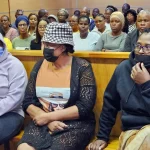
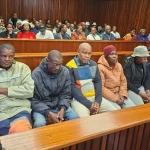
IN the corridors of the Randburg Magistrates’ Court, a chilling scene unfolded that would send shockwaves through every corner of South African society. Twelve members of the South African National Defence Force – men and women who had once raised their right hands and sworn sacred oaths to protect the nation – now stood in the dock as accused criminals. Their charges read like a crime thriller’s darkest chapters: three counts of murder, kidnapping, fraud, obstruction of justice, perjury, and theft of a motor vehicle.
But this was no fiction. This was the stark, terrifying reality of a nation grappling with the unthinkable – the possibility that its own guardians had become its greatest threat.
The Assassination That Changed Everything
The story begins on a stretch of the N1 highway near Hammanskraal, on what should have been an ordinary Sunday morning – August 6, 2023. Lieutenant Colonel Frans Mathipa, a seasoned Hawks investigator known for his relentless pursuit of truth, was driving when death came for him with military precision. The assassination bore all the hallmarks of a professional hit, executed with the kind of cold efficiency that speaks to training, planning, and access to resources that only elite forces possess.
Mathipa wasn’t just any investigator. He was the man who had dared to pull at threads that others might have left alone – threads that led deep into the shadowy world of a suspected “rogue unit” within the SANDF Special Forces. His investigation centred on the kidnapping of two foreign nationals, Abdella Hussain Abadiga and Kadir Jemal Abotese, who had vanished from the Mall of Africa on December 29, 2022, allegedly spirited away to the Zwartkop Military Base. Their fate remains unknown, a haunting question mark that underscores the human cost of institutional failure.
The Rot Runs Deep
The implications of this scandal extend far beyond the courtroom drama and headline-grabbing arrests. They strike at the very heart of South Africa’s ability to function as a constitutional democracy where the rule of law prevails. When those sworn to protect become the predators, the social contract that binds society together begins to fray.
This case starkly exposes the infiltration and corruption within law enforcement and security agencies – institutions that should serve as the frontline defenders against organised crime. The involvement of SANDF personnel in such heinous acts doesn’t just represent individual moral failure; it reveals a systemic vulnerability that organised crime syndicates have learned to exploit with devastating effectiveness.
The erosion of public trust that follows such revelations cannot be understated. When citizens cannot trust their military, their police, or their investigators, the very foundation of law enforcement crumbles. Communities become reluctant to cooperate with authorities, witnesses grow silent, and the darkness that organised crime thrives in grows ever deeper.
A Pattern of Institutional Capture
This scandal must be understood within the broader context of South Africa’s ongoing struggle with state capture – the phenomenon where criminal networks successfully infiltrate and corrupt state institutions to serve their own ends. The tendrils of corruption that have wound their way through agencies like the Hawks and SARS have created fertile ground for organised crime to flourish, and now those same corrupting influences appear to have reached into the military itself.
The vulnerability of state institutions to criminal capture represents one of the gravest threats to South Africa’s democratic project. When the very organs of state meant to uphold the law become tools for its violation, the entire system of governance is compromised. This case suggests that organised crime syndicates have not only recognised these vulnerabilities but have actively exploited them, potentially operating with impunity under the protection of those who should be hunting them down.
The Failure of Political Will
Perhaps most troubling of all is what this scandal reveals about the persistent lack of political will and institutional capacity that has historically hampered South Africa’s fight against organised crime. Despite the existence of strong anti-corruption laws and frameworks, enforcement remains inconsistent, accountability mechanisms prove inadequate, and corruption within law enforcement agencies continues to metastasise.
The case serves as a stark reminder that laws and institutions are only as strong as the people who operate them and the systems that hold them accountable. When those systems fail, when oversight becomes toothless, and when accountability becomes optional, the stage is set for the kind of institutional collapse that allows soldiers to become criminals and protectors to become predators.
A Crossroads for Justice
As the legal proceedings continue, South Africa finds itself at a critical crossroads. The National Prosecuting Authority’s serious stance on this case offers a glimmer of hope—a sign that some institutions still retain the integrity and determination necessary to pursue justice regardless of who the perpetrators might be. But it also reveals the monumental scale of the challenge facing the country.
The scandal threatens to destabilise ongoing efforts to restore credibility and effectiveness to South Africa’s criminal justice system, which has been battling issues of corruption and inefficiency for years. Every revelation in this case, every piece of evidence that emerges, serves as a reminder of how far the rot has spread and how much work remains to be done.
The Nexus of Power and Criminality
What emerges from this tragic saga is a dangerous nexus between organised crime and state actors – a blurring of the lines between those who should enforce the law and those who break it. This nexus doesn’t exist in isolation; it’s the product of systemic weaknesses that have been allowed to fester and grow over time.
The involvement of elite military personnel in kidnapping and murder suggests that organized crime in South Africa has evolved beyond simple criminal enterprises to become something far more sophisticated and dangerous – networks that can call upon state resources, exploit institutional weaknesses, and operate with a level of impunity that should be impossible in a functioning democracy.
The Price of Institutional Failure
The human cost of this institutional failure cannot be forgotten. Lieutenant Colonel Frans Mathipa paid with his life for his dedication to uncovering the truth. The two foreign nationals who were kidnapped remain missing, their families left to wonder about their fate. These are not abstract policy failures; they are real people whose lives have been shattered by the very institutions that should have protected them.
Every South African must now confront an uncomfortable truth: that the country’s security apparatus, meant to be a shield against crime and violence, may itself have become a source of both. The soldiers standing trial represent more than individual criminality; they embody a system in crisis, institutions under siege, and a democracy struggling to fulfil its most basic promise – the protection of its citizens.
A Call for Reckoning
As this case unfolds in the courts, it demands more than just legal proceedings. It calls for a fundamental reckoning with the state of South Africa’s institutions, an honest assessment of how deep the corruption runs, and a commitment to the kind of comprehensive reform that can restore public trust and institutional integrity.
The nation watches and waits, hoping that justice will be served, that accountability will prevail, and that from this dark chapter will emerge a renewed commitment to the values and principles that should guide a democratic society. The alternative – a continued descent into institutional chaos where the line between protector and predator disappears entirely -is too terrible to contemplate.
The scandal of the SANDF members accused of kidnapping and murder is more than a crime story; it’s a mirror reflecting the deepest challenges facing South African society. How the country responds to this crisis will determine not just the fate of those involved but the future of democracy, justice, and the rule of law in South Africa itself.