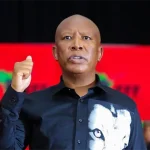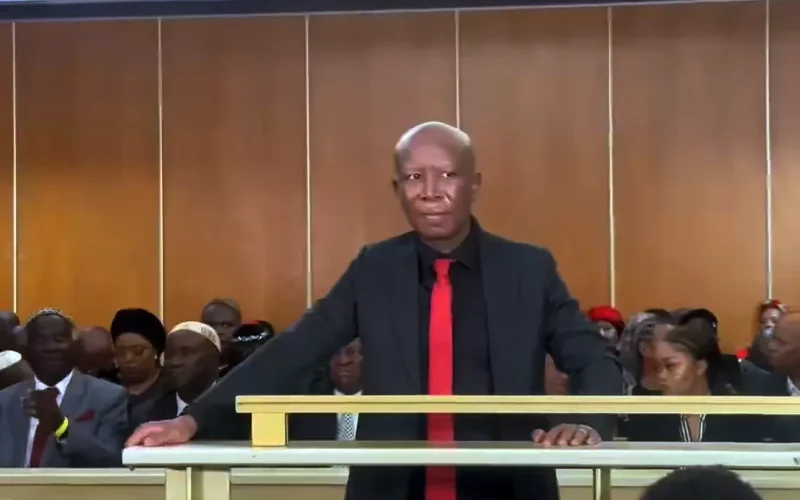
WHEN the KuGompo Magistrate Court handed Julius Malema an effective five-year prison sentence on Thursday, the ruling did far more than settle the fate of an exuberant gun discharge at a political rally six years ago. It set in motion a constitutional clock whose alarm, if it ever sounds, would reorder the architecture of South African opposition politics in ways the country has not confronted since the end of apartheid.
Magistrate Twanet Olivier sentenced the 45-year-old Economic Freedom Fighters leader to two years for unlawful possession of a firearm and a further three years for discharging a weapon in a public place – a combined effective term of five years. Malema, who had pleaded not guilty throughout, walked out of court a free man. His legal team immediately flagged an appeal, and South African criminal procedure permits him to remain at liberty while that process unfolds.
The conviction arises from a 2018 EFF rally at which Malema fired a rifle into the air. His lawyers characterised the act as a celebratory gesture; he himself maintained the weapon was a toy. State prosecutor Joel Cesar asked the court to impose the maximum 15-year custodial term, arguing that leniency would set a perilous precedent for a political leader whose conduct young people emulate.
The defence called for a suspended sentence or a fine. The court rejected that submission entirely.
The Constitutional Tripwire
The sentencing carries consequences that could fundamentally reshape South African opposition politics – and the mechanism is written directly into the Constitution. Section 47(1)(e) of the Constitution of the Republic of South Africa, 1996, disqualifies a person from membership of the National Assembly if that person has been sentenced to more than 12 months of imprisonment without the option of a fine – but the disqualification only takes effect once all avenues of appeal have been exhausted.
That single conditional clause is now the fulcrum on which Malema’s entire political future balances. His sentence of five years comfortably exceeds the 12-month threshold. If an appeal court confirms the sentence in its current form and no further appeal is available or granted, the constitutional disqualification would be automatic. Malema would lose his parliamentary seat not as a matter of political judgment but of constitutional arithmetic.
The EFF leader has been granted leave to appeal the sentence, though not the conviction itself – a distinction that matters enormously. The conviction stands for now. What Malema will argue before the High Court is that the quantum of the sentence was excessive in all the circumstances. His legal team is expected to press for a suspended sentence or a custodial term below the 12-month constitutional threshold.
“A conviction confirmed on appeal would strip Malema of his parliamentary seat — a structural blow to the EFF’s identity and electoral engine.”
The African Mirror
What Hangs in the Balance for the EFF
The Electoral Commission of South Africa confirmed after the May 2024 general elections that the EFF won 9.52 percent of the national vote, placing it fourth in the National Assembly with 39 seats. That result cemented the party’s role as the principal voice of radical economic transformation in the legislature, drawing its core support from young Black South Africans who remain locked out of the economic gains promised by the democratic transition.
The EFF was founded in 2013 following Malema’s expulsion from the African National Congress Youth League, and it has been inseparable from his personality since its inception. His combative parliamentary style, his fluency in the language of dispossession, and his talent for spectacle have been the party’s primary political currency. The EFF’s brand — its red overalls, its theatrical floor disruptions, its unapologetic maximalism on land expropriation and nationalisation — is, to an unusual degree, a projection of one man.
Any political incapacitation of Malema, therefore, risks doing more than removing a leader. It risks fragmenting a constituency that has no obvious alternative home in the current party landscape. The Democratic Alliance offers nothing to disaffected young Black voters. The ANC, from whose youth structures Malema was expelled, is the party they reject. The small socialist formations that have emerged in recent years lack the organisational depth and electoral infrastructure to absorb the EFF’s base.
The question the EFF must now answer, even as it prepares its legal arguments, is whether it has done the institutional work to survive Malema’s absence. Most analysts believe the honest answer is that it has not.
The Long Road of the Appeal
The road to a final determination will be slow. An appeal to the High Court is the first step, and that process alone could take between one and two years to reach a hearing. Should the High Court confirm either the conviction or the sentence, Malema retains the right to seek further leave to appeal to the Supreme Court of Appeal, and potentially thereafter to the Constitutional Court on a constitutional matter. During all of that time — which could realistically extend well beyond the 2029 general election — Malema retains his parliamentary seat, his party leadership, and his freedom.
The appeal process is not merely a legal formality. It is a political lifeline. So long as it continues, the constitutional disqualification cannot be triggered. This is a structural feature of South African law that protects appellants from the consequences of conviction pending final judicial determination, and it is the feature that Malema’s team will rely on to maintain the political status quo for as long as possible.
What they cannot control is the outcome. If the High Court, on hearing the full appeal, determines that the sentence was appropriate and dismisses the appeal, the constitutional machinery will begin to turn in earnest.
A Test of Equal Justice
The case has been watched closely as a test of whether South Africa’s rule-of-law institutions function without fear or favour. Critics of Malema — and there are many, across the political spectrum — have argued that a prominent politician must face the full force of the criminal justice system if the principle of equality before the law is to mean anything. The state prosecutor gave voice to that argument with unmistakable directness: a lawmaker who breaks the law must not expect to be treated differently because of the size of his following.
Malema’s defenders have offered a diametrically opposed framing. The EFF and its leadership have consistently characterised the prosecution as politically motivated, a tool of the establishment deployed against a figure whose political programme — land expropriation without compensation, nationalisation of the commanding heights of the economy — threatens entrenched economic interests. That framing, regardless of its legal merit, has deep resonance among the party’s base.
South Africa’s constitutional democracy has rarely produced a political moment of this magnitude. The closest parallel is former president Jacob Zuma, whose legal battles — stretching across two decades — tested every institution in the state. The Zuma saga ultimately ended in a 15-month prison sentence that the Constitutional Court upheld, triggering an extraordinary political reckoning whose effects are still being absorbed. Malema’s case is not yet in that territory, but the constitutional and political vectors are disturbingly familiar.
“The machinery of justice and the turbulence of politics have converged once again, with no swift resolution in sight.”
The African Mirror
The Stakes for South African Democracy
Beyond the fate of one party and its leader, the Malema case poses a question about the health of South African democracy that transcends partisan allegiance. The constitution’s disqualification provision was designed precisely for moments like this: to ensure that the legislature is not composed of persons whose conduct has been adjudged criminal by the courts. It is a provision that applies regardless of ideological persuasion or political utility.
But democracy is not only about legal architecture. It is about the political communities that architecture is designed to serve. The EFF represents a genuine constituency of the dispossessed and the excluded — millions of South Africans whose anger at the slow pace of economic transformation is legitimate and, by the evidence of repeated election cycles, undiminished. The manner in which this case resolves will say something important about whether that constituency feels it has a place within the constitutional order, or whether it concludes that the order itself is arrayed against it.
For now, Malema is free. He is a sitting member of parliament. He leads his party with his customary defiance, having addressed hundreds of supporters gathered outside the court building in KuGompo City — formerly East London — with a promise that the fight is far from over. That may be legally accurate. It is certainly politically true.
What it is not, for the first time in his volatile and consequential career, is constitutionally certain.