THE morning sun rises reluctantly over Goma, as if hesitant to illuminate the tragedy unfolding below. UN humanitarian workers had called this “one of the most protracted, complex, serious humanitarian crises on Earth,” and from her clinic window, Nurse Marie-Claire could see why. She counts the supplies in her makeshift clinic for the third time, knowing they won’t last another day.
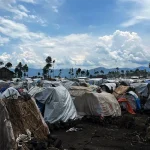
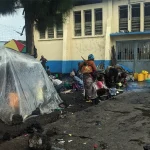
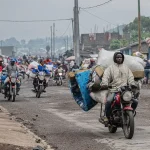
“Every step of their journey is fraught with danger. Roads are blocked, ports are closed, and those crossing Lake Kivu risk their lives in makeshift boats,” WFP spokesperson Shelley Thakral had warned, and Marie-Claire watches those words come alive before her eyes. Through the window, she sees a stream of humanity flowing past – thousands of displaced persons, carrying their lives in bundles, children strapped to their backs, elderly supported by younger relatives.
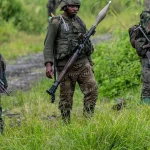
“Mama! Mama!” A young boy bursts through the door, tears streaming down his dust-covered face. Behind him, two men carry a woman on a makeshift stretcher – another victim of the morning’s violence. Marie-Claire recognizes the pattern now: the desperate dawn scrambles for firewood, the M23 fighters lying in wait, the aftermath that fills her clinic beds. WHO’s Dr Adelheid Marschang’s words echo in her mind: some women have been “raped several times in search for firewood.”
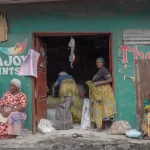
In the market, where once-bustling stalls displayed cassava and fish from the lake, prices have soared beyond reach. Amina, a mother of four, trades her wedding ring for a bag of rice. “It will last us a week,” she whispers, clutching the bag close. “After that, only God knows.” The WFP’s warning rings true – “Depending on the duration of violence, the supply of food into the city could be severely hampered.”
The internet blackout has cut them off from the world. OCHA spokesperson Jens Laerke had reported grimly of “heavy small arms fire and mortar fire” and “many dead bodies in the streets.” The war’s presence needs no digital confirmation – it announces itself in the crack of small arms fire, in the bodies that lie unclaimed in streets where children once played, in the acrid smoke that rises from burning buildings on the outskirts of town.
At the hospital, Dr. Thomas works through his thirty-sixth straight hour of surgery. His hands are steady as he removes shrapnel from a child’s leg, but his eyes betray his exhaustion. “There are currently hundreds of people in hospital, most admitted with gunshot and shrapnel wounds,” Dr Marschang had reported, and the reality surrounds him. The wards are overflowing – gunshot wounds, rape victims, malnourished infants. In one corner, a pregnant woman prays through her contractions, knowing that bringing life into this chaos is its own kind of courage.
As night falls, the city holds its breath. In the darkness, the sound of gunfire seems closer, more threatening. Marie-Claire tends to her patients by lamplight, rationing what little medicine remains. She thinks of the cholera cases rising in the camps, of the mpox that threatens to explode through the displaced populations, of the measles that stalks undernourished children. Last year’s outbreak statistics haunt her, knowing displacement will only make tracking and treating these diseases harder.
“Attacks on healthcare violate the rules of war. Healthcare must be protected at all times,” Dr Marschang had insisted, but Marie-Claire knows tomorrow will bring more wounded to her door. She watches a young medical student bandaging a child’s arm, remembering her own early days before the conflict began. The student catches her eye and manages a tired smile – a small act of defiance against the darkness.
In the maternity ward, a baby’s first cry pierces the night. For a moment, the sounds of war seem distant. The pregnant woman from earlier cradles her newborn, tears mixing with sweat on her face. “I will name her Tumaini,” she whispers. Hope. Even here, in what the UN calls a “critical” moment for the population, life persists.
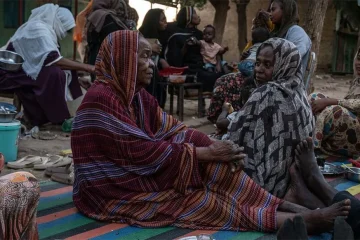
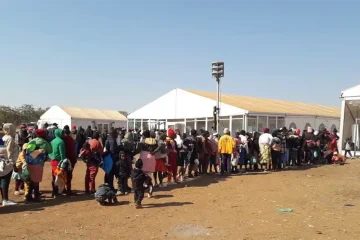
Dawn approaches, and with it, the certainty of more challenges. Three hundred thousand people have fled their homes in recent days, the UN refugee agency reported, and more arrive every hour. But Marie-Claire straightens her uniform and prepares for another day. In her pocket, she carries a small notebook where she records the names of her patients – a testament that they exist, that they matter, that their stories must be told.
Outside, the first light touches the waters of Lake Kivu, where boats already dot the horizon, carrying more desperate souls to uncertain sanctuary. Another day in Goma begins, and with it, the endless cycle of survival, resilience, and hope against impossible odds.