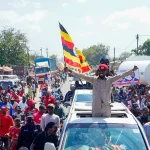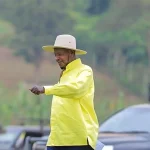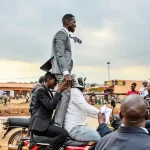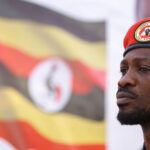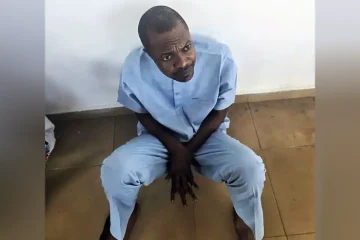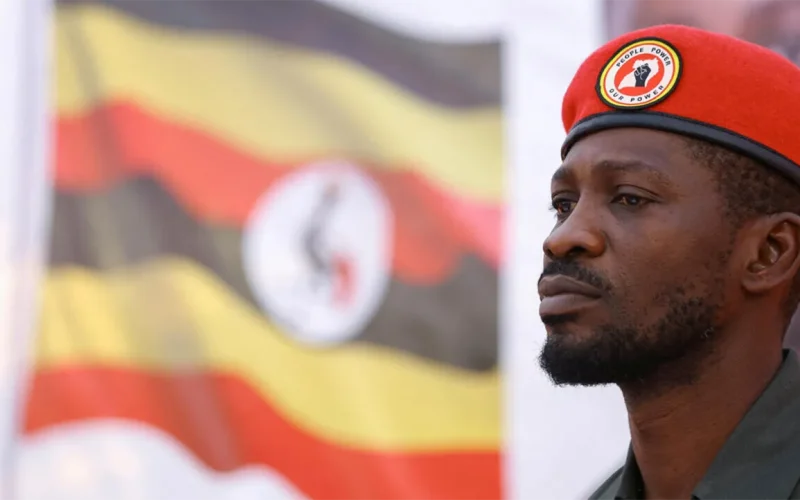
ROBERT Kyagulanyi Ssentamu – known to Uganda and to the world as Bobi Wine – is gone. Eight weeks after evading soldiers who raided his home on the outskirts of Kampala, the leader of Uganda’s National Unity Platform (NUP) confirmed at the weekend that he has left the country he spent two months hiding in plain sight within, protected, as he put it, by the very people whose stolen votes brought him here.
In a public statement addressed to “Fellow Ugandans and friends of Uganda,” Kyagulanyi said he is making a “brief exit” to engage with international allies before returning to continue what he called “the push for freedom and democracy.” He was careful to frame the departure not as a flight but as a strategy. Whether the distinction holds is a question only events will answer.
The announcement ended weeks of speculation about his fate. Since January 15, 2026 — the day Uganda went to the polls under a near-total internet blackout, and the day Yoweri Museveni claimed a seventh consecutive term with an official margin of 71.65 percent — Kyagulanyi had been a fugitive inside his own country. The military came for him the very next morning.
THE RAID AND THE ROUT
Kyagulanyi described the night of January 16 as a defining moment of terror and defiance. Power was cut to the compound. CCTV cameras were disabled. A helicopter had landed. Soldiers poured in. His wife, Barbara — known as Barbie — was subjected to what she later described as a violent assault: roughed up, reportedly stripped, and ultimately hospitalised for anxiety and bruises. She refused to tell them where her husband was. She did not know.
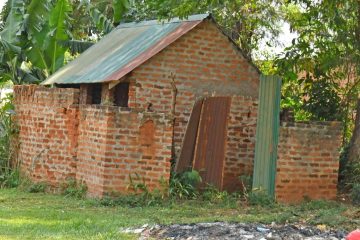
He had already escaped into a Uganda whose people would become, for eight weeks, his security infrastructure. “They couldn’t find me because the people of Uganda sheltered me and protected me,” Kyagulanyi said. It was a line that carried both gratitude and political weight — an implicit argument that the state’s overwhelming coercive apparatus had been defeated, if only temporarily, by popular solidarity.
“They couldn’t find me because the people of Uganda sheltered me and protected me.”
Robert Kyagulanyi (Bobi Wine), NUP Leader
A FAMILIAR PLAYBOOK, MORE RUTHLESS EXECUTION
Uganda’s January 2026 election was, by most credible assessments, the latest iteration of a system engineered over four decades to ensure that President Museveni — now 81, in power since 1986 — never loses. The ingredients were familiar: an internet shutdown that made independent verification impossible; biometric voter identification kits that malfunctioned at polling stations across the country, opening the door to ballot stuffing on the scale the opposition alleges; and a security presence so pervasive that Kyagulanyi had spent weeks on the campaign trail in a helmet and flak jacket.
NUP’s account of the result is unambiguous: Kyagulanyi says his party won. His official tally — 24.46 percent against Museveni’s 71.65 — is, he and his colleagues insist, a fiction manufactured through mass ballot stuffing and the systematic abduction of their polling agents. Independent verification of either claim was made virtually impossible by the communications blackout that blanketed Uganda on election day.
The African Union mission that monitored the election moved swiftly to congratulate Museveni — a decision that drew quiet but pointed criticism from democracy advocates who noted that the AU’s endorsement came even as NUP’s deputy presidents for northern and western Uganda remained missing, abducted, as Kyagulanyi alleged, by security forces on the day of the vote.
THE CRACKDOWN: WIDER THAN ONE MAN
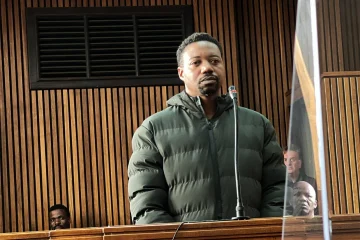
The pursuit of Kyagulanyi was only one thread in a broader tapestry of post-election repression. Police officers assigned to his campaign were arrested and dismissed. Village homes and urban safe houses were raided. Roadblocks and vehicle checks blanketed Kampala and its environs. NUP associates were swept up across the country. Bail hearings for figures like Eddie Mutwe and NUP supporters have become a running chronicle of a justice system weaponised against the opposition — rulings adjourned, prisoners held, process stretched thin.
Kyagulanyi has not been alone in this. His ally and predecessor as Uganda’s most prominent opposition figure, Dr Kizza Besigye — who has run against Museveni four times — remains behind bars in Kampala on treason charges, having been seized from neighbouring Kenya in November 2025 in what his supporters characterise as an abduction sanctioned at the highest levels. Besigye has denied all charges. His detention has drawn international condemnation but no decisive response.
Together, the post-election period amounts to what Kyagulanyi himself has called a “siege” — a systematic attempt to decapitate Uganda’s opposition infrastructure and silence the networks that sustained its most formidable electoral challenge in decades.
THE DIPLOMATIC OFFENSIVE
Kyagulanyi’s decision to leave is, on its surface, a departure. But he has been explicit that it is not a surrender. His international engagements — expected to span Europe and North America in the weeks ahead — will focus on human rights organisations and political leaders he has previously lobbied for sanctions against Ugandan officials.
The pressure points are real, if uncertain. Museveni has long cultivated a reputation as a pillar of regional stability — a posture that has made Uganda a significant U.S. security partner in the Great Lakes and Horn of Africa region. Kyagulanyi has repeatedly challenged Washington to reckon with the contradiction: “My question is, is this what they signed up to partner with?” he told NPR in late January, while still in hiding.
Whether that appeal finds purchase in the current global political climate — one markedly less animated by the democracy promotion agenda that characterised earlier eras of Western foreign policy — remains the central uncertainty hanging over Kyagulanyi’s diplomatic mission.
WHAT IT MEANS FOR UGANDA
Kyagulanyi’s brief exile arrives at a moment when Uganda’s political temperature remains elevated. His large following — disproportionately young, urban, and economically marginalised — has watched with a mixture of fear and defiance as the post-election crackdown has unfolded. Analysts have warned that any move against Wine directly could trigger significant unrest. His ability to evade the military for two months, and to announce his departure on his own terms rather than theirs, has reinforced among his supporters the narrative that this is not a movement that can simply be disappeared.
Museveni, for his part, shows no indication of altering course. At 81, after 40 years in power, having removed presidential age and term limits through constitutional amendment in 2017, he approaches his seventh term with the assurance of a leader who has seen opposition come and go. He credits his rule with delivering relative peace, economic infrastructure, and a role for Uganda as host to hundreds of thousands of refugees from the region’s various conflicts.
His critics — and they are numerous, and they are young, and they remember — argue that stability purchased through repression is a ledger that will eventually balance. Bobi Wine’s departure does not close that account. It may, by his own reckoning, be the move that opens international scrutiny of it in ways a man in hiding could not achieve.