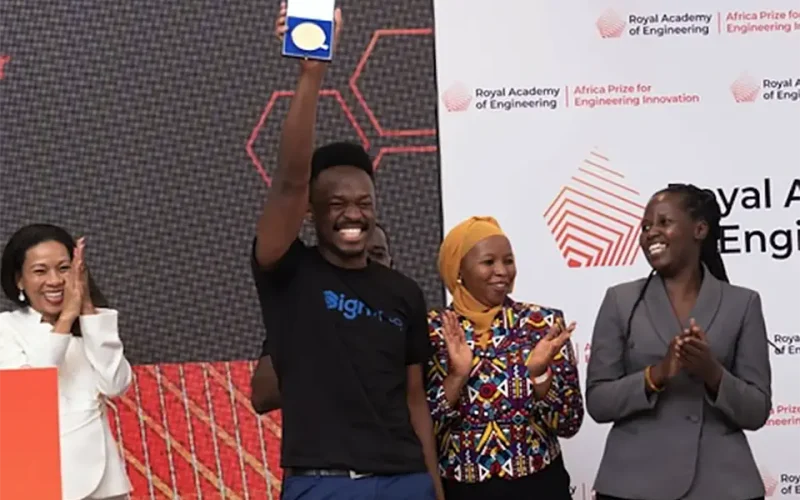
IN a groundbreaking moment for African innovation, Kenyan engineer Elly Savatia has claimed the continent’s most prestigious engineering honour, winning the 2025 Africa Prize for Engineering Innovation with technology that promises to transform the lives of millions.
Savatia’s creation, Terp 360, harnesses artificial intelligence to bridge a communication gap that has long isolated deaf and hearing-impaired communities across Africa. The application converts spoken words into sign language through lifelike 3D avatars, offering an elegant solution to the chronic shortage of human interpreters that has left countless Africans unable to fully participate in education, employment, and public life.
“I’m totally grateful for this, and it is a testament to the innovative assistive technology work that is coming from Africa,” Savatia declared after receiving the £50,000 prize (approximately KSh 8.6 million) from the Royal Academy of Engineering. “I’m really looking forward to the excellence that will come out of Signvrse, the rest of the shortlistees, and the African continent.”
What sets Terp 360 apart is its authenticity. Built on a foundation of more than 2,300 locally recorded signs, the technology respects the cultural and linguistic nuances that mass-market solutions often overlook. The real-time translation system provides an affordable alternative to human interpretation, democratizing access to services that have remained out of reach for too many.
The victory signals Kenya’s emergence as a powerhouse of inclusive technology, where engineers are not merely copying Western innovations but creating solutions rooted in African realities. Savatia’s team now plans to expand into schools, corporations, and healthcare facilities, targeting institutions that serve large hearing-impaired populations who have waited far too long for such breakthroughs.
Kenya’s innovative spirit was further recognised when fellow engineer Carol Ofafa earned finalist honours for E-Safiri, her solar-powered charging network for electric motorcycles and bicycles. The system slashes downtime for riders while channelling excess solar energy to neighbouring households, exemplifying the multi-layered problem-solving that defines African engineering.
The 2025 ceremony, held for the first time in Francophone Africa, celebrated innovations from across the continent. Finalists from Uganda and Ghana received £10,000 each for advances in healthcare and sustainable agriculture, while Mozambique’s Rui Bauhofer earned the “One to Watch” award for biodegradable plates crafted from maize husks.
Since 2014, the Africa Prize has nurtured more than 160 entrepreneurs across 20 countries, transforming promising concepts into thriving enterprises. Savatia’s triumph adds another chapter to this story of African ingenuity, proving once again that the solutions Africa needs are being built by African hands.
For the deaf and hearing-impaired communities across the continent, Terp 360 represents more than technology. It represents recognition, inclusion, and the promise that innovation can unlock doors that have remained closed for generations.
The future of African engineering is speaking loud and clear — and now, it’s signing too.