MENTION the word “fossils” to people and most will probably think of bones. Of course, body fossils make up a large part of the global fossil record. But humans and other species leave their mark in other ways too – for instance, their tracks. The study of these fossil tracks and traces is called ichnology.
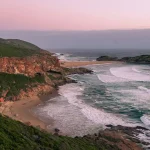
I am an ichnologist. In 2008 my colleagues and I launched the Cape South Coast Ichnology Project to study a 350km stretch of South Africa’s coastline. We’ve since identified more than 350 vertebrate tracksites, most of them in cemented dunes called aeolianites that date back to the Pleistocene Epoch (also known as the Ice Age), which began about 2.6 million years ago and ended 11,700 years ago.
At a global level, it is rare to find fossilised hominin tracks. There is something very special about them: a fossil trackway looks as if it could have been created yesterday, and the fact that our own ancestors would have created such tracks fills them with extra meaning. It’s always a thrill for researchers to find them.
We knew from the region’s extensive archaeological record that ancestral humans inhabited the region during the Pleistocene. And Homo sapiens tracks had been identified elsewhere in South Africa, on the Cape east coast in the 1960s and the Cape west coast in the 1990s. But, given their rarity, we weren’t banking on hominin tracks being among our finds.
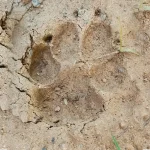
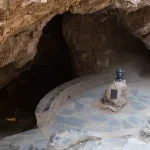
We were fortunate. In 2016 we found 40 hominin tracks on the ceiling and side walls of a cave at Brenton-on-Sea, near the town of Knysna on the Cape south coast. In subsequent years we have been privileged to find more hominin tracksites, all on aeolianite surfaces on the Cape Coast. One discovery, in the Garden Route National Park, even included the oldest Homo sapiens footprint identified anywhere in the world – it dates back about 153,000 years.
Now we’ve documented a cluster of nine hominin trace fossil sites at Brenton-on-Sea: seven track sites, and two open-air archaeological sites containing tools, shells and bone (which help us understand the diet of our ancestors). One of the track sites is the original site found in 2016. Our analysis shows that it contains the oldest known evidence of a human running. Another site shows evidence of toddler tracks alongside those of adults.
A cluster of nine sites
Each site within this 1,200-metre stretch of coastline is from a different rock unit and they appear to span a considerable time interval. Adjacent rocks have been dated using a technique known as optically stimulated luminescence to a range of between 113,000 and 76,000 years (that is a measure of how long ago grains deep within the rocks were exposed to light).
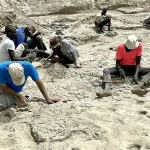
The nine sites are not easy to find: some were only briefly exposed following storm surges, and are now again covered by metres of sand, while others can only be safely accessed using ladders. At one site, the space between the track-bearing layer on the ceiling and the surface below it was so tiny that we had to bring in our caving colleagues – who love working in confined spaces – to properly document it. The rest of us struggled to fit into the narrow gap.
The Cape South Coast hominin tracks are unusual at a global level. With most hominin track sites across the world, it is usually the layer in which the tracks were made that is preserved. However, on the Cape South coast, the tracks are mostly preserved as natural casts, formed by sediment that filled the tracks. This is why our team often finds tracks on the undersides of overhangs and cave ceilings: show us an overhang from the right age and type of rock and within a few seconds we will have crawled under it and started looking up at the ceiling.
In two cases, we have found both the infill layer on the ceiling and a fallen slab beneath it containing the track-bearing layer, a phenomenon that as far as we know has not been described from anywhere else in the world. And globally, hominin tracks found in aeolianites (made on sandy dune surfaces) are exceedingly rare.
Close to the cluster of nine sites are caves containing unexcavated archaeological material beside much older Paleozoic rocks. These caves might well have been exposed and habitable at the time that all these tracks were registered. In addition, for most of this time period, the shoreline would have been not too distant, about 2km-3km seaward of the modern coastline, which would have allowed for coastal foraging. These factors may help to explain why there are so many tracks in one relatively small area.
Unfortunately, one site could not be interpreted because it was defaced by graffiti before we could get to it.
The oldest evidence of humans using sticks
Three of the Brenton-on-Sea sites also contain some of the oldest known evidence of humans using sticks. The organic matter from which such sticks were composed would long since have decayed, and the ichnology (trace fossil) record therefore provides what is probably the only viable means of identifying such stick use.
Sticks could potentially have been used as walking or running aids, to cope with ambulating with an injury, in foraging techniques, for messaging, or for what might be aesthetic purposes, such as inscribing patterns in the sand.
An ancestral ‘home base’
Together, the sites containing these hominin tracks and traces provide complementary evidence not just of a human presence through footprints, but also of the behaviour of our ancestors, providing details of their activities, their tools and their diet.
They confirm the importance of the Cape Coast as a region of great importance in the evolution of Homo sapiens prior to the subsequent diaspora out of Africa. The great preponderance of hominin track sites older than 50,000 years has now been documented from South Africa’s Cape Coast, and a cluster of seven track sites, like the one we have described, is extremely unusual globally.
We now know where and how to look for such tracks and traces, and our eyes are trained on finding further evidence that tells us more about one of humanity’s ancestral “home bases” and the activities of those who inhabited it.
Charles Helm, Research Associate, African Centre for Coastal Palaeoscience, Nelson Mandela University
- This article is republished from The Conversation under a Creative Commons license. Read the original article.