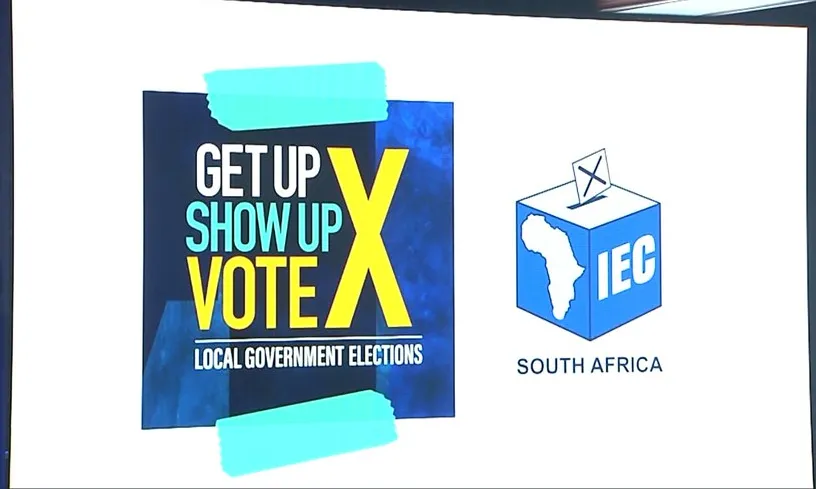
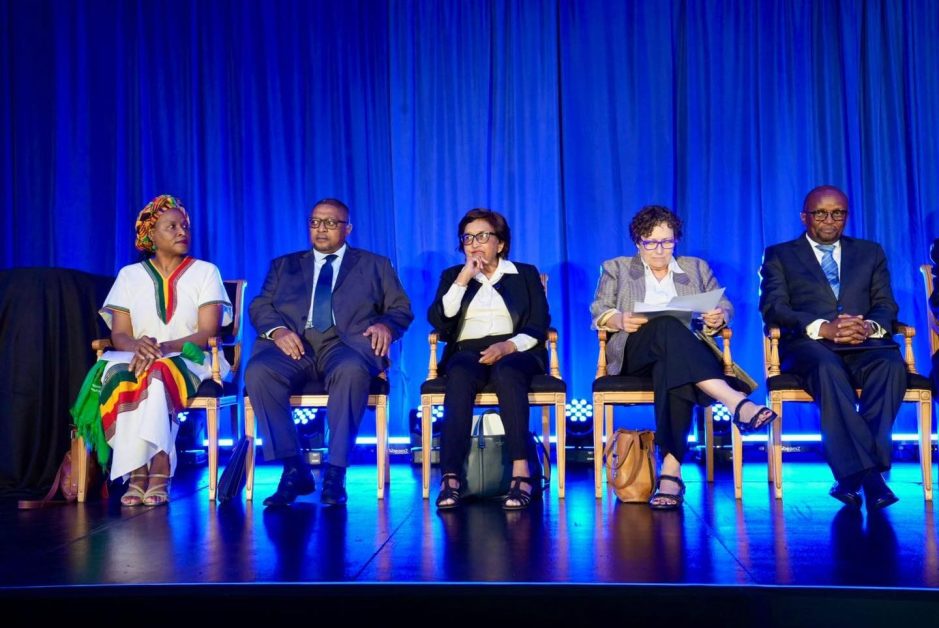
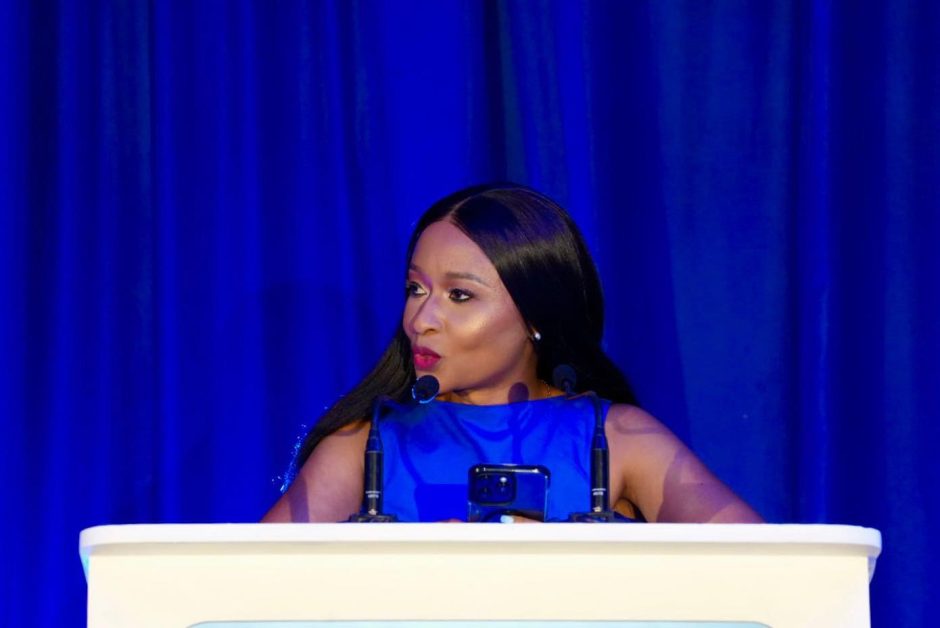
AT first glance, it might appear a ceremonial occasion: a logo reveal, a stage, officials in suits, speeches careful in cadence. But when the Electoral Commission of South Africa (IEC) assembled media, commissioners, political party representatives and civic stakeholders in Midrand, Johannesburg, the stakes were anything but ceremonial. The institution responsible for the world’s most-watched young democracy was, in effect, issuing a national emergency notice – wrapped in gold, navy and the three blunt words: Get Up. Show Up. Vote.
The reveal of the 2026/27 Local Government Elections logo and tagline marks the opening gun of what will be the most consequential municipal contest in a generation. Local government is where the state meets the street – where taps run or don’t, where rubbish is collected or isn’t, where potholes gape or disappear. It is also, increasingly, the arena where South Africans’ faith in democracy has come undone.
“Elections are not an antiquated event. Rather, elections remain a current and cool system of organising public affairs requiring consistent nourishment and renewal.”
Sy Mamabolo, Chief Electoral Officer
A NATION WARNED
The commission did not arrive at this launch in a mood of complacency. Just days before, the IEC published findings from the Human Sciences Research Council on voter participation, and those findings made for sobering reading. Three decades into constitutional democracy, public trust in institutions – including the IEC itself – has eroded. Voter registration has declined among the young. Disillusionment has metastasised into disengagement, and disengagement is democracy’s most insidious enemy.
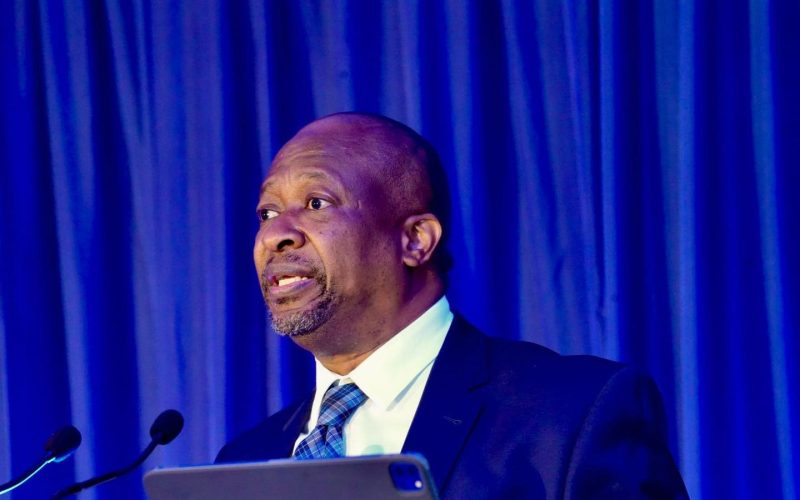
IEC Chairperson Mosotho Moepya met the crisis head-on. In his address at the launch, he did not offer false comfort. “We must also acknowledge, with humility and honesty, that many of our people have expressed disappointment with the dividends of democracy,” he said. “For too many, lived realities have not improved as they had hoped.”
That acknowledgement mattered. Too often, institutions defend their record by dodging the grievance. Moepya chose instead to absorb it and reframe it – because, as he made clear, the answer to democratic disappointment is not democratic withdrawal.
“To withdraw from this process — to retreat from participation — is to surrender that power. It is to silence one’s voice at the very moment it is meant to be heard.”
IEC Chairperson Mosotho Moepya
TRUST: EARNED, LOST, RE-EARNED
The Chairperson’s remarks on institutional trust deserve close reading by every political party, every government official and every civil society actor in South Africa. “Trust is fragile. It must be preserved with great care,” Moepya said. “Even when trust has been strained, it can be rebuilt through consistency, integrity, and deliberate effort. In short, trust must be earned, and when lost, it must be re-earned.”
This is not boilerplate. For a commission that has administered elections through disputed outcomes, political turbulence and the deepening poverty of the communities it serves, it is a frank admission that credibility cannot be assumed. It must be demonstrated — not in media statements but, as Moepya put it, “in every office, in every interaction, and in every aspect of our fieldwork across the country.”
The IEC’s commitment is to pay particular attention to parts of the country where doubt has taken root — to listen, engage and respond constructively. Whether that promise survives contact with an election cycle that will stretch the commission’s logistical, financial and human resources to their limits remains the core test of its credibility.
THE MACHINERY OF DEMOCRACY
Chief Electoral Officer Sy Mamabolo lifted the curtain on the operational scale of what lies ahead. The numbers are staggering. Approximately 23,000 registration stations will open across the country for the general voter registration weekend on 20-21 June 2026. Some 70,000 registration staff are being recruited and trained. The IEC’s stock of 40,000 Voting Management Devices – the electronic backbone of the process – has undergone mandatory maintenance, with sub-optimal coding faults that bedevilled the 2024 general elections now corrected.
Independent external ICT auditors will conduct stress testing and code reviews ahead of the registration weekend, a measure that Mamabolo indicated is designed to pre-empt the confidence deficit that technical failures inevitably produce. “An election is as much a human endeavour as it is a legal and political process,” he reminded the gathering – a line worth holding onto as algorithms and devices crowd out the face-to-face act of democratic participation.
On candidate nominations, Mamabolo projected that more than 100,000 candidates are expected to contest the elections, surpassing the 95,000 who stood in the previous local government cycle. Election deposits – R1,800 for ward candidates, R2,800 for local municipality, R4,700 for metropolitan contests, and R1,800 for district council – are subject to public comment until 8 May 2026, with reimbursement available to those who secure at least ten percent of the ward vote.
“The electoral edifice of our country is not built solely by institutions — it is sustained by citizens who choose to engage.”
Sy Mamabolo, Chief Electoral Officer
A CALL AIMED AT THE YOUNG
If the IEC’s logo and tagline have a primary target, it is not the settled middle-aged voter who has ticked the ballot box every five years since 1994. It is the young South African – born into freedom, unimpressed by its dividends, sceptical of institutions, and in increasing numbers simply absent from the voters’ roll.
The commission knows this, and it is deploying cultural tools to break through where civic messaging has failed. Beats for My Peeps – described as a “cutting-edge, limited edutainment reality series” – pairs digital creators, established and emerging music artists, and IEC representatives to produce original tracks and youth-driven content that confronts disillusionment and challenges myths about voting. It is set to air on SABC 1 in May 2026. A podcast channel goes live on 8 April.
These are not trivial add-ons. The IEC understands that it cannot reach young South Africans through the same channels, in the same language, using the same tone that spoke to their parents. The tagline itself – “Get Up. Show Up. Vote.” – is deliberately unadorned. No constitutional theory. No civics lesson. Just a human instruction, blunt enough to cut through the noise of a generation raised on short-form content.
Moepya articulated the logic: “This logo represents inclusive civic activism, shared patriotism, and national pride. It does not lecture. It does not demand. And it does not overcomplicate. It evokes a strong emotional resonance and inspires a collective sense of South African optimism.”
THE STAKES: WARD BY WARD
Lost in national narratives about democracy and voter apathy is an elemental fact: local government elections are decided not by abstraction but by ward. In a ward election, a few hundred votes – sometimes fewer – determine who controls the resources of your community for the next five years. Who fixes the drain? Who builds the clinic? Who removes the illegal dumping site?
Mamabolo underscored the geographic significance of registration. “Your place of residence is tied to a geographic entity of political representation, which is the ward,” he explained. “Voters will only vote at a voting station in the ward of registration. There is no legal facility to vote outside of the voting station of registration.” For the unregistered, or for those registered at old addresses, this is not a technicality – it is the difference between having a voice and being mute on election day.
The instruction is therefore direct: check your registration now. If you have moved, update your details. The platform is live at Registertovote.elections.org.za. The contact centre is open at 0800 11 8000. The window before the June registration weekend is the last clean opportunity for millions of South Africans to ensure they are correctly placed to vote.
WHAT ABSTENTION REALLY COSTS
There is a seductive logic to non-participation that circulates in communities long let down by politics: None of them deserve my vote. It feels like dignity. It is, in fact, abdication.
Moepya addressed it directly: “Democracy is imperfect. It reflects the imperfections of those who operate within it. Yet it remains, without question, the best system humanity has devised to ensure that every person has a voice, that every interest can find expression, and that every grievance can be addressed within a framework of peace and order. The answer to the challenges within democracy is not less participation, but more.”
This is the argument that needs to be made, loudly and repeatedly, in the months ahead. Not the platitude of duty, but the practical calculus of power. The ward councillor elected on a low turnout has less of a mandate to withstand. The party that dominates a municipality on 35 percent participation rules without genuine consent. The young South African who stays home on election day is not a conscientious objector – they are a gift to those they distrust most.
“When you stand up and vote, you do more than cast a ballot — you affirm and nourish democracy itself.”
Sy Mamabolo, Chief Electoral Officer
- THE AFRICAN MIRROR’S CALL
The African Mirror has covered democratic governance across this continent long enough to know what happens when participation collapses. We have watched elections in fragile states determined by the mobilised minorities of armed factions. We have reported on the consequences when young people, disgusted with corrupt institutions, opt out – and watched those same institutions grow more corrupt in the vacuum their absence created.
South Africa is not there. It has institutions – battered, imperfect, sometimes captured – but institutions that can still be reclaimed from within, ward by ward, vote by vote. The IEC’s task is to ensure the architecture of that reclamation is sound. The citizen’s task is to use it.
The key dates are fixed. The voter registration weekend falls on 20-21 June 2026. The national campaign launches on 27 May 2026. Candidate nominations close toward the end of July. Election day has not yet been proclaimed – but it is coming, and it waits for no one.
Three words. Three imperatives. No ambiguity.
GET UP. SHOW UP. VOTE.
CHECK YOUR REGISTRATION: Registertovote.elections.org.za
CONTACT CENTRE: 0800 11 8000
REGISTRATION WEEKEND: 20–21 June 2026