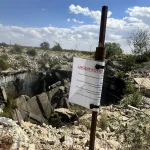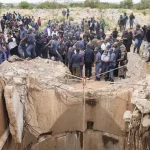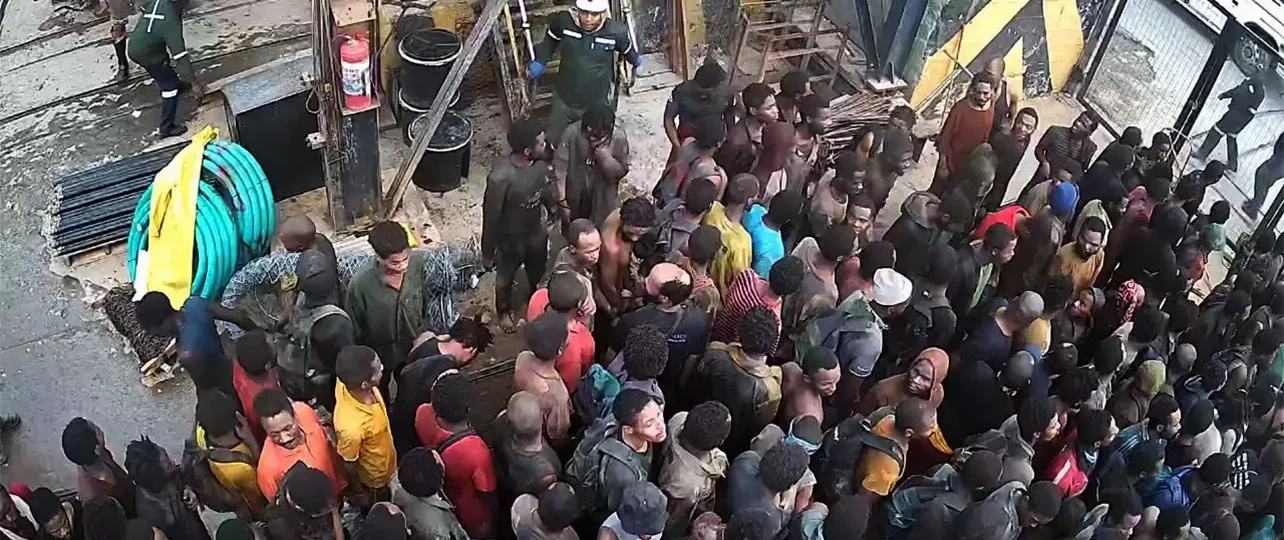

THE images from Barberton Magistrate’s Court this week painted a stark picture of South Africa’s escalating security crisis: nearly 500 illegal miners, many of them undocumented foreign nationals, standing before judges on charges that barely scratch the surface of a problem threatening the very foundations of the nation’s economy and sovereignty.
Operation Vala Umgodi’s raid on the Sheba Gold Mine in Mpumalanga represents more than just another law enforcement sweep – it’s a desperate battle in an underground war that South Africa appears to be losing.
A Crisis of Staggering Scale
The numbers tell a chilling story. Between 14,000 and 30,000 illegal miners are currently operating across South Africa’s mining heartland, with reported cases surging by over 241% in early 2024 alone. The financial haemorrhaging is catastrophic: gold theft costs the nation between R14 billion and R70 billion annually, money that should be funding schools, hospitals, and infrastructure instead of lining the pockets of transnational criminal syndicates.
This isn’t petty crime – it’s economic warfare. From the abandoned shafts of Gauteng’s Witwatersrand to the active operations in Mpumalanga’s goldfields, illegal mining has metastasised across every major mining province. The recent standoff at Stilfontein, ongoing hotspots in North West Province, and now the Barberton arrests reveal a problem that has overwhelmed traditional law enforcement capabilities.
The Human Trafficking Connection
What makes this crisis particularly insidious is its human dimension. Many of those arrested at Sheba Mine were undocumented migrants from Mozambique and eSwatini – vulnerable individuals exploited by sophisticated criminal networks that treat human lives as disposable resources. These syndicates don’t just steal gold; they traffic people, exploit desperation, and create parallel economies that operate beyond state control.
The presence of four juveniles among the Barberton arrestees adds another disturbing layer: children being drawn into dangerous underground operations that claim lives regularly. When a nation’s youth are being recruited by criminal syndicates to extract its mineral wealth illegally, national security has been fundamentally compromised.
Law Enforcement’s Uphill Battle
South Africa’s security forces are fighting bravely but are clearly outgunned. Operations like Vala Umgodi, involving coordinated efforts between police, home affairs, the Department of Mineral Resources and Energy, and private security, represent the kind of multi-agency approach needed. The arrest of nearly 500 miners in a single operation demonstrates law enforcement’s capability when resources are concentrated.
But these victories are tactical, not strategic. Even as 494 suspects appeared in court, 28 more miners resurfaced from deeper underground, highlighting the whack-a-mole nature of current enforcement. For every illegal miner arrested, others simply move to one of the nearly 6,000 abandoned mines that dot the South African landscape like open wounds.
The challenge extends beyond manpower. Illegal mining operations often occur in treacherous underground conditions where traditional policing methods are inadequate. Extracting miners safely while preserving evidence and preventing humanitarian crises requires specialised skills and equipment that strain already overstretched resources.
Corporate Accountability: The Missing Link
Perhaps most troubling is the regulatory failure that enables this crisis. Thousands of abandoned mines remain inadequately secured, creating perfect entry points for illegal operations. While legislation requires mining companies to submit closure plans and maintain site security, enforcement gaps have created a landscape where corporate negligence indirectly facilitates criminal activity.
South Africa is finally strengthening legal measures to hold companies accountable. Enhanced enforcement of the Occupational Health and Safety Act, mandatory mine closure plans with financial guarantees, and increased penalties for non-compliance signal recognition that the private sector must be part of the solution. The integration of surveillance technology—drones, thermal cameras, AI monitoring – by some companies shows what’s possible when corporate responsibility is taken seriously.
But legal frameworks are only as strong as their enforcement. Too many mining companies have walked away from their responsibilities, leaving behind environmental disasters and security nightmares that become taxpayer burdens and criminal opportunities.
The National Security Imperative
Make no mistake: this is a national security crisis. Illegal mining doesn’t just steal money – it undermines state sovereignty. When criminal syndicates can operate quasi-military operations on South African soil, moving people and resources across borders with impunity, the state’s monopoly on legitimate force is challenged.
The environmental devastation – deforestation, soil erosion, water contamination – represents another form of attack on national security. These are South Africa’s natural resources being pillaged for private gain, with the cleanup costs socialised while profits are privatised and exported.
Beyond Enforcement: Addressing Root Causes
While Operation Vala Umgodi and similar crackdowns are necessary, they’re insufficient. South Africa’s unemployment rate is above 32% creating a desperate population vulnerable to criminal recruitment. Until legitimate economic opportunities exist for both South Africans and migrants from neighbouring countries, the human supply chain feeding illegal mining will persist.
This requires a development approach that complements law enforcement: job creation programs, skills training, and regional cooperation to address migration pressures. Criminal syndicates thrive on desperation; sustainable livelihoods are the most effective long-term weapon against them.
The Path Forward
The 500 illegal miners facing charges in Barberton represent both the scope of South Africa’s challenge and the potential for decisive action. Their arrests demonstrate that with sufficient resources and coordination, law enforcement can achieve significant tactical victories.
But winning this underground war requires more than arrests. It demands a comprehensive strategy that combines enhanced law enforcement, strict corporate accountability, technological innovation, and sustainable economic development. The syndicates trafficking people and stealing gold are sophisticated, well-resourced, and adaptable. South Africa’s response must be equally sophisticated and far more determined.
The alternative is stark: continued erosion of state authority, ongoing environmental devastation, and the transformation of South Africa’s mineral wealth from a national asset into a criminal commodity. The time for half-measures has passed. This is a battle for South Africa’s economic future and national sovereignty – and it’s being fought one mine shaft at a time.
The miners in Barberton courts this week are symptoms, not the disease. Until South Africa addresses the full scope of this national security crisis, more raids will follow, more courts will fill, and the country’s mineral wealth will continue flowing into criminal hands while its people pay the price.