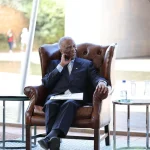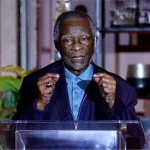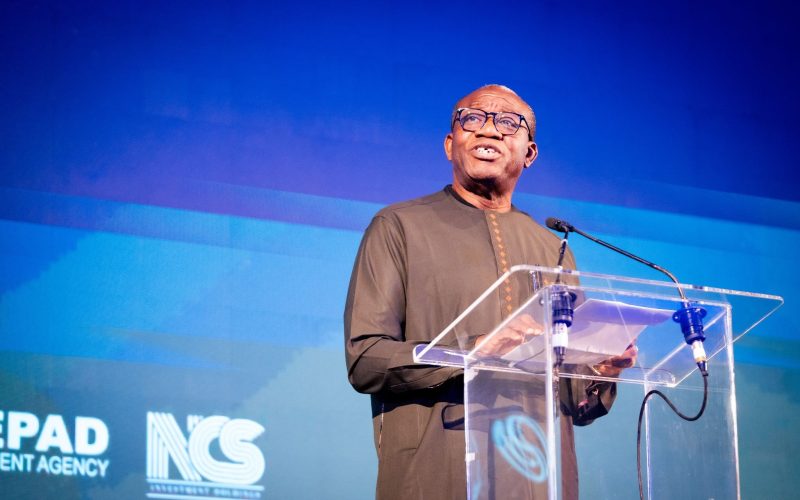
IN a lecture hall thick with continental ambition and historical weight, Dr Kayode Fayemi strode to the podium at the Century City Conference Centre and did what Africa’s most clear-eyed public intellectuals do best: told the truth – precisely, unapologetically, and with the authority of someone who has governed, failed, succeeded and reflected.
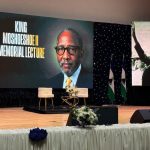
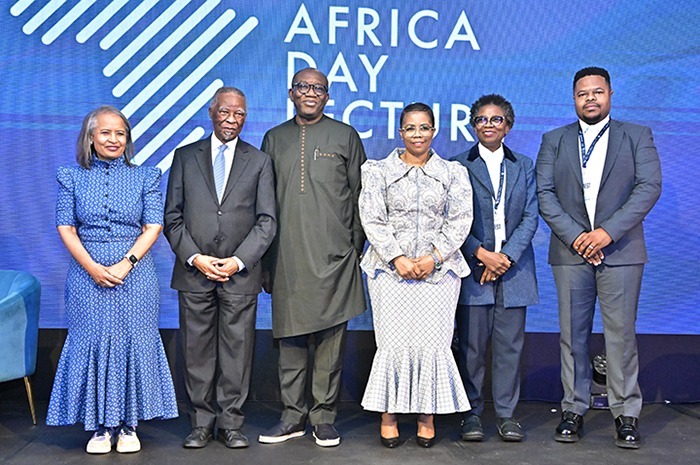
The occasion was the 16th Thabo Mbeki Africa Day Lecture, hosted by the University of South Africa (Unisa) and the Thabo Mbeki Foundation, held on 23 May 2026 under the theme “Rebuilding African Unity in an Age of Fragmentation: Sovereignty, Solidarity, and the Renewal of Institutions.” The setting, three days before Africa Day itself, was no accident. With the Organisation of African Unity’s founding spirit as its anchor and Agenda 2063 as its horizon, the annual lecture series has become the continent’s most consequential forum for pan-African intellectual reckoning.
Fayemi – a lawyer, academic, politician and former governor of Ekiti State, Nigeria, and a former chair of the African Union’s Economic, Social and Cultural Council – brought to the podium a rare combination: the hardened pragmatism of a man who has wielded executive power, and the moral clarity of someone who understands what the continent’s founding idealism demands of this generation.
What he delivered was not a speech. It was a verdict.
THE DIAGNOSIS: FRAGMENTED, DEPENDENT, INSTITUTIONALLY HOLLOW
Fayemi opened with a characterisation of the current global moment that was sweeping in its ambition and sobering in its implications. “The international system is passing through imperial and profound uncertainty and restructuring,” he told delegates. “Across the world, multilateral institutions are under strain. Geopolitical rivalries are intensifying, economic nationalism is resurgent and global cooperation is becoming more fragmented.”
But his sharpest diagnosis was reserved not for the architects of that global disorder — Washington, Brussels, Beijing — but for Africa itself. “We are allegedly politically independent, yet often economically constrained; globally relevant, yet internally fragmented; resource-rich, yet bedevilled by poor leadership and institutional vulnerability,” he said, in a passage that drew murmurs of recognition from a room populated by diplomats, parliamentarians, academics and civil society leaders.
| “Sovereignty outsourced is sovereignty diminished.” |
It was perhaps the lecture’s most devastating formulation — and its most direct challenge to African governments that have ceded control of critical governance functions, economic planning and strategic infrastructure to external actors, whether multilateral lenders, bilateral donors or private foreign capital with no accountability to African citizens.
The former governor argued that the 21st-century understanding of sovereignty cannot be reduced to flags, borders and seats at the United Nations. Real sovereignty, he insisted, requires productive capacity — interconnected economies, shared infrastructure, coordinated industrial policy, and regional cooperation that translates political independence into material power.
AFROPHOBIA: THE CONTINENT’S MOST INTIMATE BETRAYAL
If the institutional analysis was the lecture’s intellectual spine, its moral heart beat loudest when Fayemi turned to the crisis of Afrophobia — and to South Africa specifically. Speaking as a Nigerian, he reminded the audience of a debt South Africans often prefer to leave unacknowledged: that their liberation was not won alone.
| “South Africa’s liberation was not won by South Africans alone. The entire apartheid struggle became a continental responsibility across Africa.” |
He recalled how African governments, workers, intellectuals and ordinary citizens across the continent provided resources, sanctuary and solidarity to South African liberation movements during the apartheid decades. That solidarity, he argued, was not charity. It was Pan-Africanism in practice — rooted in the conviction that oppression anywhere in Africa threatens dignity everywhere on the continent.
Against that backdrop, Fayemi’s verdict on contemporary Afrophobia was damning. “Afrophobia is not merely a law enforcement issue or a question of migration policy,” he declared. “It represents a crisis of continental consciousness.”
He acknowledged the material conditions — unemployment, poverty, poor service delivery, political manipulation — that fuel anti-immigrant sentiment. But he refused the retreat into socioeconomic excuse-making that too often passes for analysis. “These realities can never justify violence or exclusion,” he said. “If Africans cannot coexist peacefully with one another, then the dream of continental integration will remain fundamentally weakened.”
It was a statement directed at South Africa’s political establishment as much as at its general public — and it landed with the moral weight that only a guest from a contributing continental nation could credibly deliver.
INSTITUTIONS OVER INDIVIDUALS: THE LONG GAME
One of the lecture’s most durable contributions was its insistence on the primacy of institutions over personalities. In a continent where politics has too often been organised around the cult of the individual — the Big Man, the Liberator, the Strongman — Fayemi’s advocacy for institutional longevity was both unfashionable and necessary.
| “Africa needs leaders who understand that power is temporary, but institutions are enduring.” |
History, he warned, demonstrates that nations fail not from a shortage of natural resources or talented citizens, but when institutions become weak, hijacked, personalised and corrupted. It was an implicit critique of governance trajectories across the continent, from resource-rich but institutionally fragile states in the Sahel to post-liberation governments that have confused electoral legitimacy with unaccountable authority.
He called for investment in strong universities, research centres and policy institutions capable of generating African solutions to African challenges — pushing back against a development model that continues to import expertise, frameworks and prescriptions from the Global North while exporting raw talent, raw materials and raw wealth in return.
FROM AID DIPLOMACY TO INTEREST-BASED DIPLOMACY
In the lecture’s most strategically pointed passage, Fayemi challenged Africa’s diplomatic posture on the global stage. “Africa must increasingly move from aid diplomacy to interest-based diplomacy,” he said. “We must engage globally not merely as recipients of external assistance but as strategic actors capable of shaping outcomes.”
The argument tracked a growing consensus among pan-African thinkers and some member state governments — that the continent’s traditional dependence on donor frameworks has not only constrained policy space but has fundamentally deformed how African governments understand their own interests. When external funding determines what gets prioritised, sovereignty is compromised before any law is passed or any policy implemented.
Fayemi’s formulation of the central challenge was clinical: “Will Africa once again remain merely a source of raw materials for external industrial powers? Will we continue to export wealth while importing poverty and dependence? Or can this historical moment become the turning point through which Africa finally moves from extraction to structural transformation?”
The AU Commission’s message, delivered virtually by Deputy Chairperson Malika Haddadi, provided a concrete counterpoint. Citing the African Vaccine Acquisition Trust’s procurement of over 400 million Covid-19 doses under conditions of global supply uncertainty, Haddadi offered the pandemic as proof that solidarity is not merely aspirational. “That was solidarity in action,” she said.
MBEKI’S PRESENCE, AFRICA’S PAST, AND THE ROAD AHEAD
The lecture’s full significance cannot be disentangled from its custodian. Thabo Mbeki — Unisa Chancellor, former President of South Africa, architect of the African Renaissance and the New Partnership for Africa’s Development — was present in the room. The AU Commission’s message described him as a leader who helped transform the vision of continental unity into practical action, whose call for capable institutions, investment in people and confident global engagement remained as relevant in 2026 as it was at the turn of the millennium.
Unisa Vice-Chancellor Prof Puleng LenkaBula struck a note of interrogative urgency in her welcome remarks, posing the questions the lecture was designed to force into the open: “What must be done about the conditions of our country, our continent, and the world? What must be done about the wars and the violence that derail and decimate humanity?”
Fayemi’s answer, distilled to its essence, was institutional: build what outlasts you, govern with vision rather than appetite, and refuse the temptation to confuse the interests of those in power with the interests of the people who placed them there.
THE VERDICT
What Fayemi delivered at Century City was not comfort. It was diagnosis, prognosis and prescription — in that order.
The diagnosis: a continent that remains, six decades after liberation, too dependent, too fragmented, and too deferential to external frameworks to realise its own considerable potential.
The prognosis: that without institutional renewal, visionary leadership and genuine continental solidarity, the next chapter of Africa’s story will look depressingly similar to the last.
The prescription: sovereignty must be built, not merely declared; solidarity must be practised, not merely invoked; and institutions must outlast the ambitions of those who build them.
| “The limitations of our past will not determine the future of Africa, but by the quality of the choices we make in this moment.” |
In an age of continental fragmentation, global reordering and resurgent nationalism, that is not a comfortable message. But it is the right one. And it is the kind of Africa’s most urgent gatherings — and its most consequential leaders — are obligated to deliver.