THERE is a language that exists beyond lawyers, beyond boardrooms, beyond the self-serving edicts of governing bodies drunk on their own authority. It is the language of the body – sovereign, unapologetic, magnificent. On Saturday afternoon at the Stade de France, the Lions of Teranga spoke it with devastating fluency.
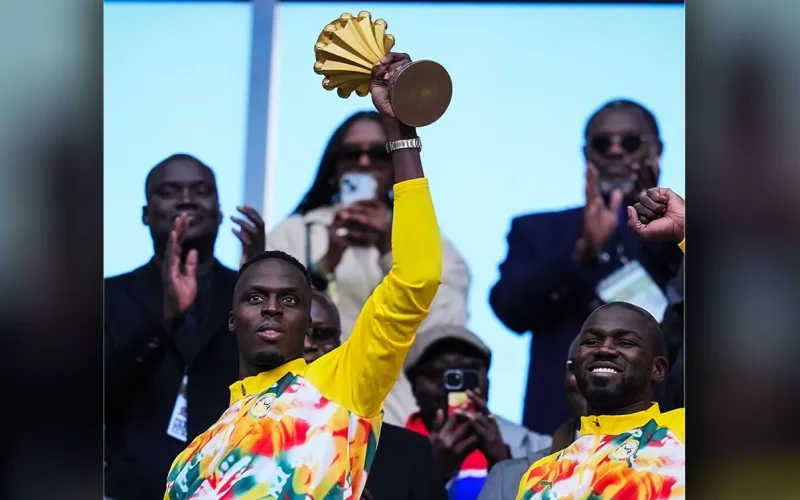
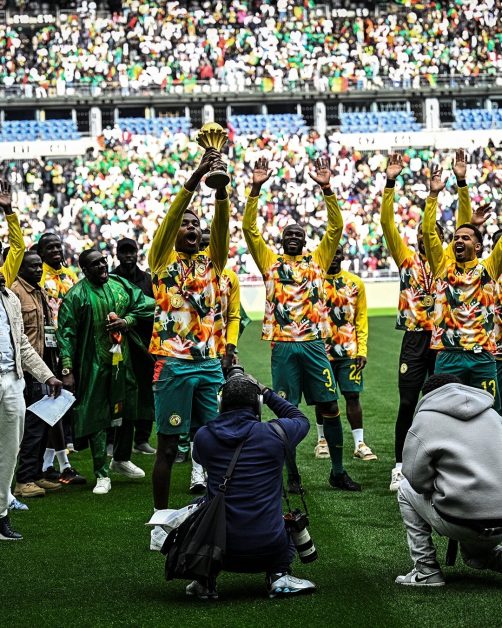
No speeches. No placards. No choreographed outrage. Just supreme athletes, draped in the green, gold and red of the Republic of Senegal, walking onto hallowed turf with the Africa Cup of Nations trophy nestled between their hands – the very trophy that the Confederation of African Football has ordered them to surrender. The very trophy they refuse, with every fibre of their being, to give back.
Captain Kalidou Koulibaly led the procession – this colossus of a man, immovable in defence, immovable in principle – cradling the golden cup as though it were a newborn. Behind him, his brothers in arms. Goalkeeper Édouard Mendy raised it to the heavens in the presidential box, in full view of Abdoulaye Fall, president of the Senegalese Football Federation, who earlier this week called CAF’s ruling the most grossly unfair administrative robbery in the history of the sport.
They deposited the trophy in the presidential box, played for their people, and left CAF to write its embarrassing footnotes alone.
Seventy thousand voices exploded. In the stands, thousands of Senegalese diaspora — proud, passionate, historically wronged — roared their defiance back at the pitch. Outside, nearly 200 supporters had gathered before the Basilica of Saint-Denis, marching to the stadium to the thunder of traditional drums, their heartbeat the ancient rhythm of West Africa, unbroken, unbowed.
The newly elected mayor of Saint-Denis, Bally Bagayoko, joined the procession. “You are the pride of the residents of working-class neighbourhoods,” he declared. “We have often been discriminated against, often looked down upon. Today, Africa is united.”
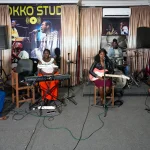
And it was Youssou N’Dour — Senegal’s greatest living cultural monument, the voice of a continent — who provided the soundtrack. If the ceremony was a rebuke, it was the most musically glorious rebuke ever delivered. CAF’s appeals board sent its letters. Youssou N’Dour played. The contrast was instructive.
The Administrative Robbery That Shocked a Continent
Let us be precise about what happened — because precision matters when history is being written.
On January 18, Senegal defeated host nation Morocco 1-0 in extra time in Rabat to win the AFCON title. Pape Gueye’s strike was the decisive blow. The goal was real. The final whistle was real. The jubilation was real.
Then CAF performed its peculiar kind of sorcery. On March 17 — nearly two months later — its appeals board reversed the result, ruling that Senegal had forfeited the final because their players briefly left the pitch in protest after Morocco were controversially awarded a stoppage-time penalty. Never mind that the players returned. Never mind that Morocco’s Brahim Diaz subsequently missed that very penalty. Never mind that the match continued to its natural, scoreline-altering conclusion. CAF ruled the walk-off a forfeit and declared Morocco the winners 3-0 on paper.
A 3-0 victory. For a match, Morocco could not win on the pitch. For a trophy Morocco’s players had not earned on the field. The bureaucratic alchemy of converting athletic failure into administrative triumph.
Pape Gueye’s goal was real. The final whistle was real. The jubilation was real — and no administrator’s letter can unmake that moment in time.
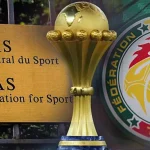
The Senegalese Football Federation has appealed to the Court of Arbitration for Sport. CAS has confirmed receipt. The legal process could stretch nine to twelve months. Senegal’s lawyer, Saër Diagne, was unambiguous about the parade’s legitimacy: ‘There is no decision from CAF or its appeals jury that orders the Senegalese Football Federation or the national team to return their medals or to return the trophy. Those decisions do not exist.’
And so Senegal did what any dignified, undefeated people would do. They kept the trophy. They paraded it. And they added a second star to their jerseys.
Two Stars. One Statement.
In the days before the match, forward Iliman Ndiaye modelled Senegal’s Puma shirt on the federation’s Instagram page. Above the badge: two stars. Two AFCON titles. 2021 and 2025. The caption was simply two star emojis. Brevity as artistry. Understatement as thunder.
CAF sent warning letters. A Moroccan lawyer, Mourad Elajouti, sent formal notices to Stade de France operators on Friday, warning against any public presentation of the trophy. The message, presumably, was that parading silverware constitutes some form of aggression. Saint-Denis did not flinch. Youssou N’Dour performed. The stars stayed on the jersey. Koulibaly gripped the cup.
There is a grim comedy in all of this that deserves to be savoured. The most powerful administrative body in African football, armed with its regulations and its rulings, its articles 82 and 84 — all of it utterly, magnificently impotent in the face of men who simply chose to walk onto a pitch and hold a trophy.
CAF can rewrite the record books. It cannot rewrite the memory of 70,000 souls who witnessed the Lions of Teranga refuse to bow.
A Continent Watches — and Judges
The Senegalese government has called for an independent international investigation into suspected corruption within CAF. The Senegalese FA president has called the ruling an administrative robbery. A Premier League manager with African roots publicly criticised the decision. The mayor of a Paris suburb marched with the fans.
The optics for CAF are catastrophic. An institution that already staggers under the weight of its own credibility deficit has now managed to transform a straightforward rules dispute into a continent-wide referendum on institutional integrity. When your attempt to enforce regulations produces scenes of 70,000 people defiantly celebrating the team you stripped of a title — on foreign soil, with a living legend providing the soundtrack — the regulations have not prevailed. You have simply revealed their limits.
Senegal’s lawyers argue that if CAS allows this situation to stand, the winner of the next World Cup could be decided in a lawyers’ firm. It is a hyperbolic warning — and not entirely inaccurate.
The Lions Do Not Beg
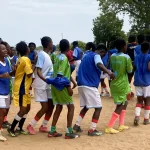
Perhaps the most extraordinary quality of Saturday’s parade was its composure. There was no fury in it — or if there was, it was the cold, controlled fury of people who know exactly who they are and what they won. Koulibaly did not rage. Mendy did not weep. The players did laps. They passed the cup hand to hand. They placed it in the presidential box. They greeted their fans. Then they played football.
Against Peru, in their first match since the disputed final, the Lions of Teranga took the pitch as what they believe themselves to be: the champions of Africa. CAF’s paperwork says otherwise. History’s jury is still deliberating.
But here is what is not in dispute: on a cold Saturday in the Paris suburbs, 70,000 people witnessed something rare and galvanising — a small nation refusing to be diminished by a bureaucracy larger than itself. No words. Just supreme athletes, in their nation’s colours, holding in their hands a trophy that the world now watches with fascination.
CAF can have its regulations. Senegal has the memory. And on Saturday, at the Stade de France, with Youssou N’Dour singing and a city roaring, the memory felt infinitely more powerful.