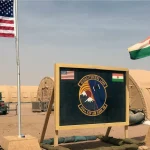
THE United States has confirmed the deployment of military personnel to Nigeria, marking Washington’s most direct intervention in West African counter-terrorism operations in years and signalling a sharp escalation in American involvement across the volatile Sahel region.
U.S. Africa Command (AFRICOM) Commander Gen. Dagvin Anderson has confirmed that a “small team” of American military specialists is now operating on Nigerian territory. The acknowledgement comes six weeks after President Donald Trump authorised Christmas night airstrikes against Islamic State positions in Nigeria’s restive northwest – the first such direct U.S. military action on Nigerian soil.
The deployment represents a significant policy shift for Washington, which has historically limited its West African military footprint to training missions, intelligence sharing, and drone surveillance conducted from neighbouring countries. The move also places American forces in one of the world’s most dangerous counter-insurgency environments, where Boko Haram, Islamic State West Africa Province (ISWAP), and affiliated militant groups have killed tens of thousands and displaced millions since 2009.
From Airstrikes to Advisors
The ground deployment follows a carefully choreographed sequence of escalation. U.S. surveillance flights over Nigeria, operating from Ghana since at least late November 2025, provided the intelligence infrastructure for the December 25 airstrikes that targeted ISIS militants in the northwest. Now, with boots on the ground, Washington has moved from remote observation to direct tactical engagement.
According to AFRICOM, the American team’s mission centres on intelligence gathering, tactical support, and advising Nigerian forces. While the Pentagon has not disclosed the size of the deployment, similar “small team” formations in counter-terrorism theatres typically number between a dozen and several dozen personnel, often including special operations forces, intelligence specialists, and communications experts.
The deployment follows discussions between Gen. Anderson and Nigerian President Bola Tinubu on the escalating terrorist threat in West Africa. Nigerian officials have confirmed cooperation with the U.S., framing the arrangement as a mutual effort to combat violent extremism threatening regional stability.
Trump’s Ultimatum and the Christian Protection Narrative
The military deployment cannot be separated from President Trump’s late-2025 rhetoric on Nigeria. Trump publicly accused the Nigerian government of failing to protect civilians – specifically Christians in the country’s predominantly Muslim north – and threatened intervention if conditions did not improve. This framing echoed his administration’s broader emphasis on religious persecution as a foreign policy priority and appeared designed to build domestic political support for military action.
The reality on the ground is more complex. While Christian communities in Nigeria’s Middle Belt and northeastern states have indeed suffered devastating attacks from Boko Haram and ISWAP, these groups employ indiscriminate violence that has claimed Muslim lives in far greater numbers. Security analysts note that the conflict’s drivers include governance failures, economic marginalisation, climate-driven resource competition, and the spillover effects of state collapse in the Sahel – not simply religious targeting.
Nevertheless, Trump’s framing provided political cover for intervention and placed the Tinubu administration in a difficult position: accept American military assistance and face accusations of surrendering sovereignty, or refuse and risk being portrayed as indifferent to Christian suffering.
Strategic Calculations and Regional Implications
For Washington, the Nigeria deployment serves multiple strategic objectives. First, it addresses growing concern about the Islamic State’s expansion in West Africa following the group’s ejection from its Middle Eastern strongholds. ISWAP has emerged as one of ISIS’s most effective franchises globally, controlling territory, collecting taxes, and mounting sophisticated military operations.
Second, the move counters growing Russian and Chinese influence in Africa. Moscow has expanded private military contractor operations across the Sahel, while Beijing has deepened economic ties throughout West Africa. An American military presence in Nigeria—Africa’s most populous nation and largest economy—provides Washington with a strategic foothold in a region where U.S. influence has waned.
Third, the deployment may signal a broader American return to counter-terrorism interventions after years of supposed retrenchment. While the Biden administration emphasised “over-the-horizon” capabilities and avoided new ground deployments, Trump has shown a willingness to recommit forces to active counter-terror missions.
For Nigeria, the arrangement carries profound risks alongside potential security benefits. American intelligence capabilities, surveillance technology, and tactical expertise could provide Nigerian forces with advantages they currently lack. U.S. support may also unlock additional military aid and intelligence sharing.
However, the deployment could inflame nationalist sentiment, with opposition figures already questioning whether the Tinubu government has ceded too much sovereignty. There are also concerns about mission creep—that a small advisory team could evolve into a larger, longer-term presence as has occurred in Somalia, where initial limited deployments expanded into years-long commitments.
Regional powers are watching closely. Niger, Mali, and Burkina Faso have expelled Western forces and turned toward Russia in recent years, viewing French and American military presence as neo-colonial interference. A visible U.S. deployment in Nigeria could accelerate this trend or, alternatively, provide a model for renewed Western engagement if it proves effective and respectful of sovereignty.
The Operational Challenge
The security environment awaiting American forces is exceptionally complex. Northwest Nigeria, where the December strikes occurred, has become a patchwork of armed group territories. Bandits operating as organised criminal militias control vast rural areas, kidnapping for ransom and extorting communities. Simultaneously, ISWAP and Boko Haram splinter factions maintain a presence in the northeast, exploiting porous borders with Niger, Chad, and Cameroon.
Nigerian security forces, despite significant investments, have struggled to contain the violence. Endemic corruption, poor morale, inadequate equipment, and human rights abuses have undermined military effectiveness. Civilian populations often view security forces with suspicion or fear, complicating intelligence gathering and population-centric counterinsurgency approaches.
American advisors will need to navigate these challenges while avoiding the pitfalls that have plagued U.S. counter-terrorism efforts elsewhere: over-reliance on kinetic strikes, insufficient attention to governance and development, and partnerships with forces that commit atrocities. The success or failure of the deployment may ultimately depend less on military tactics than on whether it contributes to a broader strategy addressing the conflict’s root causes.
Unanswered Questions
Critical details about the deployment remain unclear. The Pentagon has not specified the team’s size, exact location, rules of engagement, or duration of the mission. It is unknown whether American personnel will participate directly in combat operations or remain in purely advisory roles. The legal framework for the deployment—whether authorised under existing security cooperation agreements or new arrangements—has not been disclosed.
Congressional oversight also remains uncertain. While the president possesses broad authority for limited counter-terrorism deployments, extended operations typically require legislative notification and potentially authorisation. Trump administration officials have not indicated whether they briefed Congress before the deployment or what parameters exist for expanding or extending the mission.
The deployment’s relationship to Nigeria’s own military strategy is equally unclear. Nigerian forces have launched multiple counter-insurgency offensives in recent years with mixed results. Whether American involvement represents support for a new Nigerian-led campaign or an effort to redirect strategy remains to be seen.
A Test Case for Trump’s Africa Policy
The Nigeria deployment may provide the clearest indication yet of how the Trump administration intends to engage with Africa in its second term. Early signals suggest a transactional approach focused on counter-terrorism partnerships, resource access, and competition with China and Russia, rather than the democracy promotion and development emphasis of previous administrations.
If the deployment achieves visible security gains without significant American casualties or Nigerian sovereignty concerns, it could serve as a template for expanded U.S. military engagement across the Sahel. Conversely, if it becomes mired in an intractable conflict or triggers anti-American backlash, it may reinforce arguments for limiting direct U.S. military involvement in Africa’s complex security crises.
For now, American troops are on Nigerian soil, inserted into one of the world’s most challenging counter-terrorism environments. Their presence marks a new chapter in U.S.-Nigeria relations and West African security dynamics—one whose ultimate trajectory remains far from certain.