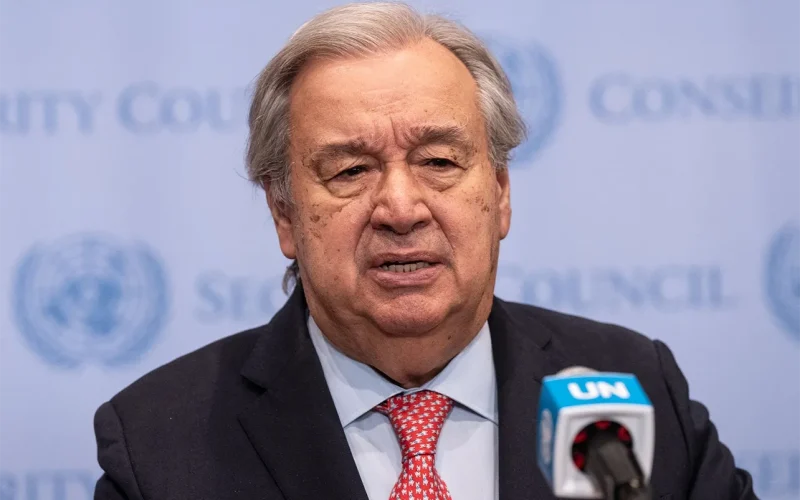
IN an emotionally charged address to the African Union, outgoing UN Secretary-General António Guterres delivered what he insisted was “not a farewell” but a solemn pledge of eternal solidarity with the continent that has defined his decade-long tenure.
Speaking with unusual candour, Guterres declared Africa would remain “priority number one” until his final day in office on December 31, and promised the continent would stay “at the centre of my concerns” for the rest of his life. He concluded in Portuguese: “Africa Sempre” — Africa Always.
The Portuguese diplomat’s tribute laid bare the depth of his partnership with African nations, crediting the African Group at the UN with “unwavering, decisive support” that he said had “moved me deeply and I will never forget.”
A Decade of Unprecedented Partnership
Guterres detailed achievements forged since he took office in 2017, including landmark Security Council Resolution 2719 establishing predictable funding for AU-led peace operations — a breakthrough decades in the making. He highlighted joint frameworks on peace, sustainable development and human rights, and collaboration during the COVID-19 pandemic.
But the Secretary-General reserved his sharpest words for global inequality, declaring the absence of permanent African seats on the Security Council “indefensible.” “This is 2026 — not 1946,” he said. “Whenever decisions about Africa and the world are on the table, Africa must be at the table.”
Blunt Assessment of Africa’s Challenges
Guterres did not shy from hard truths. He outlined grinding conflicts across Sudan, South Sudan, the Democratic Republic of Congo, and the Sahel, expressing regret over the Security Council’s failure to fund the AU mission in Somalia through assessed contributions. “If the Mission of the AU in Somalia did not warrant global support, what would?” he asked pointedly.
On economics, he cited brutal statistics: a $4 trillion annual financing gap for developing countries, with Africa losing more to debt service and illicit financial flows than it receives in aid. African nations pay up to eight times more in borrowing costs than developed economies, he noted.
The climate picture is equally stark. Despite contributing virtually nothing to global emissions, Africa faces faster-than-average warming yet receives only 2% of global clean energy investment — despite holding 60% of the world’s best solar potential.
Call for Justice and Reparations
In perhaps his most forceful remarks, Guterres championed African demands for reparatory justice frameworks addressing slavery and colonialism, and condemned the exploitation of the continent’s mineral wealth. “No more exploitation. No more plundering,” he declared. “The people of Africa must benefit from the resources of Africa.”
He called for tripling multilateral development bank lending, delivering $1.3 trillion annually to developing countries by 2035 as agreed in Baku, and ensuring African nations benefit “first and fully” from their critical minerals through fair value chains and local manufacturing.
G20 in the Crosshairs
The Secretary-General placed responsibility squarely on wealthy nations, noting the G20 accounts for nearly 80% of global emissions and must deliver “major reductions this decade.” He called for tripling adaptation finance and accelerating a “just, orderly and equitable transition from fossil fuels to renewables.”
With the planet certain to overshoot the 1.5°C warming limit, Guterres said the task is to make that overshoot “as small, short and safe as possible.”
Legacy of Solidarity
As Guterres prepares to step down after nine years at the UN’s helm, his parting message to Africa was unequivocal: the partnership will endure beyond his tenure. He guaranteed the AU-UN relationship would remain the organisation’s “deepest strategic partnership” through year’s end and affirmed his personal commitment would last a lifetime.
For a continent long marginalised in global governance, the Secretary-General’s words offered both validation and a challenge — to the world to finally grant Africa its rightful voice, and to himself to make good on a promise of perpetual solidarity.