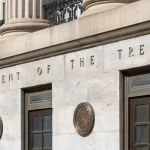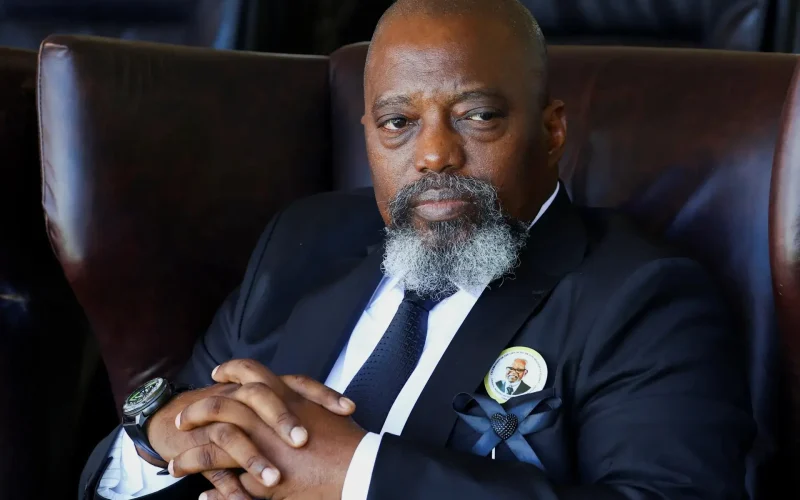
WHEN the United States Treasury Department’s Office of Foreign Assets Control (OFAC0 moved Thursday to impose sanctions on former Democratic Republic of Congo President Joseph Kabila, it was doing far more than punishing a disgraced ex-head of state. It was completing a circle – of geopolitics, mineral capital, and vengeance – that ties Washington, Kinshasa, and the killing fields of eastern Democratic Republic of Congo (DRC) into a single unambiguous arc.
OFAC sanctioned Joseph Kabange Kabila for his role in supporting the March 23 Movement (M23) and the Congo River Alliance (AFC), M23’s political-military coalition, which seeks to topple the government of the DRC. The measures are blunt instruments: any assets Kabila holds in the United States are frozen, and all transactions within the US financial system are prohibited.
But the significance of this action lies not in its mechanics. It lies in what it reveals about the architecture of American engagement in central Africa – an engagement driven by mineral appetite, dressed in the language of peace, and now deployed as a weapon in an intimate and brutal Congolese political war.
The Treasury’s indictment of Kabila is damning and specific. Kabila provided financial support to the AFC in order to influence the political situation in eastern DRC, encouraged FARDC troops to defect and join AFC forces, and sought to launch attacks from outside the DRC on the Congolese army. Most viscerally, the Treasury Department said it believed Kabila was living in Goma, where he returned with the intent to destabilize the country.
That return to Goma was no accident. Kabila had been largely absent from the DRC since 2023 in self-imposed exile, but when M23 seized Goma in January 2025 – turning the capital of North Kivu into a rebel redoubt – Kabila saw his opening. In May 2025, he appeared publicly in M23-occupied Goma, causing disquiet in Kinshasa, and met local religious leaders in the presence of M23 spokesperson Lawrence Kanyuka. The optics were unambiguous: here was a former president, sheltered under rebel protection, positioning himself as a player in whatever post-conflict political order M23’s patrons envisioned.
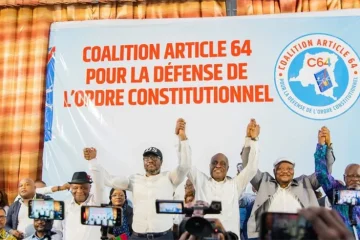
The Tshisekedi government had already drawn its own conclusions. In May 2025, the DRC Senate ran a secret ballot with an outcome of 88 votes to 5 and removed Kabila’s immunity. Then, in September, a high military court in Kinshasa convicted Kabila of treason and war crimes for collaborating with the M23 and sentenced him to death. The charges were sweeping: murder, sexual assault, torture, and insurrection, and the court ordered him to pay around $50 billion in various damages to the state and victims. Kabila’s party called the proceedings a political trial. He himself had previously branded Tshisekedi’s courts instruments of oppression.
The Americans have now sided – emphatically – with Kinshasa’s reading of events.
The Minerals Behind the Message
To understand why Washington acted, one must understand what Washington wanted. The Trump administration’s Africa policy is not primarily about human rights or democratic norms. It is about minerals – the cobalt, copper, coltan, lithium and rare earths buried beneath eastern Congo’s blood-soaked soil that are essential to American technological and military supremacy, and to breaking China’s commanding grip on global critical mineral supply chains.
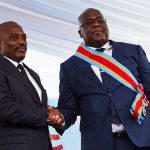
As early as February 2025, President Tshisekedi sent a letter to President Donald Trump offering US access to the DRC’s critical minerals in exchange for security assistance. That offer found eager ears. By December, Trump hosted Tshisekedi and Rwandan President Paul Kagame at the White House for the signing of the Washington Accords, simultaneously announcing bilateral agreements with both the DRC and Rwanda to unlock American access to critical minerals, declaring that “everybody’s going to make a lot of money.”
Tshisekedi has since been fêted as a vital friend to the US as the DRC emerges as an early contributor to President Trump’s effort to build a minerals trading bloc to rival China. The depth of these commercial ties is striking. A $100 million programme to establish a paramilitary force to secure the DRC’s mining sector is being funded through partnerships with the US and UAE, and the DRC and US have signed a minerals partnership under which US firm Virtus Minerals has taken over copper and cobalt miner Chemaf.
A Strategic Partnership Agreement was also signed, giving the US preferential access to Congolese mineral reserves, requiring Congo to amend its laws and potentially its Constitution, and giving Washington a level of control over the management of mining resources through a joint mechanism.
These are not the footprints of a disinterested peace broker. These are the footprints of a superpower that has concluded that Tshisekedi’s Congo is the gateway to a resource future it cannot afford to lose.
The Sanction as Strategic Instrument
Seen in this light, Thursday’s sanction against Kabila is not purely punitive. It is a protective measure for American investment. Kabila – positioned in M23-held territory, financing the AFC, and publicly calling the Tshisekedi government a dictatorship – represents an existential threat to the political framework Washington has built its mineral access. The Treasury noted that Kabila was working to regain influence over the government by backing a candidate opposed to the current leader.
More concretely, Kabila still has major business interests inside the DRC, despite government efforts to seize them, meaning his allies could risk the wrath of US sanctions if they continue to work with him. That is leverage extended far beyond Kabila himself – a financial cordon around anyone in the DRC’s business community who might consider backing the former president’s political rehabilitation.
DRC Deputy Prime Minister Jacquemain Shabani welcomed what he called a long-delayed US move against Kabila, calling him “the instigator, the initiator, the architect of the destabilisation of Congo.” Kinshasa’s relief is palpable – Washington has, in effect, ratified the death sentence its courts handed down in absentia.
A Fragile Architecture
Yet the broader picture is more troubling than this moment of convergence suggests. The Treasury’s move is part of a broader push to maintain a US-brokered peace deal signed by Rwanda and the DRC in December, which fell apart shortly after it was signed. The US had previously sanctioned the Rwanda Defence Force and top military officials for their role in the ongoing fighting in eastern DRC.
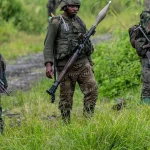
Sanctioning Rwanda’s military in March, then Kabila now, signals American frustration that its peace architecture is not holding. M23 – backed by Kigali, financed in part by Kabila, and driven by the AFC’s regime-change ambitions – continues to hold Goma and Bukavu. M23 has captured large portions of territory in eastern DRC, including the capitals of North and South Kivu provinces, resulting in the deaths of thousands of civilians and a mass displacement crisis.
The Washington Accords, for all the fanfare of their signing, have not delivered peace. Despite the signing of the peace agreement, hostilities have continued in the eastern DRC, and attacks have started to spread to other provinces.
What Thursday’s sanctions confirm, ultimately, is that Washington is fully committed to Tshisekedi — not as a democratic ally, but as the preferred custodian of a mineral estate the United States has made central to its post-China strategic calculus. Kabila, by positioning himself as M23’s political godfather, chose the wrong side of that calculation.
He is now paying the price in the only currency Washington speaks fluently in this new era: sanctions.