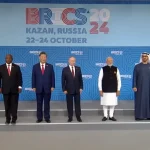
THE return of Donald Trump to the White House is expected to reshape Africa’s relationship with the United States, particularly threatening key economic partnerships and diplomatic ties at a time when the continent is deepening its engagement with China and Russia through BRICS.
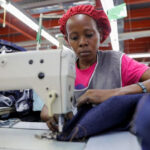
Of particular concern is the future of the African Growth and Opportunity Act (AGOA), a crucial trade agreement that has served as an economic lifeline for many African nations since 2000. Professor Kedibone Phago of North-West University warns that “a Trump presidency might be expected to threaten this agreement,” noting that South Africa’s participation is particularly crucial for AGOA’s relevance and effectiveness.
The stakes are especially high for South Africa, which faces a potentially turbulent relationship with a Trump administration. The country’s recent action against Israel at the International Court of Justice (ICJ) over the Gaza conflict, where over 48,000 people have been killed and millions displaced, could put it on a collision course with Trump’s foreign policy priorities. This diplomatic tension could be further complicated by South Africa’s strengthening ties with China and Russia through BRICS.
Trump’s “America First” approach during his previous term raised concerns about U.S. commitment to international cooperation. Etse Sikanku, a senior lecturer at Accra’s University of Media, Arts and Communication, emphasizes that “Africa should be concerned about the possible return of Donald Trump to the presidency,” citing Trump’s isolationist tendencies and previous derogatory comments about African nations.
However, some analysts suggest that geopolitical realities might force a Trump administration to maintain engagement with Africa. Daniel Silke, a South African political analyst, argues that “the growing influence of China, Russia and other countries would force Trump and his administration to be less isolationist than many would think.”
The economic implications are significant. The United States remains South Africa’s second-largest export destination after China, accounting for nearly 9% of exports according to UN Comtrade database. Any disruption to this trading relationship could have severe consequences for the African economy.
Prof Phago suggests that under Trump, “South Africa’s geopolitical positioning may be put under immense pressure to either choose friends and allies of the US to maintain favourable and friendly relations with the US.” This could force African nations to navigate carefully between their relationships with the US and their BRICS partners.
While some Africans, like Samuel Ofoso in Ghana, support Trump for what they perceive as his infrastructure contributions and political relations with Africa, others express concern about his approach to international cooperation and climate change. Charles Martin-Shields of the German Institute of Development and Sustainability warns that Trump would likely focus on domestic policy while ignoring critical issues like climate change, which disproportionately affects African nations.
For Africa, a Trump presidency could mean walking a diplomatic tightrope between maintaining crucial economic ties with the United States while preserving its sovereignty in foreign policy decisions and its relationships with other global powers. The continent’s ability to navigate these complex international waters could determine its economic and diplomatic future in an increasingly multipolar world.
As the November 5th election approaches, African leaders are closely watching, knowing that the outcome could significantly impact their nations’ development trajectories and international relationships for years to come.