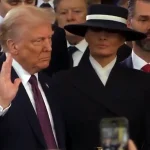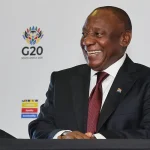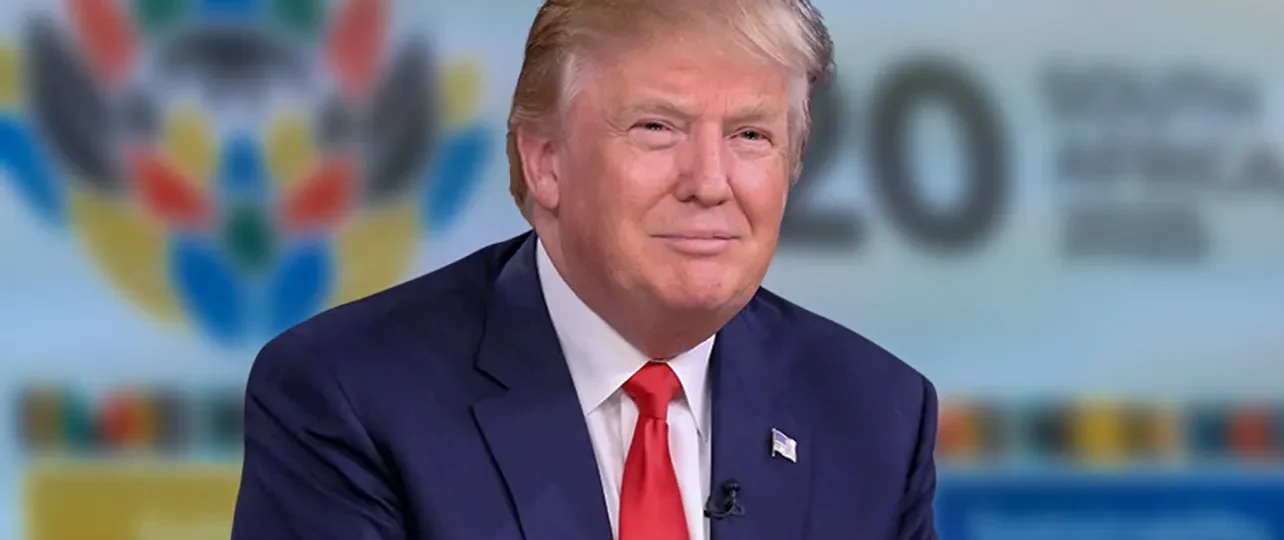

US President Donald Trump’s likely November G20 visit to South Africa is already fuelling speculation about a potential shift in his administration’s calculus on Africa.
For a president whose earlier expletive comments about Africa drew global backlash — referring to African nations as “shit-hole countries” — this would be his first visit to the continent.
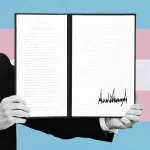
Speculation about his G20 trip follows a fresh wave of executive orders he issued soon after assuming office that has raised eyebrows across Africa.
Trump has suspended foreign assistance programs for 90 days, withdrew from the Paris Climate Agreement and WHO, and doubled down on fossil fuel exploration.
The incoming president also plans to establish an external revenue service to impose tariffs and taxes on other countries that could affect African exports to the lucrative American market.
These policies are seen by many observers as antithetical to Africa’s developmental priorities.
Still, Trump’s attendance at the G20 could signal either an olive branch or a continuation of a fraught relationship.
Africa, though not the centrepiece of the G20 — which counts South Africa as its only permanent member from the continent — has consistently been invited to the summit alongside representation from the African Union.
This year, however, with the Africa Union’s newly minted permanent membership, the continent has a stronger platform to push its priorities.
If confirmed, Trump’s presence will throw a spotlight on U.S.-Africa relations at a time when the global landscape is shifting due to heightened competition between the United States, China, and Russia.
Aly-Khan Satchu, a Nairobi-based financial analyst, believes Trump’s relationship with Africa has always been more nuanced than many assume.
“Interestingly, President Trump, during his first administration, polled very high among Africans. The nuance was that the average African felt his sharp comments, in particular about African leadership, were pertinent,” Satchu observed.
He added that while Trump’s directness resonated with some, the current administration may lack the institutional memory to capitalise on that equity.
“I think his attendance would be an important signal, but I remain sceptical that he will attend,” Satchu noted.
“For Africa from a geopolitical perspective, America’s presence would provide extra optionality, and all optionality is ipso facto good.”
For African leaders, however, this uncertainty presents both a challenge and an opportunity.
The G20 platform could be leveraged to advocate for the renewal and expansion of the African Growth and Opportunity Act (AGOA), a trade pact that expires in 2025.
AGOA has been instrumental in granting African countries tariff-free access to U.S. markets, and its extension could be a major talking point during the summit.
Trump’s transactional foreign policy style—focused on deals rather than aid—might align with African leaders eager to move beyond dependency narratives.
Satchu emphasised the importance of understanding Trump’s approach.
“President Trump is by nature transactional, and that knowledge should infuse African thinking in any engagement with him,” he explained.
Taiwo Oyedele, the chairman of Nigeria’s Presidential Committee on Fiscal Policy and Tax Reforms, believes more US engagement could for instance encourage countries like Nigeria to revamp their tax systems.
“By revamping our tax system, we can better navigate potential challenges and seize any opportunities this development may present,” he wrote on X.
By stressing Africa’s young, growing population, its burgeoning markets, and its critical role in global supply chains, leaders could frame the continent as an indispensable partner.
Trump, who often prides himself on his ability to negotiate deals, might find such proposals appealing if they involve mutual economic gain.
South African political economist Phumlani Majozi called Trump’s policy directives a bluff, asserting that moves such as new tariff targets are merely bargaining chips.
“I hope Trump’s economic reform agenda inspires African leaders to pursue pro-market reform and stronger law and order,” he said on Trump’s executive orders.
“We as developing nations should stop relying on US taxpayers’ money. We must get our act together and create wealth and address our problems. It’s our problems – must be addressed by us.”
Meanwhile, great power rivalry continues to shape Africa’s global relevance. China has solidified its presence on the continent with massive infrastructure investments and loan forgiveness initiatives.
Russia, too, has been making strategic moves, seeking to expand its influence. The U.S., by contrast, has often been criticized for its lukewarm ties with the continent. Trump’s attendance at the G20 could provide an opportunity to change that narrative, but only if African leaders present a united front.
Observers argue that Africa must capitalize on its geostrategic importance.
The continent’s vast natural resources, youthful population, and growing markets make it a pivotal player in global economics.
For instance, African leaders could frame the continent’s renewable energy sector as an untapped market for American investment, offering mutual economic benefits.
Trump’s business-oriented worldview might resonate with proposals emphasising trade and investment over aid dependency.
By highlighting initiatives like the African Continental Free Trade Area (AfCFTA), leaders can showcase Africa’s readiness to engage as an equal partner on the global stage.
Still, the shadow of his inflammatory remarks about Africa looms large, making any potential visit as much about repairing damaged perceptions as about policy.