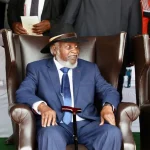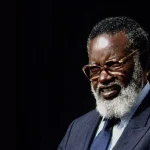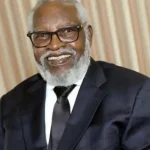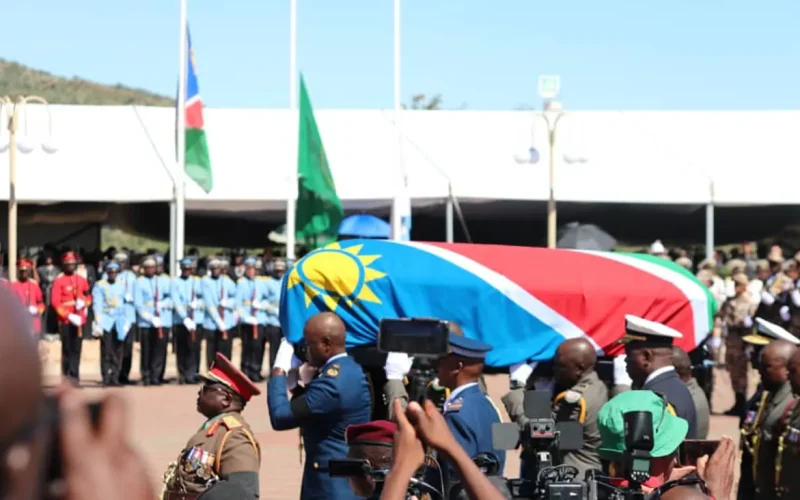
THE sun rose with solemn brilliance over Windhoek on Saturday, casting long shadows across a city draped in national colours. The capital of Namibia stood still in reverence as thousands gathered to honour the passing of a titan – Dr Sam Nujoma, founding father of the nation and one of Africa’s most revered revolutionary leaders.
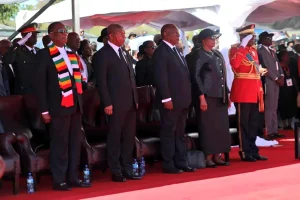
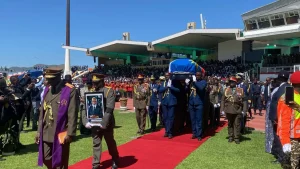
Independence Stadium pulsed with emotion as mourners from all corners of Namibia and beyond converged in a magnificent tapestry of grief and celebration. The crowd swelled, their collective voice rising in the familiar chant that had once rallied a nation to freedom: “Sam ouli peni?” (“Sam, where are you? Raise the Namibian flag!”). The poignant echo of this liberation-era song filled the air as thousands of flags rippled like waves across the stadium—a visual symphony of national pride and profound loss.
“Today, we do not just bury a man,” declared President Dr Nangolo Mbumba, his voice steady despite the weight of emotion. “We honour the architect of our freedom, the visionary who led us from darkness into light.” The President’s words resonated through the hushed crowd as he reflected on Nujoma’s extraordinary legacy. “We fought under your command and we won the liberation struggle and forever removed apartheid colonialism from the face of Namibia. Indeed we are, in your own words, the masters of our own destiny.”
Mbumba said: “Who else could rise from the humble dwellings of Etunda to lead a nation to independence? Who else could traverse from a dusty village to the hallways of the United Nations? Who else could rise from relative obscurity and end up rubbing shoulders with some of the most iconic leaders of the 20th century? Only an extraordinary human being could achieve such feats.”
Utoni Nujoma, the founding president’s eldest son, paid a warm tribute to his father, describing him as a pillar of strength and a fountain of wisdom in the family.
Utoni said: “Although we could not have him around us all the time, we nevertheless understood very well that he embodied and personified the liberation struggle for Namibia’s freedom and independence. Despite the fact that our hearts are engulfed by grief, we, therefore, celebrate his long and fulfilling life as well as his unwavering spirit when he dedicated his entire life to the liberation of our motherland and the entire African continent.”
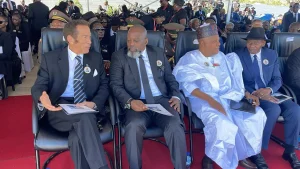
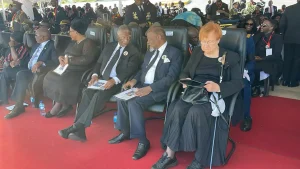
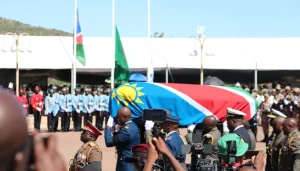
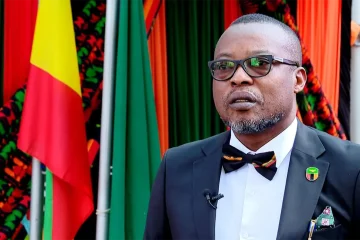
A procession of African heads of state and government leaders filed past Nujoma’s casket, each paying homage to a man whose struggle transcended Namibia’s borders and embodied Africa’s broader fight against colonial oppression. Among them was former South African President Thabo Mbeki, who had arrived in Windhoek with a heavy heart.
“This is indeed a sad moment,” Mbeki had remarked upon his arrival. “But it is also an opportunity for us – Namibians and South Africans alike – to honour Nujoma’s legacy through our actions.” International Relations Minister Ronald Lamola sat beside him, representing a nation whose destiny had been intertwined with Namibia’s throughout the liberation struggle.
The stadium fell silent as Bishop Zephaniah Kameeta approached the podium. His words cut through the grief with the clarity of truth: “Nujoma did not fight for a society in which rape and gender-based violence are rampant,” he declared. “He did not endure decades of exile so that we might turn against one another in tribal conflicts and power struggles.” The Bishop’s impassioned call for peace and unity resonated deeply with the assembled mourners. “This is not the peace Nujoma fought for. I call for peace to honour Nujoma’s fight for peace.”
The ceremony painted a vivid portrait of Nujoma’s remarkable journey – from humble beginnings in 1929 to his emergence as a labour activist in the 1950s, fighting against the injustices of apartheid South Africa in the territory then known as South West Africa. With Andimba Herman Toivo ya Toivo, he co-founded the Ovamboland People’s Congress in 1959, which would evolve into the South West Africa People’s Organization (SWAPO) the following year.
For nearly three decades, Nujoma led from exile, orchestrating a liberation struggle that cost some 20,000 African lives between 1966 and the late 1980s. His triumphant return in 1989 led to victory in the country’s first democratic elections, and in March 1990, he was sworn in as Namibia’s first post-independence leader—a position he would hold with distinction until 2005.
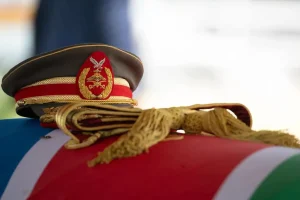
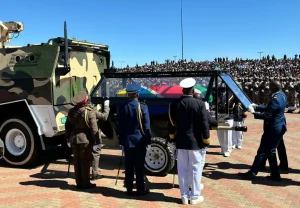
As the ceremony at Independence Stadium concluded, the procession moved to Heroes’ Acre, where Nujoma would rest among fellow freedom fighters. The 95-year-old icon’s final journey was accompanied by military honors, traditional songs, and the unrestrained tears of a grateful nation.
The passing of Sam Nujoma at 95 marked not just the end of a man’s life, but the closing of a momentous chapter in African history—the era of the first generation of liberation leaders who transformed colonies into proud, independent nations. Yet as the sun began to set over Heroes’ Acre, casting the monument in golden light, there was a powerful sense that while the man had departed, his vision for a united, peaceful, and prosperous Namibia would continue to guide generations to come.
In the words inscribed on his memorial: “Freedom is not free. Remember those who sacrificed.”
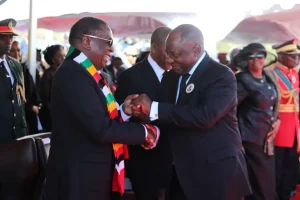
Present and ex-African heads of state attended the memorial service and funeral, including South Africa’s Cyril Ramaphosa, Democratic Republic of Congo’s Joseph Kabila, Zimbabwe’s Emmerson Mnangagwa, Botswana’s Ian Khama, Angola’s João Manuel Gonçalves Lourenço, Tanzanian Vice President Philip Mpango and Lesotho’s Prime Minister, Samuel Matekane.