A shadowy network of powerful elites and armed bandits is systematically plundering Nigeria’s gold resources, according to explosive new research that reveals the depth of corruption in the country’s mining sector.
The investigation, published in The Conversation by Dr Oluwole Ojewale, Research Fellow at Obafemi Awolowo University and Regional Coordinator at the Institute for Security Studies, exposes how politically connected individuals are partnering with violent criminal groups to exploit mineral wealth at the expense of the nation.
“Bandits collude with elites to engage in illegal gold mining and undermine peace,” Dr Ojewale writes, following qualitative interviews with 17 respondents from mining communities in Katsina and Zamfara states, including miners, community leaders, and security agents.
The study paints a disturbing picture of resource exploitation that has evolved over decades into a well-organized criminal enterprise with international connections.
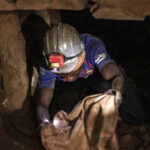
“For more than four decades, gold mining has been done by wealthy and influential people in communities,” Dr Ojewale explains. “Intense competition between the owners of the minefields led them to hire bandits to guard their minefields from their competitors.”
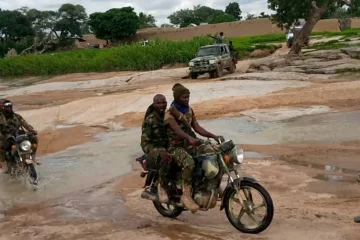
This unholy alliance has become deeply entrenched, with wealthy mine owners providing bandits with “weapons, arms, drugs, food and logistics” in exchange for protection of their gold pits.
Many of these mine owners wield significant political influence. Dr Ojewale found that “a number of the wealthy mine owners wield influence in local politics” and that “some individuals were employed by influential figures in government or business.”
The findings align with recent statements from Nigeria’s highest officials. The country’s Minister of Solid Minerals, Dele Alake, asserted in late 2024 that “powerful individuals engaged in illegal mining were sponsoring banditry in the country.” Similarly, Edo North senator Adams Oshiomhole alleged that “retired military officers coordinated illegal mining activities nationwide.”
The Human Cost
The collaboration between elites and bandits has fueled a cycle of violence that has devastated communities across northern Nigeria. According to conflict data cited in Ojewale’s research, “1,615 incidents and 4,201 deaths were recorded due to banditry from 2010 to 2023 in Katsina and Zamfara states alone.”
Ojewale notes that “violence arises from competition over mining locations, funding of armed groups’ activities, and taking control from civilians.”
As bandits gain access to funds from illegal mining operations, they “can expand their influence, recruit new members and carry out attacks,” perpetuating a cycle of violence and instability.
International Networks
Perhaps most alarming is the international reach of this criminal enterprise. Ojewale’s research found that “criminals involved in illegal mining had strong connections in the gold market, both domestically and internationally.”
“The transnational supply chain of the illicit economy extends through Chad, Niger, Libya and Algeria,” Ojewale writes, adding that “foreign networks also operate in the criminal supply chain.”
The illegal gold follows established smuggling routes: “Some of these traders are business elites from other states in Nigeria who typically sell the gold in the Diffa region in Chad, or in Agadez (Niger), Tripoli (Libya) and Algiers (Algeria). Some gold traders transport the mineral to Benin.”
Economic Impact
The scale of Nigeria’s losses is staggering. While the Nigeria Extractive Industries Transparency Initiative estimates that the legal mining sector contributed N814.59 billion (US$527 million) over 15 years, the illegal sector is believed to be exponentially larger.
The northwestern region is particularly rich in strategic minerals including “granite, gypsum, kaolin, laterite, limestone, phosphate, potash, silica sand and gold,” representing significant potential wealth for the nation if properly managed.
Breaking the Cycle
Dr. Ojewale offers several recommendations to address this crisis, starting with law enforcement and accountability.
“Large areas of north-west Nigeria are ungoverned,” the study notes. “The federal government should enhance border policing and law enforcement capabilities by upgrading security and intelligence gathering infrastructure.”
The paper also recommends “advanced contraband-detection technologies, such as spectroscopy, at land borders” and insists that “individuals with ties to illegal gold trade and supporting criminal activities must be identified, apprehended and prosecuted.”
Additionally, Ojewale calls for comprehensive reform of the mining sector, which has been “largely neglected” due to Nigeria’s focus on oil production.
Community involvement is also crucial: “The security agencies can foster community partnerships to source human intelligence on the activities of bandits, illegal miners and mineral smugglers.”
Finally, Dr Ojewale advocates for “targeted sanctions and asset freezing” against elites involved in the illegal gold trade, an approach that “has been used in Nigeria and in South Africa, among other countries in the world.”
Without concerted action, the unholy alliance between Nigeria’s elites and bandits will continue to drain the country’s resources and fuel violence for years to come.