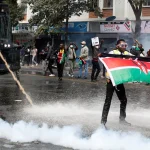
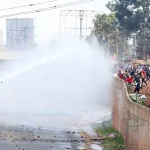
WHAT began as peaceful commemorations of Kenya’s historic pro-democracy movement erupted into deadly violence on July 7, 2025, as security forces opened fire on protesters marking the 35th anniversary of the “Saba Saba” rallies, leaving at least 11 people dead and dozens wounded across the country.
The bloodshed unfolded in Nairobi’s streets and spread to towns including Nyeri, Embu, Nakuru, and Eldoret, as police deployed live ammunition, tear gas, and water cannons against demonstrators who had gathered to voice mounting grievances against President William Ruto’s administration.
In the capital’s Kangemi suburb, the toll was particularly severe. Police fired directly into crowds of advancing protesters, with two of six people rushed to Eagle Nursing Home dying from gunshot wounds. Kenyatta National Hospital treated at least 24 injured civilians, while police reported 52 officers wounded nationwide.
The Kenya National Commission on Human Rights put the civilian death toll at 10, with at least 29 injuries documented among protesters. The discrepancy in casualty figures underscores the chaos that engulfed Kenya’s major urban centres as authorities struggled to contain the unrest.
Catalyst for Rage
The protests were ignited by the recent death of Albert Ojwang, a 31-year-old blogger and teacher who died in police custody under circumstances that have shocked the nation. Ojwang, known for his vocal criticism of the government, showed evidence of assault and trauma according to autopsy results, sparking outrage among Kenya’s youth.
Six people, including three police officers, have been charged with Ojwang’s murder, all entering pleas of not guilty. But for many protesters, his death represents a broader pattern of state violence and impunity that has plagued Kenya since mass demonstrations began in 2024.
“This is about more than one man’s death,” said a protester in Nairobi who declined to give his name for fear of reprisals. “It’s about a system that kills its own people for speaking the truth.”
The demonstrations initially erupted over proposed tax increases in 2024 but have evolved into a broader movement demanding accountability for corruption, police brutality, economic hardship, and the disappearance of government critics. Generation Z activists, organizing primarily through social media, have emerged as the driving force behind the sustained resistance.
Heavy-Handed Response
The government’s response has drawn sharp criticism from human rights organizations, who documented the presence of hooded, plainclothes officers operating from unmarked vehicles despite court orders requiring police to be identifiable during protests. The Kenya National Commission on Human Rights also reported criminal gangs wielding whips and machetes working alongside police in Nairobi and Eldoret.
Interior Minister Kipchumba Murkomen defended the crackdown, characterising the protests as “terrorism disguised as dissent” and warning of “decisive action” against those seeking to cause chaos. The minister reiterated the government’s commitment to protecting life and property, even as evidence mounted of excessive force by security personnel.
Major roads into Nairobi were blocked, city movement was restricted, and most schools and shopping malls shuttered in anticipation of violence. In Nakuru, mounted police dispersed stone-throwing crowds, while authorities reported widespread looting and property damage across multiple cities.
International Alarm
The violence has drawn condemnation from international partners, with the European Union, United States, and United Kingdom calling for thorough investigations into police conduct and Ojwang’s death. The scale of casualties has raised concerns about Kenya’s democratic trajectory under Ruto’s administration, which took power in 2022.
Since June 2024, at least 80 people have died in protest-related violence, with many more unlawfully detained according to Amnesty International and local rights groups. The organisation has condemned the use of live ammunition against protesters and called for accountability for extrajudicial killings.
Press freedom has also come under assault, with the Communications Authority of Kenya attempting to ban live broadcasts of protests before courts quickly overturned the order. The move raised alarms about the government’s commitment to transparency and democratic norms.
Unresolved Tensions
As Kenya grapples with the aftermath of the “Saba Saba” violence, the fundamental grievances driving the protests remain unaddressed. President Ruto’s administration faces no clear political rival ahead of the 2027 elections, despite mounting public anger and a youth-led movement that shows no signs of backing down.
The government has accused opposition figures of exploiting the unrest but has presented no evidence to support these claims. Meanwhile, protesters continue to demand justice for Ojwang, an end to police brutality, and meaningful reforms to combat corruption and economic inequality.
The heavy-handed response to the anniversary protests has further alienated many young Kenyans, creating a volatile situation with the potential for additional unrest. As the nation mourns its latest casualties, the central question remains whether Kenya’s leadership will address the systemic issues fueling the discontent or continue to rely on force to maintain order.
The Saba Saba anniversary, once a celebration of Kenya’s democratic progress, has instead become a stark reminder of how far the country has yet to travel on its path toward genuine accountability and reform.