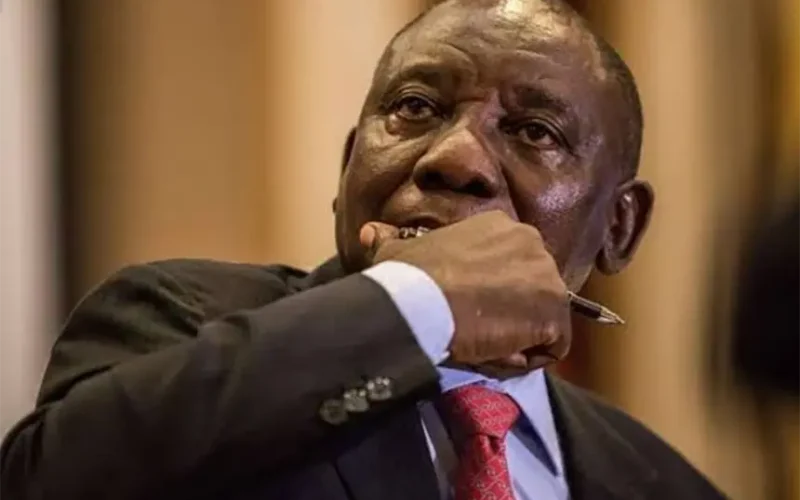
THE gloves are off in South Africa’s Government of National Unity as President Cyril Ramaphosa unleashes unprecedented criticism against his coalition partner
“The DA has positioned itself as part of a right-wing nexus that seeks to use a foreign state to effect changes to democratically developed national policies in our own country.”
With these blistering words, President Cyril Ramaphosa has drawn the sharpest battle lines yet in South Africa’s increasingly fractious Government of National Unity, delivering what may be the most brutal presidential attack on the Democratic Alliance (DA) since the coalition’s formation.
The extraordinary statement, released by the Presidency on Tuesday, represents a dramatic escalation in the simmering tensions between the ANC and its primary coalition partner, the DA. At the centre of the storm lies the controversial appointment of Mcebisi Jonas as Special Envoy to the USA – a move that has exposed the deep ideological chasms threatening to tear apart South Africa’s experimental unity government.
The former deputy finance minister has to salvage ties with Washington amid a diplomatic deep freeze and global trade war, but Jonas’s appointment has instead become a lightning rod for broader coalition disputes. The DA’s persistent questioning of Jonas’s effectiveness and credentials has clearly struck a nerve with Ramaphosa, who responded with unprecedented fury.
“The Democratic Alliance’s latest effort to embarrass President Ramaphosa’s Special Envoy to North America, Mr Jonas Mcebisi, involves claims – in the DA’s framing – that the United States has rejected Mr Jonas’s ‘credentials’ and that Mr Jonas is therefore unable to perform his role as Special Envoy,” the Presidency stated, dismissing the opposition’s concerns as deliberate disinformation.
The absence of South Africa’s special envoy to the United States, Mcebisi Jonas, from a pivotal meeting between President Cyril Ramaphosa and President Donald Trump has sparked controversy, with conflicting reports regarding his visa status. This absence has provided ammunition for DA critics who question Jonas’s ability to fulfil his mandate.
The President’s Fury Unleashed
Ramaphosa’s statement pulls no punches in its assessment of the DA’s motivations and methods. “The DA seeks to add sensationalism to its claim by suggesting President Ramaphosa and Mr Jonas face a crisis in view of the United States’ pending implementation of trade tariffs announced several days ago by President Donald Trump,” the Presidency declared, characterising the opposition’s concerns as manufactured drama.
The president’s anger appears to stem from what he perceives as the DA’s willingness to undermine South Africa’s national interests for political gain. “The Presidency is therefore concerned about the Democratic Alliance’s persistent campaign against South Africa’s national interest and its posture of trying to embarrass and belittle our country, and in this specific circumstance, Mr Jonas,” the statement reads.
A Coalition on the Brink
The president’s accusations go beyond mere political disagreement, suggesting a fundamental betrayal of national unity. “This campaign has its origins in a Democratic Alliance visit to the United States earlier this year, to advance an ideological agenda rather than our national interest,” Ramaphosa charged, implying that the DA has been working against South African interests on foreign soil.
The statement reveals the depth of the president’s frustration with his coalition partners, accusing them of exploiting sensitive diplomatic negotiations for domestic political purposes. “The DA is trying cheaply but dangerously to exploit a critical engagement between South Africa and the United States to protest President Ramaphosa’s removal of Mr Andrew Whitfield as Deputy Minister of Trade, Industry and Competition.”
International Relations as Battleground
Perhaps most damaging to the coalition’s unity is Ramaphosa’s accusation that the DA’s approach threatens South Africa’s broader international relationships. “The DA’s pronouncements and insults against countries and international organisations – such as the Republic of Cuba or the United Nations Relief and Works Agency for Palestine Refugees offend South Africa’s international relations and posture,” the Presidency stated.
The president painted a stark picture of the potential consequences, warning that “If the DA were to succeed in undermining South Africa relations with various nations or institutions, the party will harm the viability of businesses and livelihoods of hundreds of thousands of South Africans who work in sectors that depend on the expansion of our trade relations with the world.”
Jonas’ appointment already sparked controversy over disparaging remarks he made about US President Donald Trump more than four years ago, adding another layer of complexity to an already delicate diplomatic situation. Special envoy Mcebisi Jonas, as far as we know, has not once set foot in the US, lending credence to DA concerns about the effectiveness of the appointment.
Yet Ramaphosa’s defence of Jonas suggests broader principles at stake. The president detailed Jonas’s behind-the-scenes work: “Mr Jonas has, however, played an important role in working with the DTIC to develop the trade proposals in which South Africa is currently engaging the United States in good faith and with the expectation of mutually beneficial terms.”
A Coalition’s Future in Question
The president’s statement represents more than a defence of a single appointment – it’s a declaration of war against what he perceives as the DA’s fundamental approach to governance within the coalition. By accusing the DA of being part of a “right-wing nexus” that seeks to use foreign influence to change domestic policies, Ramaphosa has essentially questioned whether the DA can be trusted as a coalition partner.
The brutality of the language – describing the DA’s actions as “cheaply but dangerously” exploiting critical diplomatic engagements – suggests a relationship that may be beyond repair. In a coalition government that was already walking a tightrope between competing ideologies, this latest escalation may prove to be the moment when South Africa’s experiment in unity government finally fractures.
As the political temperature soars and diplomatic stakes rise, one thing is clear: the gloves are not just off – they’ve been thrown down as a challenge to the very foundation of South Africa’s coalition government. The question now is whether the DA will pick them up or seek to de-escalate a confrontation that threatens to consume the Government of National Unity from within.