US President Donald Trump’s sweeping tariff offensive against Africa has triggered the most significant realignment of the continent’s trade relationships in decades, with African governments scrambling to cushion economic blows while pivoting toward alternative partnerships that could fundamentally reset global power dynamics.
The tariff regime, which took effect on August 7, 2025, has struck at the heart of African economies with unprecedented severity. South Africa, the continent’s most industrialised economy, faces a crushing 30% tariff on all exports to the United States -effectively ending more than two decades of preferential trade access under the African Growth and Opportunity Act (AGOA) that had covered over 6,000 South African products.
The implications extend far beyond trade statistics. As African governments mobilise sophisticated response strategies combining diplomatic engagement, economic diversification, and regional cooperation, the continent is accelerating its integration into alternative economic blocs – particularly BRICS – in ways that could diminish American influence for generations.
The Tariff Landscape: A Continental Economic Assault
The scale of Trump’s tariff architecture reveals a systematic approach to reshaping US-Africa relations through economic pressure. South Africa and Algeria face the steepest penalties at 30%, while Libya matches this rate despite ongoing political instability that limits its response capacity.
Tunisia confronts a 25% tariff burden, while a broad swath of African economies—including continental powerhouses Nigeria, Ghana, and the Democratic Republic of Congo—face 15% tariffs. Angola, Botswana, Cameroon, Chad, Ivory Coast, Equatorial Guinea, Madagascar, Malawi, Mauritius, Mozambique, Namibia, Uganda, Zambia, and Zimbabwe all fall into this category.
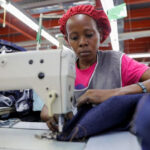
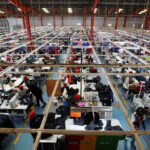
Lesotho’s case demonstrates both the severity of Trump’s initial approach and the potential for diplomatic intervention. Originally threatened with a devastating 50% tariff – the highest proposed for any US trading partner – intensive negotiations reduced this to 15%. However, even this “compromise” has triggered an economic crisis, forcing the government to declare a state of disaster as the crucial textile sector, which employed thousands and drove private sector growth, collapsed under the weight of cancelled US orders.
Countries not specifically targeted maintain a baseline 10% tariff, but this still represents a significant departure from previous trade relationships and signals a comprehensive recalibration of US-Africa economic engagement.
South Africa’s Multi-Track Response: Diplomacy, Support, and Diversification
South Africa’s response exemplifies the sophisticated strategies African governments are deploying to navigate this new reality. President Cyril Ramaphosa’s administration has launched a three-pronged approach that could serve as a template for continental responses.
Diplomatic Offensive: South African officials have maintained intensive dialogue with Washington, challenging what they term a “contested interpretation” of trade balances. The government submitted a comprehensive “Framework Deal” aimed at resolving disputes through data-driven negotiations and mutual investment commitments. South African negotiators have emphasised that their average tariff on US goods stands at just 7.6%, with over half of American products entering South Africa duty-free under existing global agreements.
Economic Support Infrastructure: Recognising that diplomatic solutions may prove elusive, South Africa has established an Export Support Desk to provide direct assistance to affected companies. This initiative offers tailored guidance on market entry, regulatory compliance, and alternative destination development. The government is finalising broader support packages that include working capital facilities, equipment financing, and job protection schemes across vulnerable sectors, including automotive, agriculture, and manufacturing.
Strategic Market Diversification: Perhaps most significantly for global trade patterns, South Africa has accelerated partnerships across Asia, the Middle East, and within Africa itself. New trade agreements and investment frameworks with China, Thailand, Japan, the UAE, Qatar, and Saudi Arabia are expanding rapidly. This diversification strategy extends beyond simple market replacement – it represents a fundamental reorientation toward economic partnerships that offer greater reciprocity and long-term stability.
Lesotho’s Crisis Response: From Disaster to Diversification
Lesotho’s experience illustrates both the devastating potential of Trump’s tariff regime and the resilience of African economic adaptation. The tiny kingdom’s economy, heavily dependent on textile exports to the US market, faced immediate catastrophe when American brands froze or cancelled orders.
The government’s declaration of a state of disaster reflects the scale of disruption: mass layoffs swept through garment factories that had been the country’s largest private employers, vital infrastructure projects were suspended, and foreign currency earnings plummeted. However, even in a crisis, Lesotho’s response demonstrates strategic thinking. Trade officials are actively seeking alternative markets while using the economic emergency to accelerate domestic manufacturing resilience and reduce dangerous over-dependence on single-market relationships.
Continental Implications: BRICS and the New Economic Order
The Trump tariffs are accelerating Africa’s integration into alternative economic frameworks, with BRICS membership and partnerships emerging as particularly attractive options. South Africa’s existing BRICS membership provides a template for continental engagement with this expanding bloc, which now includes major economies like China, Russia, India, and Brazil, alongside newer members Iran, Egypt, Ethiopia, and the UAE.
African governments are finding that BRICS partnerships offer several advantages over traditional Western relationships: more favourable investment terms, technology transfer agreements, infrastructure development support, and crucially, respect for sovereignty in economic policy-making. The tariff crisis has highlighted the vulnerability of depending on Western markets subject to political volatility, making the stability and growth trajectory of BRICS partners increasingly attractive.
Regional economic communities across Africa are coordinating responses that emphasise collective bargaining power and shared infrastructure development. This cooperation strengthens the continent’s position in negotiations with global partners while building the integrated African market envisioned under the African Continental Free Trade Area.
Sectoral Transformation and Long-term Consequences
The tariff regime is forcing fundamental changes in African economic structures that will outlast any political cycle in Washington. South Africa’s automotive sector, worth billions in annual exports, is rapidly developing new supply chains and partnerships. Agricultural exporters of citrus and wine are finding enthusiastic markets in Asia and the Middle East. Manufacturing sectors are modernising to meet different international standards and consumer preferences.
These adaptations create path dependencies that make future American market re-entry more complex and less essential. African companies investing in new partnerships, supply chains, and market development are unlikely to abandon successful diversification strategies even if US tariffs are eventually reduced.
The Geopolitical Reset
Trump’s tariff offensive may achieve the opposite of its intended effect on American influence in Africa. Rather than compelling African compliance with US trade preferences, the policy is accelerating African economic independence and integration with alternative power centres.
China’s Belt and Road Initiative, already popular across Africa, gains additional appeal as a stable, long-term partnership model. Russian agricultural and energy cooperation becomes more valuable as African governments seek to reduce Western dependencies. Middle Eastern sovereign wealth funds find new opportunities for strategic investment in African development projects.
The irony is stark: an American policy designed to rebalance trade relationships may instead rebalance global influence, with Africa’s 1.4 billion people and vast natural resources increasingly oriented toward partnerships that offer greater predictability and mutual benefit.
Looking Forward: A New Chapter in Global Trade
As African governments continue refining their responses to Trump’s tariff regime, the continent is writing a new chapter in global economic relations. The sophisticated combination of diplomatic engagement, domestic support measures, and strategic diversification represents a mature approach to economic statecraft that reflects Africa’s growing confidence and capabilities.
The ultimate success of these strategies will depend on execution and sustained political commitment. However, the initial responses from South Africa, Lesotho, and other affected countries suggest that African governments are prepared to meet this challenge with creativity, resilience, and strategic thinking that may well reshape global trade patterns for decades to come.
The Trump tariffs, intended as economic pressure, may instead catalyse African economic sovereignty and integration into a more multipolar global economy. For a continent long seen as peripheral to major power competition, this transformation represents both challenge and opportunity – one that African leaders appear increasingly ready to seize.