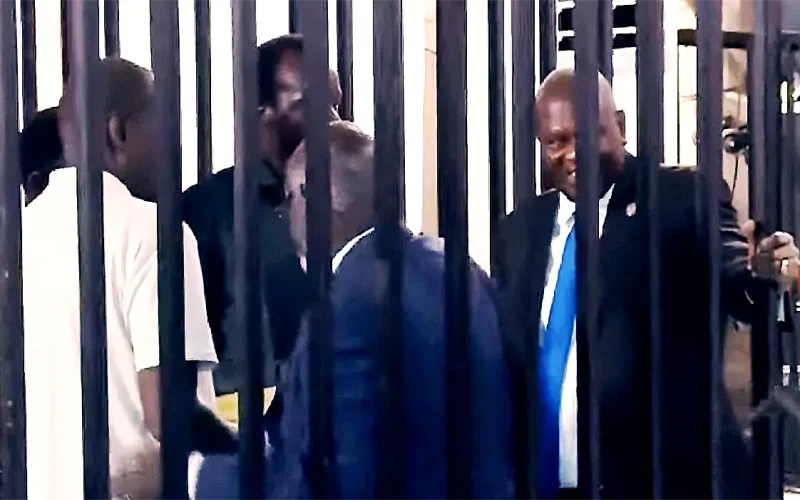
THE man who once commanded armies and shaped the destiny of a nation sat trapped behind iron bars Monday, a stark symbol of how swiftly political fortunes can crumble in Africa’s youngest country.
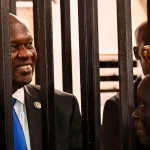
Former South Sudan Vice President Riek Machar, his imposing frame hunched within the confines of a courtroom cage, faced his accusers for the first time since his arrest in March. The dramatic scene in Juba’s central courthouse—broadcast live across the nation—captured one of the most precipitous falls from grace in South Sudanese politics, transforming a man who once wielded immense power into a defendant fighting for his freedom.
The 71-year-old Machar, whose trademark white beard has grown greyer during months of house arrest, appeared alongside co-accused suspects as prosecutors outlined a devastating array of charges: murder, conspiracy, terrorism, destruction of public property and military assets, and crimes against humanity. The allegations stem from his purported orchestration of a deadly assault on a government garrison earlier this year—an attack that reignited the smouldering embers of South Sudan’s brutal civil war.
For those watching the proceedings unfold on state television, the imagery was inescapable. Here was Riek Machar—the rebel commander who fought for South Sudan’s independence, the vice president who helped birth the world’s newest nation, the opposition leader whose insurgency plunged the country into chaos—reduced to a caged defendant in his own homeland.
“This court has no jurisdiction over me,” Machar declared through his legal team, his voice carrying the defiant tone that has defined five decades of political struggle. His attorneys argued that their client enjoys immunity under the 2018 peace agreement that formally ended South Sudan’s devastating civil war—a conflict that claimed at least 400,000 lives and displaced millions more.
The defence painted the trial as a political vendetta, the latest chapter in a personal rivalry that has torn South Sudan apart along ethnic lines. The animosity between Machar, a member of the Nuer ethnic group, and President Salva Kiir, who belongs to the dominant Dinka community, runs deeper than politics—it’s rooted in historical grievances, competition for resources, and fundamentally different visions for South Sudan’s future.
Their partnership began promisingly in 2005, when both men stood united in the struggle against Khartoum’s rule. Machar served as Kiir’s deputy in the movement that would eventually deliver independence to South Sudan in 2011. But their alliance fractured spectacularly in December 2013, when political disagreements exploded into violence that would consume the nation.
What followed was a merciless cycle of atrocities. Government forces and Machar’s rebel coalition engaged in ethnic massacres, recruited child soldiers, and weaponised sexual violence. Towns were razed, oil facilities destroyed, and entire communities forced to flee. The international community watched in horror as South Sudan—born with such hope—descended into one of the world’s most devastating humanitarian crises.
The 2018 peace deal was supposed to end this nightmare. Machar returned from exile, resuming his role as vice president in a unity government alongside his former enemy. But the arrangement proved fragile, undermined by mutual distrust, competing loyalties, and the difficulty of transforming armed factions into political parties.
Now, as Machar sits in detention, questions loom over South Sudan’s precarious stability. His supporters view the charges as politically motivated persecution designed to eliminate him as a threat to Kiir’s rule. Government officials insist they’re simply pursuing justice for alleged crimes that threatened the nation’s peace.
The trial proceedings, expected to continue for weeks, will test South Sudan’s fragile judicial institutions and democratic foundations. International observers are watching closely, concerned that the case could either strengthen the rule of law or further polarise an already divided society.
For ordinary South Sudanese, weary from years of conflict and economic hardship, Machar’s appearance in court represents both hope and fear—hope that accountability might finally arrive for those who have caused immense suffering, and fear that renewed political tensions could drag their young nation back toward the abyss.
As Monday’s session concluded, Machar was returned to custody, his political future now in the hands of judges rather than voters or rebels. The cage that confined him in court serves as a powerful metaphor for a nation still imprisoned by its past, struggling to break free from cycles of violence and build a truly peaceful future.
The man who once promised to liberate South Sudan now faces the prospect of spending his remaining years behind bars—a reminder that in politics, as in war, there are no permanent victories, only temporary advantages that can vanish as quickly as they appeared.