THEY lie in a heap beside the broken stones—dozens upon dozens of them. Sandals worn thin at the heels. Leather shoes scuffed from daily wear. A child’s small sneaker, its laces still tied. Each pair tells a story that will never be finished, marking the exact spot where joy turned to catastrophe at Arerti St Mary’s Church.
The morning of October 2nd had dawned with promise. The faithful had come from across Minjar Shenkora Woreda in Ethiopia’s Amhara Region, their hearts lifted by devotion, their feet carrying them toward the church’s freshly painted dome that gleamed like hope itself against the sky. The building was still rising, still reaching toward heaven, its bones of wood and faith supporting the dreams of a community.
They climbed the temporary scaffolding – wooden beams lashed together to hold not just people, but prayers, not just bodies, but believing souls. The structure groaned under their collective weight, under the pressure of their unified worship. And then, in a moment that shattered everything, it gave way.
“It just crushed the people beneath,” survivor Tadesse Tesfaye would later recall, his voice carrying the weight of those who could no longer speak. The scaffolding crumpled like paper, like a prayer left unanswered. Those at the edges fled, their survival a matter of mere feet. But those in the middle – trapped in the very heart of their devotion – perished beneath splintered wood and falling dreams.
Thirty-six souls. Thirty-six lives extinguished in an instant. More than two hundred others were injured, their bodies broken, some clinging to life in critical condition as the hours ticked by. Local police chief Ahmed Gebeyehu confirmed what everyone already knew in their hearts: the numbers could still climb higher.
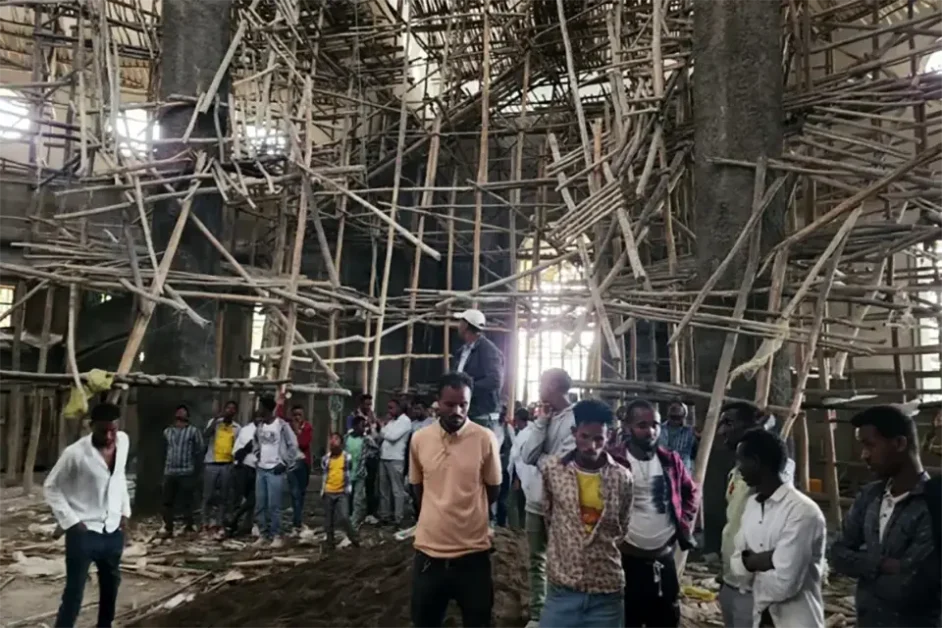
Now the scaffolding’s twisted skeleton remains frozen in place, a terrible monument beneath that beautiful dome. The masonry lies in pieces. The wooden poles that were meant to lift a church toward God instead became instruments of tragedy.
And the shoes – oh, the shoes. They wait in their silent pile, patient witnesses to catastrophe. Each pair was removed by someone who expected to slip them back on, to walk home, to return tomorrow. Instead, they form a memorial more powerful than any words: a testament to lives interrupted mid-step, to journeys ended before their time, to the unbearable fragility of the distance between devotion and disaster.
The painted dome still gleams above them all, beautiful and terrible, a prayer house christened in grief instead of glory.