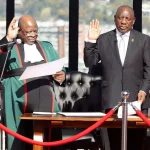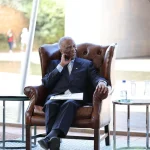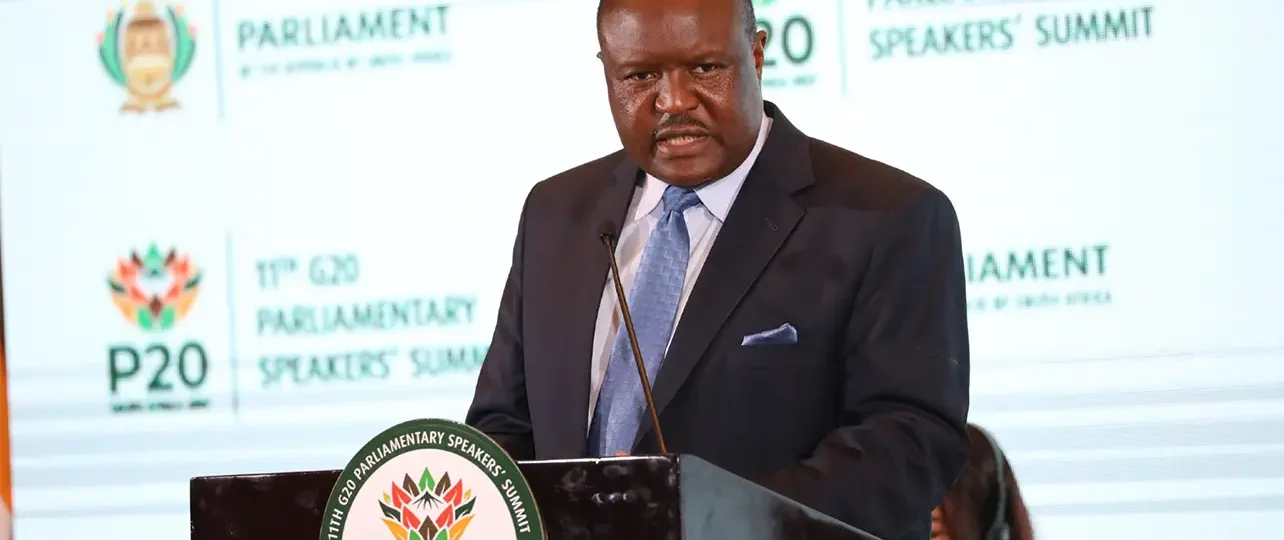

AFRICA’S top parliamentary leader issued a powerful call to action, demanding that the continent’s lawmakers stop being “passive bystanders” and take decisive control over issues affecting two-thirds of the world’s population.
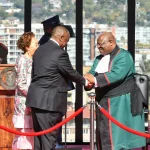
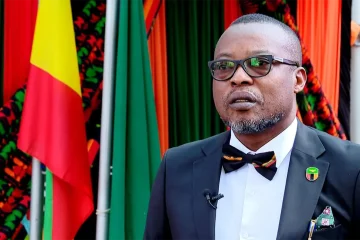
Pan-African Parliament President Chief Fortune Charumbira delivered the rallying cry at the opening of the 11th G20 Parliamentary Speakers’ Summit in Cape Town, where he challenged fellow parliamentary leaders to transform their institutions from mere debating chambers into engines of change.
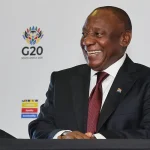
“We are here because together, we represent the collective voice of our people,” Charumbira told an audience that included South African President Cyril Ramaphosa and parliamentary speakers from the world’s largest economies. “Our citizens expect us to not only represent their voices, but also to safeguard their rights and interests.”
Climate Justice: Africa Pays the Highest Price
Charumbira reserved his sharpest words for the climate crisis, noting the cruel irony facing the continent. “Africa contributes only a small fraction of global greenhouse gases, yet it is among those bearing the greatest burdens: drought, flooding, desertification, biodiversity loss, and food insecurity,” he said.
The PAP president called on parliaments to craft bold legislation mandating emissions reductions and renewable energy deployment, while ensuring the transition to net-zero “leaves no one behind.”
“The climate crisis is neither an abstraction nor a distant threat,” he warned. “It is unfolding in our present reality.”
Global Governance: “Africa’s Voice Matters”
In a direct challenge to the current world order, Charumbira demanded comprehensive reform of international institutions designed “in a different era, shaped by power balances and colonial divisions that do not fully reflect the reality of our times.”
He called for permanent African seats with full voting rights on the UN Security Council, reform of the veto power, and restructuring of global financial institutions to give developing countries greater ownership.
“Africa bears a disproportionate share of many global problems—yet, historically, has had less representation in the decision-making centres of global governance,” Charumbira said. “For Africa and the Global South, reform is not just desirable: it is indispensable.”
Silencing the Guns: Parliament’s Peace Role
Addressing Africa’s persistent conflicts—from Sudan to the Democratic Republic of Congo to the Sahel—Charumbira emphasised that parliaments cannot be mere observers in peacebuilding.
“Without peace, none of our aspirations in health, education, economic transformation, or justice can fully flourish,” he said, referencing the African Union’s goal of “Silencing the Guns by 2030.”
He urged parliamentarians to use their positions as mediators and confidence-builders, noting they are “closer to the people than many in the executive.”
Food, Energy, and AI: Urgent Action Needed
The PAP president highlighted the dual crises of food and energy insecurity plaguing Africa, where power outages and high costs undermine agricultural productivity and deepen poverty. He pointed to the PAP’s Model Law on Food and Nutrition Security as a tool for member states.
On artificial intelligence, Charumbira warned that Africa risks becoming “consumers of technologies rather than creators of solutions” without urgent parliamentary action on data protection, AI ethics, and digital trade policies.
“AI is not only about machines, it is about people, opportunity, and survival,” he said.
A Generation-Defining Moment
Closing his address, Charumbira challenged his fellow speakers to seize a historic opportunity. “The world is changing fast, and injustice, inequality, conflict, climate breakdown, failing institutions—you and I know these impose tremendous cost on our people,” he said.
“Let us commit to being the generation of leaders who changed the narrative and reshaped the future for our people.”
The P20 Summit brings together parliamentary leaders from G20 nations and invited countries to provide legislative backing for commitments made by heads of state, who will meet for the 20th G20 Summit in November.