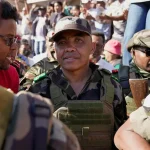
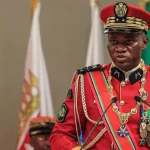
THE transformation was swift and theatrical: Colonel Michael Randrianirina, once clad in the olive-drab fatigues of Madagascar’s elite CAPSAT unit, his chest adorned with military medals earned through decades of service, strode into the High Constitutional Court on Friday, draped in civilian authority. The presidential sash replaced his ribbons. The suit supplanted his combat uniform. And with raised swords glinting and trumpets blaring their brassy proclamation, Africa’s latest coup leader became Madagascar’s newest head of state.
The colonial-era courthouse—a red-brick monument to French imperial architecture, with its elegant segmental arches and stone balustrades—provided an almost ironic backdrop for a ceremony that marked yet another rupture in Madagascar’s turbulent democratic journey. As Randrianirina placed his hand over his heart and pledged to “fully, completely, and justly fulfil” his presidential duties, the question hanging over the island nation wasn’t whether he meant it—but whether the restive Generation Z revolutionaries who lit the fuse of change would give him the chance.
The General’s Gambit: Two Years to Democracy
Randrianirina’s promise is ambitious, perhaps dangerously so: a military-led committee will govern for up to two years, working alongside a transitional civilian government before organising fresh elections. It’s a timeline that echoes across Africa’s graveyard of failed democratic transitions, where military “caretakers” have an unfortunate habit of extending their welcome.
The 30-million-strong island nation—where three-quarters of the population survives in grinding poverty and the average monthly income barely scrapes $600—has heard such promises before. Since independence in 1960, Madagascar has endured a catastrophic 45% plunge in GDP per capita, making it one of the rare nations to have grown poorer over six decades, according to World Bank data.
The Youth Revolution: Victors or Victims?
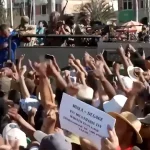
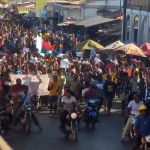
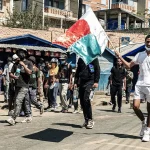
The irony is bitter and inescapable. Madagascar’s population skews breathtakingly young—the average age hovers below 20 years—and it was these digital-native Gen Z protesters, mobilised by chronic power blackouts and water shortages that made daily life unbearable, who stormed the streets in their thousands. Their target: ex-President Andry Rajoelina, himself a coup veteran who seized power in 2009 and had clung to it ever since.
As the youth-led uprising swelled, Rajoelina fled abroad, lawmakers impeached him in absentia, and security forces defected en masse. The High Constitutional Court, with unseemly haste, rubber-stamped the military takeover within hours. Now Rajoelina, isolated in exile, issues defiant statements refusing to step down—a general without an army, a president without a country.
But here’s the combustible question: Will the same Gen Z activists who toppled one strongman tolerate another, even one promising restoration rather than perpetuation?
Already, murmurs of discontent ripple through social media channels and street-corner gatherings. While many cheered Rajoelina’s downfall, scepticism is mounting about the army’s lightning-fast seizure of the power vacuum. The youth demanded change—not a changing of the guard.
The General’s Credentials: Kingmaker Turned King
Randrianirina’s biography reads like a manual for military intervention. As commander of CAPSAT, Madagascar’s elite army unit, he was instrumental in the very 2009 coup that installed Rajoelina. For years, he served the regime faithfully. But last week, in a dramatic about-face that sealed Rajoelina’s fate, Randrianirina ordered soldiers not to fire on protesters—a calculated break that positioned him as both saviour and successor.
The African Union and UN Secretary-General António Guterres have predictably condemned the takeover, adding Madagascar to the continent’s growing roster of military governments. But international opprobrium has rarely reversed a successful coup, and Randrianirina, surrounded by loyal officers and legitimised by the court, appears firmly in control—for now.
The Ticking Clock: How Long Before the Next Revolution?
History suggests Madagascar’s Gen Z won’t wait patiently for two years if promises remain unfulfilled. This is a generation that organised uprisings while their phones charged during rare electricity windows, that filled water containers between protests, that watched staple rice prices spiral beyond their families’ reach. They toppled a president. They can certainly challenge a general.
The pressure points are predictable: If power cuts continue, if water remains scarce, if rice prices keep climbing while the promised “transitional” government moves with bureaucratic languor, the streets will fill again. And next time, the target will be wearing a presidential sash instead of a military uniform—a distinction that may prove meaningless to a generation that has learned its power.
Randrianirina has promised to “dedicate all my strength to defending and strengthening national unity and human rights.” The ceremonial swords have been sheathed, the trumpets have fallen silent, and the new president has moved into the palace. But in Madagascar’s impoverished neighbourhoods, where 20-year-olds constitute the electoral majority and revolutionary memory is measured in weeks rather than decades, the countdown has already begun.
The question isn’t if Gen Z will rise again—but when.