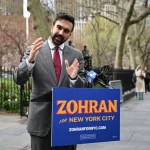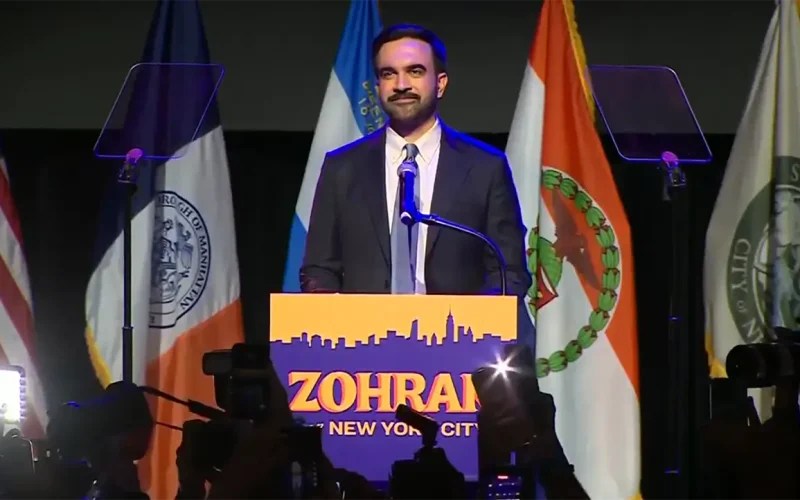
IN a political upset that has sent shockwaves through the American establishment, Zohran Kwame Mamdani, a 33-year-old Uganda-born democratic socialist, has decisively won the race for Mayor of New York City, positioning himself to lead the United States’ largest metropolis and delivering what analysts are calling a referendum on progressive politics in the post-Trump era.
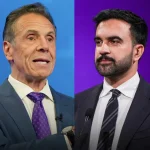
Mamdani’s crushing 43.5 percent to 36.4 percent victory over former Governor Andrew Cuomo – a political heavyweight with decades of experience and formidable financial resources – represents more than a changing of the guard. It signals a fundamental rupture in American urban politics, driven by grassroots anger over inequality that will resonate across cities worldwide, from Johannesburg to Lagos to Nairobi.
For African observers, Mamdani’s rise offers particular resonance. Born in Kampala and raised in South Africa before immigrating to the United States, his trajectory embodies the transnational nature of 21st-century politics and the growing influence of the African diaspora in Western democracies. His victory speech left no doubt about his identity: “New York will remain a city of immigrants – a city built by immigrants, powered by immigrants, and as of tonight, led by an immigrant.”
Mamdani’s campaign tapped into a nerve that transcends American borders: the crisis of urban affordability that is hollowing out cities globally. With one in four New York residents living in poverty and 500,000 children going to bed hungry nightly in one of the world’s wealthiest cities, his message struck at contradictions familiar to African urban dwellers, where gleaming skyscrapers often stand metres from sprawling informal settlements.
His platform reads like a progressive manifesto: free public transportation, universal childcare, rent freezes on subsidised housing, and city-operated grocery stores. Critics, including The New York Times editorial board, have dismissed these proposals as “uniquely ill-suited to the city’s challenges,” questioning their financial viability and warning that rent controls could paradoxically reduce housing availability.
Yet such criticism misses the political moment. Mamdani’s victory demonstrates that voters, particularly younger ones, are willing to gamble on ambitious solutions rather than accept managerial incrementalism that has manifestly failed to address deepening inequality. This phenomenon is not uniquely American – across Africa, established political classes face similar challenges from youth-driven movements demanding radical change.
Taking on Trump
Perhaps most striking was Mamdani’s confrontational victory speech, directly challenging President Donald Trump in language rarely heard from Democratic politicians. “Donald Trump, since I know you’re watching, I have four words for you: Turn the volume up,” Mamdani declared, promising to hold “bad landlords” like Trump accountable, end corruption that allows “billionaires like Trump to evade taxation,” and protect immigrant communities.
“To get to any of us, you will have to get through all of us,” Mamdani warned, drawing a line in the sand that positions New York as a bulwark against federal overreach.
This combative stance reflects a broader recalibration within progressive politics. After Trump’s 2024 presidential victory – which saw gains even in liberal New York neighbourhoods – Democrats are divided between those advocating moderation and those, like Mamdani, arguing that bold progressive policies offer the only path forward.
Mamdani’s trajectory deliberately mirrors that of Alexandria Ocasio-Cortez, the democratic socialist who shocked the political establishment in 2018 by defeating a senior congressman. With endorsements from Ocasio-Cortez and Bernie Sanders, Mamdani mobilised a grassroots volunteer army that overwhelmed Cuomo’s traditional political machine.
His strategic use of New York’s ranked-choice voting system – securing cross-endorsements with other progressive candidates – demonstrated sophisticated political acumen that belies his outsider status. This tactical innovation offers lessons for opposition movements globally, including in African nations experimenting with electoral reforms.
What It Means for Africa
Mamdani’s victory carries implications beyond American shores. As African cities grapple with explosive growth, inadequate infrastructure, and deepening inequality, his platform’s emphasis on public goods – free transport, universal childcare, public food systems – challenges the neoliberal orthodoxy that has dominated urban policy for decades.
His success also symbolises the political maturation of the African diaspora. From London to Toronto to New York, politicians of African origin are increasingly winning major offices, not by downplaying their identities but by embracing them as sources of alternative perspectives on governance.
The Ugandan government has remained conspicuously silent on Mamdani’s victory, perhaps uncertain how to respond to a compatriot whose democratic socialist politics sit uncomfortably with Kampala’s increasingly authoritarian trajectory. South Africa, where Mamdani spent formative years, has seen its own rise of economic populism, though questions remain about implementation.
Rhetoric and governance are different beasts. New York’s next mayor will confront a $7 billion budget shortfall, rising crime concerns, a homelessness crisis, and powerful interests threatened by progressive reforms. Whether Mamdani can translate campaign promises into policy achievements will determine not just his political future but the viability of progressive governance as a model.
African leaders watching this experiment should note both the opportunities and constraints. Mamdani’s victory proves that bold platforms can energise voters weary of conventional politics. But New York’s fiscal realities will inevitably force compromises that may disappoint supporters – a dynamic familiar to every African government that has promised transformation only to confront IMF conditions and capital flight.
As Mamdani prepares to govern one of the world’s most complex cities, his success poses uncomfortable questions for political establishments everywhere: What happens when voters decide incremental change is inadequate? Can progressive policies deliver in practice what they promise in theory? And can a new generation of leaders, unburdened by old assumptions, imagine different futures?
For Africa’s youth, who comprise 60 percent of the continent’s population and increasingly demand accountability from gerontocratic leaderships, Mamdani’s rise offers both inspiration and caution. Change is possible. But governing is harder than campaigning.
The Big Apple’s new leader faces a historic test. The world – including Africa – will be watching.