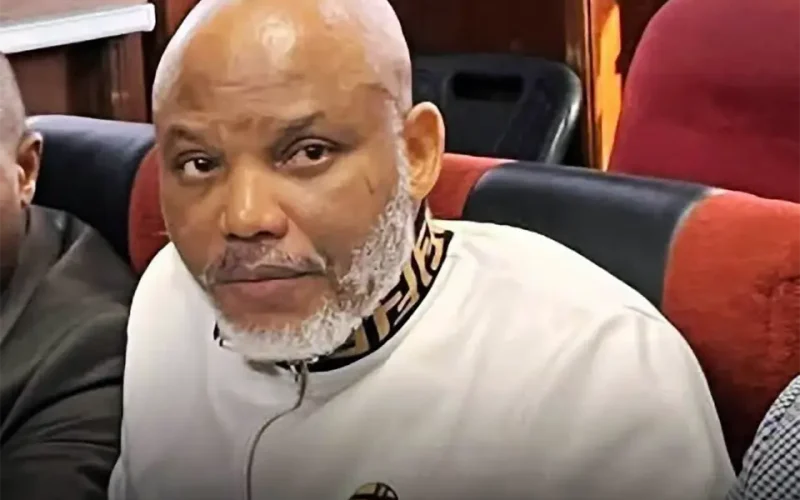
A Nigerian judge convicted separatist leader Nnamdi Kanu on all seven terrorism charges Thursday and sentenced him to life imprisonment, ending a tumultuous decade-long trial that has become a flashpoint for ethnic tensions threatening to fracture Africa’s most populous nation.
Judge James Omotosho declared that prosecutors had proven Kanu’s broadcasts and commands to his now-banned Indigenous People of Biafra movement incited deadly violence against security forces and civilians in his campaign to carve out an independent Biafra state from Nigeria’s Igbo-dominated southeast.
“His intention was quite clear as he believed in violence,” Omotosho said in his judgment. “These threats of violence were nothing but terrorist acts, which were duly carried out by his followers.”
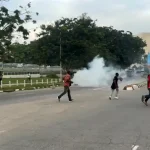
The dramatic ruling came amid fortress-like security around the Abuja Federal High Court, with riot police, armoured vehicles, and soldiers deployed to prevent protests. Just weeks earlier, authorities had fired teargas and sealed off roads across the capital to crush demonstrations demanding Kanu’s release—a preview of the explosive reaction analysts now fear could engulf the volatile southeast.
Omotosho rejected prosecutors’ demands for the death penalty, saying he must “temper justice with mercy” despite what he described as Kanu’s arrogance and complete lack of remorse.
“The death sentence globally is being frowned upon by the international community, so consequently and in the interest of justice, I hereby sentence the convict to life imprisonment,” the judge declared.
Kanu also received a combined 25 years for two charges without the option of a fine, all to run concurrently with the life sentence. He has 90 days to appeal.
The 58-year-old British-Nigerian citizen—born the same year his homeland launched its doomed bid for independence as Biafra—exploded in anger during proceedings and was physically removed from the courtroom before the verdict was read. He had repeatedly argued that his unlawful 2021 arrest in Kenya and extraordinary rendition to Nigeria destroyed any possibility of a fair trial.
The conviction caps months of courtroom chaos that cycled through four different judges. After the government closed its case with just five witnesses, Kanu refused to mount a defence, claiming Nigeria’s terrorism law had been repealed and the charges were legally invalid. He dramatically fired his legal team in open court in September.
Omotosho ruled in November that Kanu had “squandered” multiple opportunities to present his case, leaving the court no option but to proceed to judgment.
Kanu first faced terrorism charges in 2015 after using his Radio Biafra platform to broadcast incendiary calls for southeastern secession. He secured bail in 2017 but fled Nigeria, only to be controversially detained in Kenya four years later and returned to face justice.
His prosecution has become far more than a criminal trial—it symbolises the unresolved trauma of the 1967-1970 Biafran War that killed over a million people and left deep scars across Nigeria’s ethnic landscape. IPOB’s resurgence under Kanu’s leadership has channelled long-simmering Igbo grievances about political marginalisation, economic exclusion, and the concentration of power and resources in other regions.
The guilty verdict threatens to pour gasoline on already burning tensions. Recent months have witnessed escalating violence between suspected IPOB militants and security forces, with deadly clashes reported across multiple southeastern states. The government blames IPOB for orchestrating attacks; the group denies involvement and accuses authorities of extrajudicial killings to crush legitimate political activism.
President Bola Tinubu’s administration has deployed overwhelming military force to the region while IPOB supporters have staged increasingly defiant protests—many met with teargas, water cannons, and mass arrests.
Human rights organisations and political analysts warn that Thursday’s life sentence could transform Kanu into a martyr, energising rather than extinguishing separatist fervour and potentially triggering a dangerous spiral of violence.
“The conviction could stoke separatist sentiment and complicate efforts to restore calm,” said security analysts, noting that the fundamental issues driving Biafran nationalism—demands for self-determination, resource control, and political representation—remain unaddressed.
As news of the verdict spread Thursday, the southeast braced for potential unrest. The government maintains its hardline stance will preserve national unity; Kanu’s supporters vow the struggle for Biafran independence will only intensify.
The ghost of Africa’s bloodiest civil war, it seems, continues to haunt Nigeria’s present—and now has a living symbol behind bars for life.