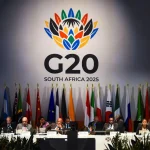
THE rain fell on Nasrec on Saturday afternoon, as it often does during Johannesburg’s summer storms — sudden, powerful, unapologetic. Inside the Nasrec Expo Centre, another kind of storm was breaking: the world’s major economies, gathered on African soil for the first time in G20 history, were doing something extraordinary. They were moving forward. Without America.
By late afternoon, as lightning crackled across the Gauteng sky, the G20 leaders had adopted their declaration. The document – addressing climate change, debt sustainability, energy transitions, and the development priorities of the Global South – represented not just policy consensus but a seismic shift in global power dynamics. It was a declaration written, negotiated, and agreed upon without input from the United States, whose president had boycotted the summit based on false claims of white farmer persecution in South Africa.
The message was clear, powerful, and dual-edged: the world’s major economies remain united in confronting shared challenges. And they will do so whether Washington joins them or not.
Solidarity Over Subjugation
President Cyril Ramaphosa, standing at the podium where Nelson Mandela’s vision of South Africa taking “its rightful and responsible place in the community of nations” had finally materialised in its fullest form, spoke with a steel that had been absent during his subdued visit to the White House three months prior. There, he had endured Donald Trump’s false accusations about genocide, his corrections politely ignored. Here, at the Cradle of Humankind, he was not asking for permission.
“There’s been overwhelming consensus and agreement,” Ramaphosa declared, his voice carrying the weight of a continent that had waited too long for its moment. “We should not allow anything to diminish the value, the stature and the impact of the first African G20 presidency.”
The declaration “can’t be renegotiated,” his spokesperson Vincent Magwenya later told reporters – a statement that would have been unthinkable in previous G20 gatherings, where American preferences shaped every comma. But this was South Africa’s presidency, guided by the theme of “Solidarity, Equality and Sustainability,” and the 19 other member nations had decided that solidarity meant moving forward together, not waiting indefinitely for one member to return to the table.
Foreign Minister Ronald Lamola put it even more bluntly: “This G20 is not about the U.S. It’s about all the 21 members of the G20. We are all equal members.”
Equal members. In that phrase lies a revolution.
The Language of Power
What made Washington’s absence even more pointed was what appeared in the declaration. Despite U.S. officials indicating they would oppose any reference to climate change – President Trump having long rejected the scientific consensus on global warming – the document stressed “the seriousness of climate change and the need to better adapt to it.” It praised ambitious renewable energy targets. It acknowledged the crushing debt burdens of poor nations.
Every word was a deliberate choice. Every clause was language “long disliked by the Trump administration,” as sources familiar with the drafting confirmed. The declaration represented not capitulation to American exceptionalism but its calculated rejection. The envoys from Europe, Asia, Latin America, and Africa had spent the period leading to the heads of state’s summit crafting a document that reflected their shared reality: that climate disasters don’t wait for political consensus in Washington, that debt crises in developing nations threaten global stability, and that energy transitions are necessary and urgent.
The G20 had moved from being a forum where America led and others followed to one where America’s absence simply meant the work continued without American obstruction.
Thunder from the South
The symbolism of location cannot be overstated. This was not just the first G20 summit in Africa; it was held at the Cradle of Humankind, where fossil evidence suggests all humanity originated. Ramaphosa invoked this deliberately: “We gather here at the Cradle of Humankind to affirm our common humanity.”
It was a pointed reminder that American exceptionalism – the idea that one nation stands apart and above – runs counter to the very origins of our species. We are all, quite literally, African.
South Africa’s G20 priorities reflected this continental consciousness: disaster resilience for climate-vulnerable nations, debt sustainability for African countries, mobilising finance for just energy transitions in developing economies, and ensuring that African nations benefit from their own critical minerals through local beneficiation rather than raw extraction.
These were not abstract policy preferences. They were survival strategies for nations that have borne the brunt of climate change they did little to cause, that are drowning in debt often accumulated through predatory lending, that possess the minerals essential for global energy transitions but see none of the wealth.
The G20 Africa Expert Panel, led by South Africa’s former Finance Minister Trevor Manuel, had argued that “African efforts to accelerate productive investment require new global partnerships and strong multilateral cooperation.” The declaration’s adoption, despite the American boycott, suggested those partnerships were forming, just not with the traditional hegemon.
The Middle Finger Heard Round the World
Make no mistake: the declaration’s adoption was the diplomatic equivalent of a raised middle finger to Washington. Trump had not merely skipped the summit; he had boycotted it based on racist conspiracy theories, rejected its entire agenda, and – according to reports – effectively “ordered” that no declaration be adopted without U.S. participation.
The response from Johannesburg was elegant in its defiance: the declaration was adopted on day one of the summit, with “overwhelming consensus,” making it impossible to renegotiate even if America eventually returns to the table. The White House, notably, had no immediate comment – perhaps because there was no diplomatic playbook for being this comprehensively sidelined.
EU Commissioner Ursula von der Leyen, in her remarks, warned about “the weaponisation of dependencies” that “only creates losers.” She did not name the United States directly. She didn’t have to. Everyone understood that America’s attempt to weaponise its G20 membership – to hold the forum hostage to its president’s whims – had backfired spectacularly.
Rain as Prophecy
In African tradition, as Ramaphosa well knows, rain carries meaning. It is blessing and prophecy, cleansing and renewal. The storms that swept across Johannesburg during the summit seemed almost too perfectly timed – as if the ancestors were weighing in on this historic gathering.
If there is meaning in that lightning, it might be this: power, like rain, falls where it will. It cannot be commanded by those who think themselves entitled to it. It comes to those who prepare the ground, who build the systems to harvest it, who work together rather than demanding obeisance.
For decades, the United States has positioned itself as the indispensable nation, the leader of the “free world,” the one power without which global cooperation cannot function. The Johannesburg declaration suggests a different reality emerging: that American leadership was never indispensable, merely convenient, and that its absence creates not paralysis but opportunity.
The G20, after all, represents two-thirds of the world’s population and 85% of global GDP. The United States, for all its power, is one member among twenty. And if that one member chooses to ostracise itself based on false claims and ideological rigidity, the other nineteen have discovered they can still make rain.
The Road Ahead
The geopolitical implications will unfold over months and years. Bilateral relations between Washington and many G20 members – particularly South Africa, but also European nations that participated in drafting the declaration – will be strained. Trump’s administration will likely retaliate through trade measures, aid cuts, or diplomatic isolation attempts.
But the damage to American soft power may be irreversible. The G20 members have now experienced what it feels like to operate without American veto power, without having to water down every climate commitment or development priority to satisfy Washington’s objections. They may find they prefer it.
South Africa’s presidency has demonstrated that African nations can successfully host and manage major global forums, that Global South priorities can drive international agendas, and that solidarity among developing nations – when backed by major economies like the EU, China, and others – can produce tangible outcomes.
The rain that fell on Nasrec was a summer storm, fierce but temporary. The storm breaking over traditional global power structures may prove more lasting. The declaration adopted in Johannesburg is not just a policy document; it is evidence that the world is reorganising itself, that new partnerships are forming, and that the old assumption – that America leads and others follow – has been washed away.
In African tradition, the first rain after a long drought is cause for celebration, for dancing, for hope. At the Cradle of Humankind, on the first day of Africa’s first G20 summit, the leaders of the world’s major economies danced to a new rhythm. And they did not wait for Washington’s permission to begin.
The thunder is still echoing. The rain is still falling. And the ground beneath the old world order is shifting, irreversibly, toward something new.