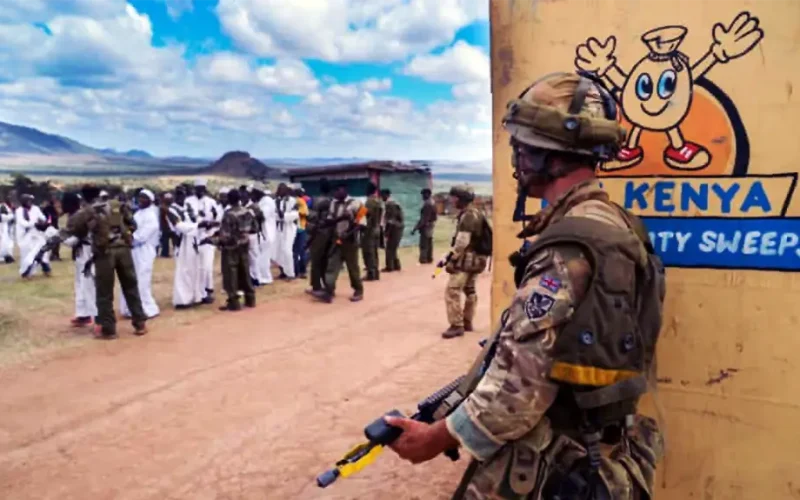
FOR over half a century, British soldiers have arrived in Kenya’s central highlands with a stated mission of partnership and preparation – training troops, honing military skills, building capacity for peacekeeping. But a devastating parliamentary investigation has unveiled a darker legacy: one of systematic violence, sexual predation, and abandoned justice that has left Kenyan communities traumatised and betrayed.
The recently released 94-page report from Kenya’s parliamentary committee doesn’t merely document misconduct. It chronicles what victims describe as an ongoing assault on human dignity – a catalogue of horror perpetrated by those who arrived under the banner of cooperation but behaved, in the words of affected communities, like an occupying force.
A Pattern of Predation
The testimony is harrowing. Women were attacked while collecting firewood. Girls were assaulted while fetching water for their families. Herders targeted while tending livestock in remote grazing lands. The parliamentary inquiry documented what it called “compelling evidence” of widespread sexual violence, particularly against women from the Samburu and Maasai communities – some of Kenya’s most vulnerable populations.
Among the most chilling accounts: a 1997 incident in Archer’s Post where thirty women were gang-raped at knifepoint, some violated inside their own homes. These weren’t isolated acts of individual criminality. The report describes a pattern – predatory behaviour that has continued across decades, leaving survivors without recourse and perpetrators without consequence.
The sexual violence extended beyond brutal assaults. Witnesses described British soldiers engaging in public indecency, exposing themselves in town centres and social venues, often while intoxicated. The committee heard accounts of disorderly, sexually aggressive conduct that terrorised local communities, who had no power to hold these foreign troops accountable.
The Children Left Behind
Perhaps nothing illustrates the human cost more starkly than the dozens of children fathered by British soldiers who simply returned home, leaving single mothers to face stigma, financial hardship, and the lifelong challenge of raising “fatherless” children alone. These aren’t abstract statistics; they’re young lives marked from birth by abandonment, growing up in communities where their very existence serves as a reminder of exploitation.
Justice Denied
When Agnes Wanjiru’s body was discovered in a septic tank in 2012, nearly three months after she spent an evening with British soldiers, it should have been a turning point. Instead, it became emblematic of a broken justice system. The pursuit of justice, the parliamentary panel found, has been “slow and fraught with frustration,” marked by what victims allege is deliberate obstruction by British military personnel.
A former British soldier was only arrested last month – twelve years after Wanjiru’s death. He denies the charges and intends to fight extradition.
The case of herder Tilam Leresh, allegedly killed by a British sergeant in 2012, tells a similar story. Despite UK expressions of regret, no arrest has been made in either country. British prosecutors cite insufficient evidence; Kenyan families cite insufficient will.
The parliamentary report found that survivors of sexual violence consistently reported cases being dropped or mishandled by local authorities. Many victims were denied access to justice entirely. The pattern suggests not mere incompetence but systemic failure—or worse, systematic protection of perpetrators.
Communities near the training bases in Laikipia and Samburu counties told parliamentarians they no longer see the British Army Training Unit in Kenya (Batuk) as a development partner. Instead, they described it as “an occupying presence,” drawing explicit parallels to colonial-era injustices. The language is significant; it speaks to a profound betrayal of trust, a feeling that the power dynamics of the empire never really ended, merely changed uniform.
The irony is savage: soldiers sent to train others in peacekeeping and professional military conduct stand accused of behaviour that violates the most basic standards of human rights and military discipline.
Perhaps most damning is the refusal of British military authorities to meaningfully cooperate with Kenya’s parliamentary investigation. While the UK High Commission expressed regret that its submission wasn’t reflected in the report’s conclusions, affected communities see something else: a continued pattern of evasion, a jurisdictional shell game where no one takes responsibility.
The report also documented environmental destruction and labour violations, but these fade against the human toll—the women still living with trauma, the children growing up fatherless, the families still seeking justice for murdered loved ones.
A Reckoning Delayed
Britain’s Batuk operation trains over 1,000 Kenyan soldiers annually, while thousands of UK troops rotate through for exercises. It’s a substantial military relationship built on mutual benefit. But what benefit comes to the woman assaulted while collecting firewood? What partnership exists for the child who will never know their father? What training in peacekeeping is offered to communities that have known only violence and abandonment?
The parliamentary committee’s report isn’t merely a historical accounting. It’s a demand for reckoning, one that has been decades in the making. The question now is whether Britain will finally acknowledge the full scope of harm done in its military’s name, or whether the pattern of evasion will continue, leaving another generation of Kenyans waiting for justice that never comes.
For communities in Laikipia and Samburu, the soldiers who came to train peacekeepers became something else entirely: predators in uniform, protected by jurisdictional complexity and official indifference. That’s not a partnership. That’s an ongoing violation – one that demands more than regret. It demands accountability, compensation, and an end to the impunity that has defined this dark chapter for far too long.