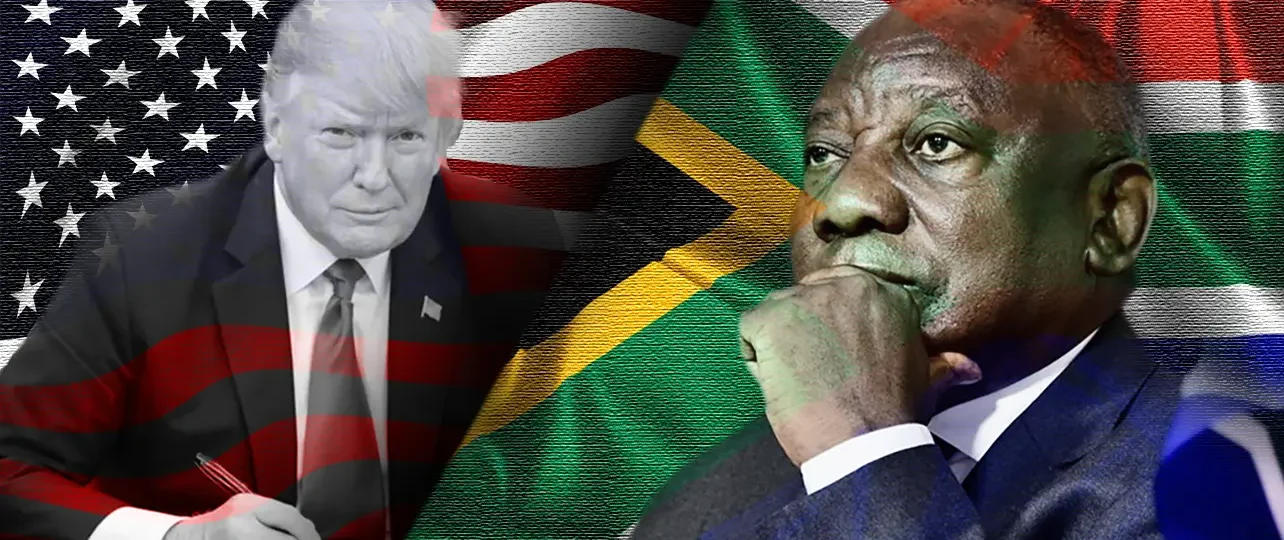

RELATIONS between the United States and South Africa have deteriorated sharply following the brief detention of US officials and the arrest of seven Kenyan nationals allegedly processing refugee applications for Afrikaners seeking relocation to America, marking the latest flashpoint in what analysts describe as the most serious bilateral crisis since the end of apartheid.
The incident has exposed the Trump administration’s controversial effort to facilitate mass migration of white South Africans based on claims of racial persecution – assertions Pretoria vehemently rejects as both false and inflammatory.
Two US Citizenship and Immigration Services refugee officers were briefly detained during a South African operation that resulted in the arrest of seven Kenyan nationals. While the Americans were quickly released, the Kenyans face deportation for working without proper permits.
The conflicting narratives surrounding the event highlight the diplomatic chasm. Washington condemns what it characterises as the detention of officials “performing their duties to provide humanitarian support to Afrikaners.” Pretoria insists no US officials were arrested and frames the operation purely as sovereign immigration enforcement.
“The government will not negotiate its sovereignty and the implementation of the rule of law,” South Africa’s Ministry of International Relations stated, emphasising that the deportations were “conducted in strict accordance with South African immigration law.”
At the heart of the crisis lies the Trump administration’s determination to resettle thousands of white South Africans in the United States. The programme rests on the president’s repeated – and disputed – claims that Afrikaners face systematic racial persecution.
This narrative has become a recurring theme in Trump’s second term, used to justify punitive measures, including aid cuts and South Africa’s recent exclusion from G20 meetings. The claims have been consistently rejected by South African authorities and contested by independent observers who note that while legitimate concerns exist about crime affecting all communities, there is no evidence of state-sponsored persecution of white citizens.
The use of Kenyan contractors rather than South African nationals to process these applications appears designed to circumvent local opposition, but has instead triggered a sovereignty dispute that Pretoria clearly views as non-negotiable.
Further complicating the crisis are US allegations that passport information of its officials was publicly released – what the State Department termed “an unacceptable form of harassment.”
South Africa has categorically denied state involvement, calling the allegation “unsubstantiated” while pledging to investigate through official diplomatic channels. The foreign ministry emphasised that “bilateral engagements must be grounded in mutual respect and factual dialogue” – a pointed reference to what many South African officials privately describe as Washington’s increasingly unilateral and confrontational approach.
A Relationship in Freefall
This confrontation follows what sources describe as the “biggest breakdown” during and after the recent G20 summit held in South Africa, though details of that rupture remain unclear. What is evident is that the relationship between Africa’s most industrialised economy and its longtime Western partner has entered unprecedented territory.
Analysts note that Trump’s focus on South Africa’s white minority – comprising less than 8% of the population – ignores the country’s complex post-apartheid realities and undermines the government’s legitimacy. By framing emigration assistance as “humanitarian support,” Washington effectively accuses Pretoria of persecution, a charge that resonates with apartheid-era propaganda and deeply offends the governing ANC.
“We call on the Government of South Africa to take immediate action to bring this situation under control and hold those responsible accountable,” the State Department demanded Thursday, language more typically directed at adversarial states than democratic partners.
Both governments insist they remain committed to diplomatic channels, but the pathway to de-escalation appears narrow. South Africa has made clear it will not compromise on immigration sovereignty, while the Trump administration shows no sign of abandoning its Afrikaner resettlement initiative or moderating its rhetoric about racial persecution.
The crisis raises fundamental questions about whether the bilateral relationship can survive such divergent worldviews. For South Africa, this is about sovereign equality and post-colonial dignity. For the Trump administration, it appears to be about a domestic political narrative that plays well with certain constituencies but risks permanently alienating a strategic African partner.
As both sides dig in, the prospects for the kind of “mutual respect and factual dialogue” that Pretoria calls for seem increasingly distant – leaving a relationship once characterised by shared democratic values facing an uncertain and potentially irreparable future.