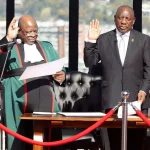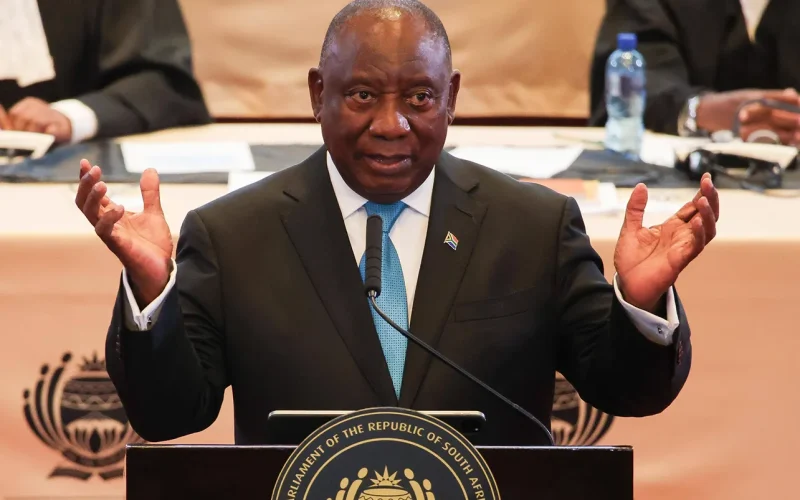
PRESIDENT Cyril Ramaphosa painted an optimistic picture of South Africa’s economic trajectory on Thursday while announcing a raft of interventions to tackle the country’s most pressing crises, from gang violence, crime, fraud and corruption to water shortages that have sparked protests across major cities.
In a State of the Nation Address marking 70 years since the historic 1956 Women’s March, Ramaphosa declared the nation has reached “a turning point,” leaving behind “an era of decline and turning towards an era of prosperity and growth.”
Army Deployed to Fight Gang Violence
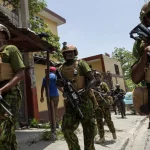
In perhaps the most dramatic announcement, the president confirmed he is deploying the South African National Defence Force to support police operations against gang violence in the Western Cape and illegal mining in Gauteng, replicating the successful model used against illegal miners.
“We have to act to rid our country of gang violence,” Ramaphosa said, directing the Ministers of Police and Defence to develop a tactical deployment plan within days.
The move comes as organised crime has become “the most immediate threat to our democracy, our society and our economic development,” with children caught in gang crossfire in the Western Cape and communities terrorised by illegal miners in Kagiso.
5,500 New Police Officers and Special Courts
The president announced the recruitment of 5,500 additional police officers this year, adding to 20,000 previously committed positions. To fast-track commercial and infrastructure-related cases that impact economic development, the government will establish specialised commercial courts with dedicated judges and court rolls.
Following revelations from the Madlanga Commission exposing rampant corruption in police services, the State Security Agency will re-vet senior management across SAPS and metro police departments, including lifestyle audits.
A new criminal justice reform initiative, modelled on the successful Operation Vulindlela economic reform programme, will be established in the Presidency to tackle organised crime, corruption and illegal firearms.
National Water Crisis Committee Formed
Responding to widespread protests over water shortages that have gripped Johannesburg and other cities, Ramaphosa announced the creation of a National Water Crisis Committee that he will personally chair – mirroring the approach that successfully ended load shedding.
“Poor planning and inadequate maintenance of water systems by many municipalities are the main cause of the problems we are going through now,” the president acknowledged, promising to hold water service providers accountable and withdraw licenses from failing municipalities.
The SA government has committed R156 billion over three years for water and sanitation infrastructure. In an immediate intervention, criminal charges will be laid against municipal managers personally for violating the National Water Act, with 56 municipalities already facing charges.
A new R54 billion incentive will ensure metros reinvest water revenues directly into infrastructure rather than diverting funds elsewhere.
Economic Growth Gains Momentum
Ramaphosa touted four consecutive quarters of GDP growth, two consecutive primary budget surpluses, improved credit ratings, declining interest rates, and inflation at 20-year lows as evidence that the economy is “growing again, and this growth is gathering pace.”
The government has committed more than R1 trillion in public investment over three years for infrastructure – “the largest allocation of its kind in our country’s history.”
Through the sixth South Africa Investment Conference on March 31, the president aims to raise R2 trillion in new investments over five years, building on R1.5 trillion raised at previous conferences.
Green Economy and Critical Minerals
With “some of the world’s largest reserves of critical minerals” valued at over R40 trillion, Ramaphosa positioned mining as “a sunrise industry.” This week, the Industrial Development Corporation announced over R300 million for the Frontier Rare Earths Project in the Northern Cape, potentially becoming one of the world’s largest producers of smartphone and battery minerals.
From March, a 150 percent tax deduction for investment in new energy vehicles will be introduced. International pledges to the Just Energy Transition Investment Plan now stand at approximately R250 billion.
Agriculture Crisis: Foot-and-Mouth Vaccination Campaign
Declaring foot-and-mouth disease a national disaster, the president announced plans to vaccinate South Africa’s entire national herd of 14 million cattle with 28 million vaccines over 12 months. The outbreak has resulted in export bans and trade restrictions, devastating the cattle industry.
Social Interventions and Education
The Social Relief of Distress Grant, introduced during COVID-19, will continue and be redesigned to support livelihoods, skills development and work opportunities. The president also announced a mission to end child stunting by 2030, with targeted interventions during the crucial first 1,000 days of life.
Last year’s matric class achieved an 88 percent pass rate – the highest in South African history – while the 2025 class recorded over two-thirds of bachelor’s passes from the most disadvantaged communities.
A massive rollout of Lenacapavir, a six-monthly HIV prevention injection, will support efforts to imagine “a country without AIDS.”
Immigration and Border Security
To address illegal immigration “while ensuring that the fundamental human rights of every person in this country are upheld,” the government will hire 10,000 additional labour inspectors this year and redevelop key border posts through public-private partnerships.
Employers hiring foreign nationals without required visas will “face the full might of the law,” while the president insisted no foreign nationals should be unlawfully barred from public facilities.
Digital Transformation
Home Affairs will launch a Digital ID this year, enabling secure access to digital services. Driver’s licenses, matric certificates and Master’s Office services will be digitised, with police statements available online and SASSA grant eligibility tested remotely through the MyMzansi platform.
Hundreds more bank branches will offer Smart ID and passport services to decrease queues.
Local Government Overhaul
A revised White Paper on Local Government will be finalised in the coming months, proposing fundamental changes including differentiated municipal powers based on capacity, structured cooperation with traditional leadership, and independent appointment processes for senior officials free from political interference.
“While these fundamental reforms are underway,” Presidential Working Groups will continue targeted support for eThekwini and Johannesburg, with the latter facing “collapsing infrastructure, financial mismanagement and electricity and water interruptions.”
Foreign Policy and Continental Vision
Ramaphosa reaffirmed South Africa’s commitment to sovereignty and multilateralism, warning: “We will not be bullied by any other country.”
Building on its G20 presidency, South Africa will advance Global South priorities, including debt relief, climate action and critical mineral beneficiation. The country requested UN permission to withdraw troops from the Democratic Republic of Congo “with a view to consolidating our defence force.”
The president declared South Africans “cannot consider ourselves free for as long as the people of Palestine, Cuba, Sudan, Western Sahara and elsewhere suffer occupation, oppression and war.”
National Dialogue Expands
The National Dialogue process launched last year will spread across every community, school and university under guidance from an Eminent Persons Group, culminating in a national convention to formulate an overarching national compact and the next phase of the National Development Plan beyond 2030.
“Now is not the time to rest,” Ramaphosa concluded. “Now is the time for all South Africans to be part of taking our country forward.”