
SOUTH Africa’s Department of Home Affairs was systematically transformed into a corrupt marketplace where visas, permits, and ultimately citizenship were sold to the highest bidder, a landmark investigation by the Special Investigating Unit (SIU) has revealed – exposing a scandal that has hollowed out the international credibility of the South African passport and left the country’s borders dangerously exposed.
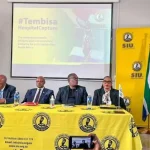
The findings, announced at a press conference on Monday by the SIU’s Acting Head, are nothing short of devastating. Authorised by President Cyril Ramaphosa under Proclamation 154 of 2024, the investigation has uncovered financial gains exceeding R181 million linked to fraudulent visa applications, a nefarious syndicate of adjudicators enriching themselves on government salaries of less than R25,000 a month, and a cast of high-profile figures, including fugitive prophet Shepherd Bushiri, controversial pastor Timothy Omotoso, Zimbabwean national Kudakwashe Mpofu, and Nigerian rapper Prince Daniel Obioma, better known as 3GAR. who exploited a system rotten to its core.
“South Africa was being sold one permit at a time,” the Acting Head of the SIU told assembled media. “The country’s borders were not protected by law. They were auctioned off through corruption.”
The Syndicate in the Shadows: Officials Living Like Millionaires on Civil Servant Salaries
At the heart of the scandal is what the SIU has described as a “nefarious syndicate” – a coordinated network of department officials whose official job was to lawfully process, adjudicate, and approve visa applications. Instead, they turned those duties into a personal revenue stream of extraordinary scale.
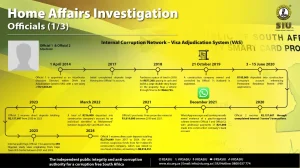
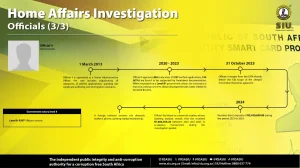
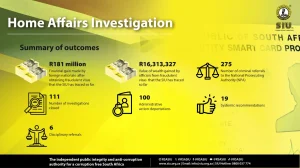
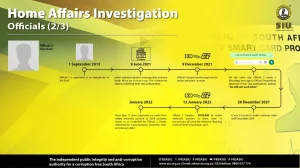
The SIU has confirmed that four officials, each earning less than R25,000 per month, received a combined total of R16,313,327 in direct deposits that cannot be explained by their legitimate income. The money trail leads to mansions, paved private roads, large-scale solar installations, cash-purchased properties, and high-value construction projects – all wildly inconsistent with government salaries.
The modus operandi was as brazen as it was organised. Applications were sent via WhatsApp for expedited approval, and money flowed almost immediately thereafter – but never directly into the officials’ own accounts. Spouses became silent partners in crime, with payments funnelled through accounts registered in their names to disguise the bribes.
The SIU’s forensic trail is damning in its specificity. In one documented case, a permit was approved on 20 December, and by 21 December, R3,000 had been deposited into a spouse’s account. Another transaction saw R6,000 transferred within days of two permits being approved. Transaction references used to mask payments included labels such as “Permit,” “Visa Process,” and – in a darkly cynical touch – “Building Material.”
Analysis of a construction company registered in the name of one official’s husband revealed deposits totalling R8.9 million between 2020 and 2023, with payments explicitly referencing “PRP” (Permanent Residence Permit). At least R185,000 was directly and unambiguously linked to PRP applications.
In perhaps the most striking individual case, one official accumulated enough wealth to build a mansion and a paved road to her home – all on a monthly salary of R25,000.
The Asylum Loophole: E-Wallets, Cash in Application Forms, and Dummy Phones
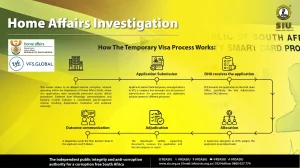
The investigation began when a whistleblower approached the SIU with allegations that foreign nationals were entering South Africa, fraudulently obtaining asylum seeker permits, and subsequently using them as a pathway to permanent residence and ultimately citizenship – without any genuine assessment of their asylum claims.
Armed with a Special Tribunal order and working alongside the Hawks (Directorate for Priority Crime Investigation), the SIU in May 2024 raided five Refugee Reception Offices, seizing laptops, desktops, cellphones, external drives, and files. A total of 237 items were imaged for cyber forensic analysis.
What investigators found on those devices was explosive. Cell phone analysis revealed direct communication between officials and foreign nationals, with payments ranging from R500 to R3,000 per transaction. The methods used to transfer bribes were deliberately designed to evade detection: cash hidden inside application forms with office doors closed to avoid CCTV cameras; E-Wallet deposits made through non-RICA-registered or fraudulently RICA’d numbers; asylum seekers sending E-Wallet payments to themselves before handing OTPs to officials; and in-kind payments, including officials having their private rent paid by those seeking permits.
Officials also used “dummy phones” – unregistered devices kept solely to conduct corrupt transactions – to ensure their primary numbers remained clean.
Prophet Bushiri: The Church That Approved His Own Application
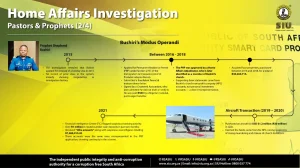
One of the most explosive revelations in the SIU report concerns Prophet Shepherd Bushiri, the self-styled “Major 1” of ECG Ministries, who fled South Africa in 2020 while facing fraud and money laundering charges, and who has since been fighting extradition from Malawi.
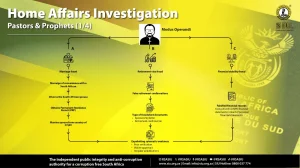
The SIU’s investigation reveals that Bushiri’s Permanent Residence Permit was approved by an adjudicator who was a member of his own church, ECG Ministries – a textbook conflict of interest that should have disqualified the official immediately.
The fraudulent application was supported by a letter of financial independence signed by a Chartered Accountant who admitted he was paid solely for his signature – lending professional credibility to a document he never genuinely verified.
Bushiri also claimed an aircraft purchase as proof of financial means. The SIU found that USD 1.2 million in cash was paid from his Non-Profit Company at Lanseria Airport, raising serious red flags about money laundering and the misappropriation of religious donations.
Church members played active operational roles in the scheme. Associates drafted and submitted fraudulent documentation. Donations were rerouted from ministry accounts into personal accounts under labels such as “TITHE” or “Seed.” Payments were also disguised as “Crossover T-shirts.” Bushiri, the investigation found, held directorships in 14 companies and owned multiple properties in Pretoria.
“Religious donations were converted into bricks, mortar, and corporate shares,” the SIU stated bluntly.
Pastor Omotoso: A Pattern of Deception Built Over Years
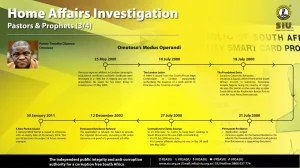
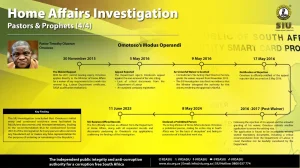
Pastor Timothy Omotoso, currently facing serious criminal charges in South Africa, including human trafficking and rape, entered the country through what the SIU describes as a pattern of systematic deception that spanned years.
His initial entry was secured through a fraudulent work permit issued in a country where he was not a citizen, based on an unauthorised directive. He then consistently provided conflicting information about his travel history and residency, submitted affidavits claiming lost documents to avoid producing verified credentials, and used the initial fraudulent permit to support subsequent, more permanent immigration applications.
When his visa renewal was eventually denied for non-compliance, Omotoso sought a ministerial waiver – which the SIU found was unlawfully granted by an official who did not have the necessary delegated authority to do so. It was, investigators concluded, a deliberate strategy of exploiting administrative gaps to override lawful rejections.
The Mpofu Case: A Fraudulent Permit That Built a R1.6m Career
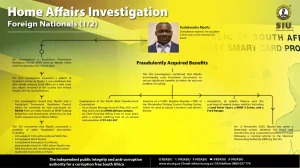
The investigation of Kudakwashe Mpofu is a masterclass in how a single fraudulent document can cascade through an entire system of government.
Mpofu obtained a fraudulent Permanent Residence Permit in 2018 through an agent for just R3,000. The document was riddled with errors – incorrect fonts, misspelt stamps, and reference numbers that did not exist in Home Affairs’ own records.
But no one checked. Armed with that document, Mpofu secured a position as Asset Manager at the North-West Development Corporation (NWDC), earning R900,000 per annum. He was subsequently promoted to Acting CFO, then CFO, with his salary rising to R1.6 million per annum. He used further fraudulent visas and exemption certificates to extend his stay and employment, and used the fraudulent documentation to obtain vehicle finance for a Land Rover Sport, a Ford Ranger, and a BMW 3 Series, while also manipulating Traffic Registration Numbers to secure licences.
Following the SIU’s referral to the National Prosecuting Authority, Mpofu was convicted at the Mmabatho Regional Court and sentenced to three years’ imprisonment under correctional supervision, with an additional suspended sentence.
The McLaren Crash and the Ghost Who Re-entered South Africa
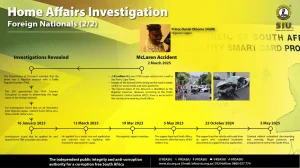
In a finding that raises profoundly troubling questions about border control, the SIU reveals that Prince Daniel Obioma – the Nigerian national linked to a high-profile McLaren supercar crash in Cape Town – overstayed his visitor’s visa in 2023, remained in South Africa illegally, departed, and then re-entered the country with no record of that re-entry in the system.
Despite being unlawfully present in the country, he was identified at the scene of the McLaren accident in March 2025. The SIU describes his unexplained re-entry as highlighting “serious failures in border management and movement control systems.” In plain terms: a man with no legal right to be in South Africa walked back in, and the state did not know he was here.
DNA Swapping, Fingerprint Fraud, and the Passport That Isn’t Yours
Perhaps the most disturbing finding of all involves identity fraud at a biological level.
Working in conjunction with Interpol, the SIU has uncovered a sophisticated scheme in which foreign nationals collude with corrupt Home Affairs officials to gain unauthorised access to departmental offices. Once inside, they use the fingerprints of unsuspecting South African citizens while substituting the photograph on the passport application with their own – effectively stealing the identity of an innocent South African to obtain a genuine South African passport.
In a parallel scheme, the SIU found prima facie evidence of DNA sample swapping and manipulation at the National Health Laboratory Services – the agency responsible for conducting DNA tests required for certain visa categories. Biological results, the SIU found, are being tampered with to benefit fraudulent applicants.
These findings directly explain what has long been suspected: the declining international standing and heightened scrutiny of the South African passport in recent years is, at least in part, a consequence of organised criminal activity that has turned genuine South African travel documents into commodities available to anyone who can pay.
The Scale of the Damage: R181 Million and a System-Wide Crisis
The numbers tell a story of industrial-scale corruption. The SIU has traced financial gains exceeding R181 million associated with the beneficiaries of fraudulent visa applications underpinned by fake documentation. Sectors affected span real estate, transport, banking, healthcare, education, fiscal policy, and border security.
The SIU is calling for urgent systemic reform, including employee vetting across the department, full system integration between Home Affairs and other government departments, strengthened physical access controls, quality assurance processes before any visa is issued, and mandatory post-issuance compliance monitoring – particularly for the retirement visa category, which the investigation found has no age restriction and is spectacularly easy to abuse because the department never followed up to check whether recipients actually maintained the required R37,000 monthly income.
What Happens Next
The SIU’s interim report has been submitted to President Ramaphosa. Several matters have been referred to the National Prosecuting Authority, and civil litigation is expected to follow to recover the proceeds of corruption. The full scope of disciplinary action against Home Affairs officials is still being determined.
“Corruption in the visa system is not incidental,” the Acting Head of the SIU said in closing. “It is organised, deliberate, and devastating to public trust. Integrity is betrayed.”
For millions of South Africans who carry a passport that the world is increasingly treating with suspicion, those words land with particular weight. The document that is supposed to represent the sovereign identity of a free citizen was, for years, for sale.
I welcome the SIU’s interim report on visa maladministration over a 20 year period between 2004 and 2024. Over the past 20 months, we’ve made major strides holding corruption to account and driving digital transformation to close systemic loopholes. Rebuilding the rule of law! ???? pic.twitter.com/lAEbHuPVji
— Leon Schreiber (@Leon_Schreib) February 23, 2026