WHEN a government – not a football federation, not a sports ministry, but the executive arm of a sovereign state – issues a formal press release accusing the continent’s premier football body of corruption and vowing to pursue it through international courts, something seismic has happened. That moment arrived on Wednesday morning, when Senegal’s Secretary of State to the Prime Minister, Marie Rose Khady Fatou Faye, signed her name to a statement that framed a football dispute as a matter of national honour, institutional integrity, and African justice.
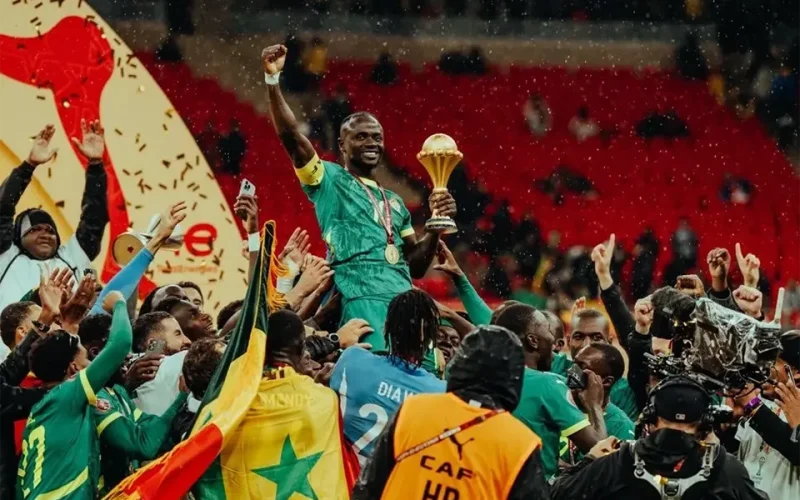
The occasion was the response of the Government of the Republic of Senegal to the decision by the CAF Appeals Committee to annul the Lions of Teranga’s 1-0 victory in the AFCON 2025 final – a match played and completed in Rabat in January 2026 – and to award a 3-0 administrative victory to Morocco. The grounds: an alleged violation of regulations related to the Senegalese players’ brief walk-off protest in the wake of a contentious penalty decision. The consequence, according to Dakar: the erasure of a legitimate sporting triumph.
What makes this intervention remarkable is its institutional weight. This is not a statement from the Senegalese Football Federation (FSF), nor from the team’s technical staff. The government has spoken – directly, in its own name, through its own spokesperson – and the language it has chosen is unsparing.
‘A MANIFESTLY ERRONEOUS INTERPRETATION’
The government’s statement opens with a declaration of dismay that quickly escalates into a charge of institutional misconduct. The CAF ruling, it states, is one
“of exceptional gravity, directly contradicts the cardinal principles that underpin sporting ethics, foremost among which are fairness, loyalty, and respect for the truth of the game.”
The phrase ‘truth of the game’ is significant — it is an assertion that the result on the pitch, not an administrative technicality, constitutes the authentic record of what occurred in Rabat. In Senegal’s framing, CAF has not corrected an irregularity; it has falsified a result.
The government is precise about the legal and regulatory basis of its objection. The ruling, it charges, stems from
“a manifestly erroneous interpretation of the regulations, leading to a grossly illegal and profoundly unjust decision.”
The word ‘manifestly’ is a term of art in legal drafting: it signals that the error is not merely debatable, but obvious – a standard that, if upheld by an independent arbitral tribunal, would be grounds for reversal. Dakar is not appealing to sentiment. It is framing its case in the language of arbitration.
INSTITUTIONAL CREDIBILITY ON TRIAL
The government’s sharpest blow is not directed at the ruling itself, but at what it signals about CAF’s fitness to govern African football. The statement warns that by
“Calling into question a result achieved at the end of a match that was properly played to its conclusion and won in accordance with the rules of the game, the CAF seriously undermines its own credibility as well as the legitimate trust that the African people place in continental sporting institutions.”
This framing deliberately elevates the dispute beyond a bilateral grievance between Senegal and Morocco. It positions CAF – and, by extension, all of African continental sport governance – as the defendant. The government is putting the institution on notice: the legitimacy of African football’s governing structure is contingent on its capacity to render just decisions. If that capacity is compromised, the trust of the continent’s people is forfeit.
It is a political argument dressed in sporting language — and it is a deliberate one. Dakar knows that African publics have long harboured suspicions about the integrity of CAF’s decision-making. By invoking those suspicions formally, in an official state document, the government gives them institutional standing.
THE CORRUPTION ALLEGATION
The most incendiary element of the statement is its call for
“an independent international investigation into suspected corruption within the CAF’s governing bodies.”
This is an extraordinary demand. It implies that the Appeals Committee’s ruling was not merely mistaken, but tainted — that improper influence shaped the outcome. No evidence is cited in the statement to substantiate the allegation, but the political effect of making such a demand publicly, over the official seal of the Senegalese government, is immediate. It puts every CAF official who participated in the appeals process under a cloud of suspicion and compels the confederation to respond.
CAF has not, as of the time of writing, issued a formal response to the Senegalese government’s demands. The silence, in context, speaks.
LEGAL ESCALATION: THE ROAD TO LAUSANNE
The government’s statement makes clear that Senegal does not intend to accept the ruling passively. Alongside the FSF, which has already indicated it will challenge the decision at the Court of Arbitration for Sport (CAS) in Lausanne, the government has announced it will pursue
“all appropriate legal avenues, including before the competent international courts, to ensure that justice is served and the primacy of sporting results is restored.”
The reference to ‘international courts’ beyond CAS is notable. It is unclear at this stage whether Dakar has a specific tribunal in mind, or whether this represents a maximalist negotiating posture. What is clear is that the government is not confining the fight to the corridors of sports arbitration. It is signalling a willingness to internationalise the dispute at a diplomatic and legal level that would be without precedent in African football governance.
The CAS process alone — should it proceed — would be highly consequential. CAS has previously overturned CAF decisions, but the annulment of a continental final result and the restoration of a stripped title would be among the most significant interventions in the institution’s history. Senegal will need to demonstrate not merely that the punishment was disproportionate, but that the regulatory basis for the ruling was legally unsound.
CITIZENS BEHIND BARS: A DIPLOMATIC DIMENSION
The government’s statement closes with a passage that introduces a dimension entirely absent from the purely sporting narrative. Dakar reiterates
“the solidarity of the entire nation with the Senegalese citizens detained in Morocco following the incidents at the AFCON final”
and commits to monitoring the matter for a resolution. This is a reminder that the events in Rabat produced consequences that extend far beyond the scoreline. The walk-off protest and the disturbances that accompanied the final, resulted in the detention of Senegalese nationals on Moroccan soil.
By including this dimension in a press release ostensibly about the CAF ruling, the government has woven together the sporting, legal, and diplomatic strands of the crisis into a single official narrative. The AFCON result and the fate of detained citizens are, in Dakar’s framing, aspects of the same injustice — and the same fight.
THE BROADER STAKES FOR AFRICAN FOOTBALL
It would be a mistake to read this statement purely through the lens of Senegal’s immediate interests. The government of a major African nation declaring that CAF’s governing bodies may be corrupt, that its rulings are illegal, and that it will seek redress through international courts represents a direct challenge to the authority of the continental football structure — and, by extension, to FIFA, which maintains oversight of CAF.
For African football supporters who have long demanded greater accountability and transparency from CAF, Dakar’s statement may read as overdue. For those who fear the fragmentation of continental football governance, it will read as a dangerous escalation. What is beyond dispute is that the government of Senegal has drawn a line — clearly, publicly, and on the record.
The Lions of Teranga won the final. The government of Senegal intends to ensure that history records it that way.