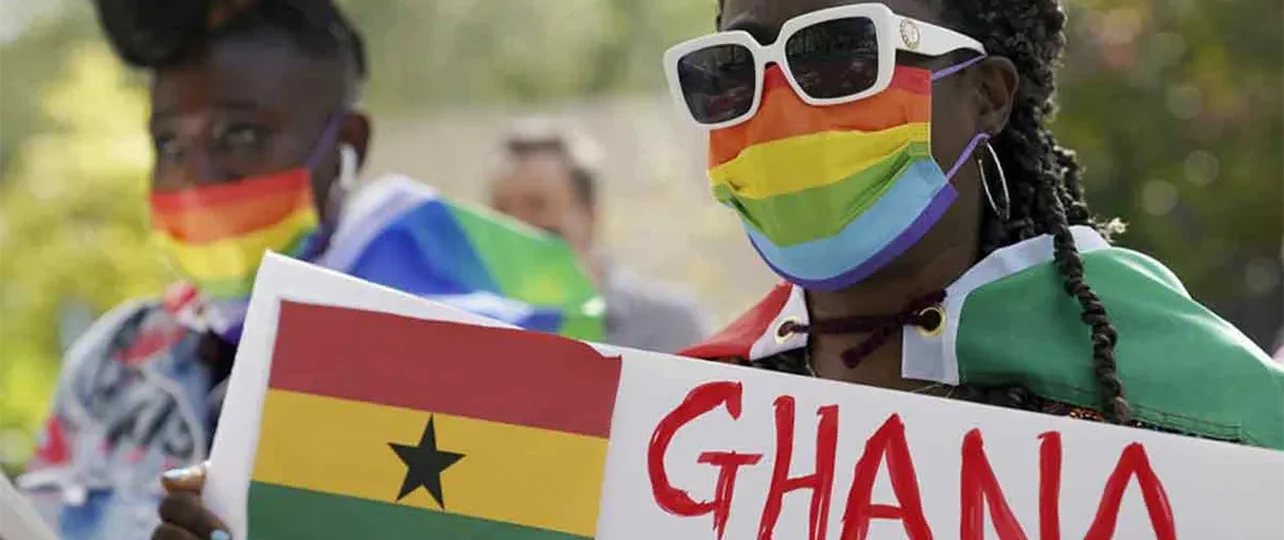

HUMAN Rights Watch has issued a sweeping indictment of Ghana’s Human Sexual Rights and Family Values Bill, 2025, warning the country’s parliament that the legislation represents one of the most expansive assaults on individual rights ever to come before a Ghanaian legislature – and demanding that it be killed before it reaches a second reading.
In a formal written memorandum submitted Monday to the Parliament’s Constitutional and Legal Affairs Committee, the global rights body warned that the bill does not merely regulate conduct – it criminalises identity, mandates citizen surveillance, destroys civil society, and threatens to land journalists, doctors, lawyers, teachers and parents in prison for doing their jobs.
“This Bill extends well beyond the regulation of conduct, criminalizing identity, stifling advocacy, dismantling important civil society structures, and compelling citizens to surveil and denounce one another.”
Human Rights Watch, 30 March 2026
The bill was revived by Ghana’s parliament on 10 March 2026 after earlier versions stalled in the legislature. Its return has alarmed human rights organisations across Africa and internationally. HRW’s memorandum is the most detailed legal dismantling of the bill yet produced by any international body.
WHAT THE BILL DOES
Under Section 3(1)(e), the bill would make it a criminal offence to identify as lesbian, gay, bisexual, transgender, transsexual, pansexual, an ally, non-binary, queer, or any identity outside the binary male-female categories – punishing who a person is rather than any harm they have caused to others.
Consensual same-sex sexual conduct would be prohibited under Section 3(1)(a), carrying penalties of between two months and three years in prison. HRW notes that existing colonial-era anti-gay laws have already been used to drive LGBT Ghanaians away from reporting violence to police – the new bill would compound that effect dramatically.
Sections 9, 11, 12 and 13 would impose prison sentences of up to ten years for producing or distributing material that promotes any act prohibited by the bill, and three to five years for funding or sponsoring such acts. Existing LGBT organisations would be forcibly disbanded, and no new ones could be formed. HRW says this would wipe out HIV prevention and sexual health services, endangering public health far beyond the LGBT community.
Section 18’s definition of ‘ally’ – read together with Section 9 – is particularly sweeping. It would expose journalists, researchers, healthcare workers, lawyers, teachers, and parents to criminal prosecution of up to ten years simply for performing their professional duties if those duties touch on prohibited subjects.
Section 16 compels every person with knowledge of an offence under the bill to report it to the police or a community authority within three days. Section 19 then designates all such offences as extraditable, potentially exposing Ghanaians abroad to prosecution for exercising rights legally protected in the countries where they live.
Section 10 would impose six to ten years in prison for any material directed at a child that ‘sparks interest’ in a prohibited act or imparts knowledge about any gender other than male or female. The bill explicitly excludes comprehensive sexuality education from its definition of ‘human sexual rights’, depriving children of evidence-based health information.
THE LEGAL CASE AGAINST THE BILL
HRW’s submission methodically maps every major clause onto Ghana’s binding international and regional obligations — and finds the bill wanting on every count.
The criminalisation of LGBT identity violates Articles 2, 3 and 4 of the African Charter on Human and Peoples’ Rights, which Ghana ratified in 1989. The African Commission on Human and Peoples’ Rights has interpreted the Charter’s prohibition on discrimination by ‘other status’ to include sexual orientation and gender identity, in its landmark Resolution 275 adopted at its 55th Ordinary Session in Luanda in 2014.
The prohibition on consensual same-sex conduct breaches Articles 5 and 6 of the African Charter and Articles 5 and 6 of the Maputo Protocol, the continental instrument on women’s rights. It also violates the International Covenant on Civil and Political Rights as interpreted by the UN Human Rights Committee in the seminal Toonen v. Australia case, which established that criminalising consensual same-sex conduct breaches the right to privacy under Article 17 of the ICCPR.
The suppression of expression, advocacy and association in Sections 9, 11, 12 and 13 violates Articles 9, 10 and 11 of the African Charter and Articles 19 and 22 of the ICCPR. HRW invokes the UN Committee on Economic, Social and Cultural Rights’ General Comment No. 14, which makes clear that access to sexual health information is a component of the right to health under international law — a right Ghana cannot abrogate.
The mandatory reporting regime under Section 16 is condemned as incompatible with the rights to dignity, privacy and liberty under both the African Charter and the ICCPR. The UN Human Rights Committee, in its Concluding Observations on Uganda, has already held that mandatory reporting obligations attached to laws criminalising consensual private conduct are incompatible with Article 17 of the ICCPR.
“Ghana has long been regarded as a beacon of democratic governance, rule of law, and respect for human rights on the African continent. The passage of this Bill would jeopardise those gains.”
HRW Memorandum
On children’s rights, HRW draws on the UN Committee on the Rights of the Child — which in its own Concluding Observations on Ghana specifically recommended that Accra introduce comprehensive sexuality education into school curricula — and the UN Special Rapporteur on the Right to Education, who has described sexual education as both a human right in itself and an essential means of realising the rights to health and information.
HRW’s submission does not limit itself to legal citations. It grounds its argument in documented reality. Its researchers have been operating in Ghana since 2016. What they found was a country in which LGBT people are already victims of mob attacks, physical assault, sexual violence, extortion, and family rejection — and in which existing anti-gay laws prevent victims from reporting these crimes to police for fear of arrest.
Lesbian women in particular face documented pressure to enter forced marriages. The bill’s mandatory reporting regime would, HRW warns, create new vectors for state-sanctioned abuse of women on the basis of their sexual orientation or intimate relationships — a direct violation of the Maputo Protocol’s Article 4 guarantee of the right to life, integrity and security.
WHAT HRW DEMANDS
The memorandum closes with ten concrete recommendations to the Constitutional and Legal Affairs Committee. The central demand is unambiguous: recommend that the bill not proceed to a second reading in its current form.
Beyond that, HRW calls for the removal of the identity criminalisation clause under Section 3(1)(e), the removal of the prohibition on consensual same-sex conduct under Section 3(1)(a), and the scrapping of the advocacy, funding and association penalties in Sections 9, 11, 12 and 13. It calls for a root-and-branch revision of the ‘ally’ definition, the repeal of the mandatory reporting obligation, the removal of the extradition amendment, and restoration of access to comprehensive sexuality education for children.
HRW also calls for broad, inclusive public consultations — including meaningful participation by LGBT Ghanaians — and a formal human rights impact assessment before any future legislative initiative on these issues is introduced in parliament.
The memorandum was signed by Dr Larissa Kojoue, Researcher for LGBT Rights at Human Rights Watch, and Dr Alex Müller, Director of LGBT Rights at Human Rights Watch.
Ghana’s Supreme Court upheld an existing colonial-era law criminalising same-sex conduct in July 2024. The Human Sexual Rights and Family Values Bill would go substantially further — adding identity criminalisation, mandatory denunciation, civil society dissolution, and sweeping restrictions on information and expression that have no precedent in Ghana’s legal history.
Ghana’s own Commission on Human Rights and Administrative Justice has already warned that the bill infringes fundamental constitutional rights. HRW urges the Parliamentary Committee to weigh its memorandum alongside submissions from Ghanaian civil society, legal scholars, and affected communities.