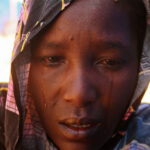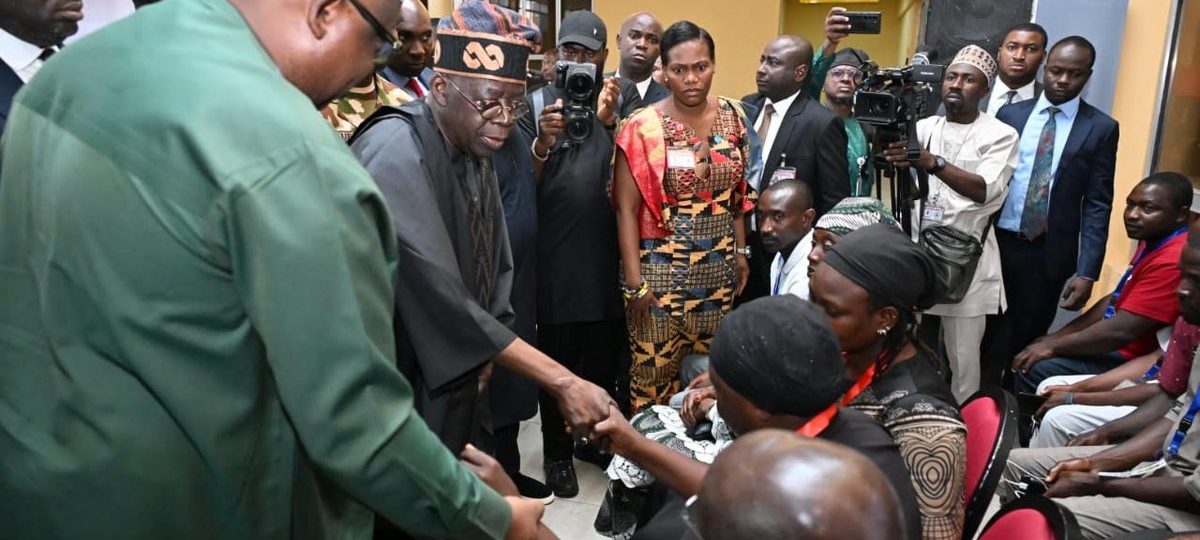

THE woman had already buried her son once – in her arms, in the viral video that stopped Nigeria cold. She had held young Ayuba’s body in the dust of Angwan Rukuba, her face a portrait of a grief too enormous for words. Now, five days after the gunmen came at dusk on Palm Sunday, she stood inside a makeshift hall near the runway of Jos Airport and heard the President of Nigeria say her boy’s name.
‘I know the pain,’ Bola Tinubu told her. ‘I saw how you held your own son Ayuba in the video, and the pain and agony in your heart. But only God can give you joy and comfort.’
It was not the comfort of policy. It was not the comfort of security deployments or camera grids or the emergency appropriations that may or may not follow. It was simply a man, the most powerful man in Nigeria, telling a mother that the country had seen her and had not looked away.
For the families of the at least 28 people killed in the Gari Ya Waye community in the early evening of 29 March – Palm Sunday, the holiest threshold of the Christian calendar – that may have been the most anyone has given them in a long time.
“Those who seek to spread fear will not prevail.”
President Tinubu
The visit almost did not happen the way it did. Tinubu had already postponed his planned commissioning of the Gateway International Cargo Airport in Ogun State – a ribbon-cutting replaced by a flight north toward grief. But Jos Airport does not support night operations. Its runway has no navigational aids for after dark. The road into the city from the airport runs forty minutes on a good day. The arithmetic was brutal: he could land, drive into Jos, meet survivors, and still make it back before the last light died – or he could not.
He could not. So they brought the community to him.
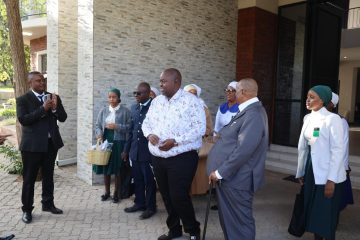
State and federal officials arranged for representatives of affected families and community leaders to be brought to a hall adjoining the runway. Among those waiting were the Minister of Defence, the Chief of Army Staff and the Inspector General of Police – officials who had visited Rukuba, the epicentre of the attack, where the blood was still not fully dry in the red laterite soil.
The President’s own communications team has since been at pains to explain the optics. Special Adviser Bayo Onanuga, in a press release issued Thursday, detailed the bilateral pressure from Chad’s President Mahamat Idriss Déby Itno – a meeting focused on cross-border security cooperation that ran longer than scheduled – and the logistical impossibility of a night convoy into the city. The explanation is credible. But explanations, however accurate, carry their own political charge in a country where the bereaved have learned to read the distance between Abuja and their villages in the language of condolence visits that never come.
This one came.
“There is nothing I can give you — whether money in billions — but console you and promise you that this experience will not repeat itself.”
In the hall near the runway, Tinubu was not performing. He moved among the people. He listened to the local leaders. He summoned a former governor -Jonah Jang, a long-serving political figure in Plateau – and in a moment that caught observers off guard, turned to him and said: ‘Get up and give me assurance of your support.’ Jang rose, took the microphone, and acknowledged the President’s handling of the crisis. It was part theatrics. It was also, in the forensic sociology of Nigerian politics, a public compact – the federal government demanding that Plateau’s own political establishment stop treating the recurring violence as someone else’s problem.
The meeting was televised live. It was solemn. The President wept with families. He promised 5,000 AI-enabled cameras to be deployed across Jos to improve surveillance and enable the identification and arrest of attackers. He invited community leaders to Abuja for further talks. He left before dark, as the runway required.
What he flew back toward was a country with a memory. The blood on Plateau’s soil is not new. Between late March and the night of 13 April last year – Holy Week, 2025 – Fulani militia attacks killed at least 126 people across the state in a concentrated fortnight of violence. The Palm Sunday massacre of Zikke village in Bassa Local Government Area alone claimed 56 lives, including 15 children. One hundred and three households were razed. From Christmas 2023, when more than 200 Christians were killed in a single Plateau outbreak, to the December 2025 attacks near Barkin Ladi, to the killing of young Ayuba in Angwan Rukuba – the pattern has not shifted. Only the body counts accumulate.
Amnesty International has documented attacks across 167 rural communities in eight local government areas, displacing 65,000 people over two years. Its Nigeria country director, Isa Sanusi, put the structural diagnosis plainly: the crisis is the product of governance failure at the local level, where impunity has filled the vacuum that policing left behind.
Tinubu cautioned the media against framing the Angwan Rukuba attack in purely religious terms. That caution is politically understandable and analytically contentious. Governor Mutfwang has himself used the words ‘genocide’ and ‘ethnic cleansing’ to describe what his state has endured. When a president and his governor narrate the same crisis differently, the dissonance is not merely semantic. It shapes the response architecture. A conflict framed as a resource dispute calls for land-use reform. A conflict framed as targeted killing calls for prosecution and protection. Plateau State needs both, and has received neither at scale.
The President closed his X statement this week with the phrase ‘Nigeria First’ — the slogan of his administration’s economic and infrastructure push. On Plateau, that phrase now carries a question it did not carry before: first for whom? For the families who have buried their dead during Holy Week two years in a row, Nigeria First must mean security first. It must mean the prosecutions that have not come. The disarmament that has not happened. The intelligence infrastructure that has not been built. The structural reform of a Middle Belt scarred by decades of institutional abandonment.
The cameras promise something. The Abuja conversation will promise more. The test, as it always is, will arrive in the quiet after the President’s motorcade has gone – in the nights that follow, in the weeks without headlines, in the long dry season when the grazing routes shift and the guns that were stilled for a presidential visit are, without structural change, loaded again.
But on Thursday evening, in a hall beside a runway in Jos, a mother heard her dead son’s name spoken by the head of state. The President of Nigeria had seen her. He had not looked away.
For now, in a place that has known too many nights when no one came, that is not nothing.
I have postponed my trip to Iperu, Ogun State. My first duty at this moment is to stand with the people of Plateau.
— Bola Ahmed Tinubu (@officialABAT) April 1, 2026
I will be in Jos to commiserate with families who have lost loved ones and to reaffirm that those who seek to spread fear will not prevail. We will continue to…