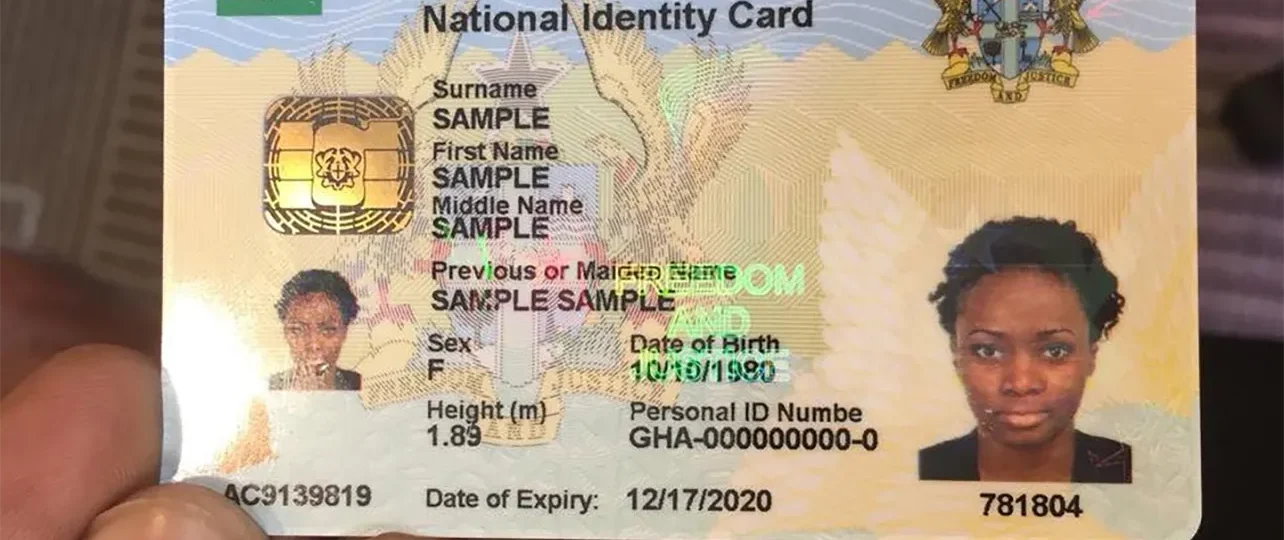

GHANA has done what financial inclusion advocates have demanded for a generation: it has collapsed the identity card and the bank account into a single piece of plastic – and, in doing so, become the first African nation to embed a sovereign payments system directly into its national identity infrastructure, cutting out the US-based card duopoly of Visa and Mastercard in the process.
The National Identification Authority (NIA) this week confirmed that the electronic wallet feature of the Ghana Card is now live. Cardholders can activate the e-wallet through the MyCitizens App or by dialling *402#. Once activated, the card functions as a full payment instrument: ATM withdrawals, in-store purchases, online transactions, international payments in more than 200 countries, insurance services, and emergency assistance – all anchored not to a commercial bank account but to a citizen’s national identity.
The implications – for Ghana’s 34 million people, for a continent where tens of millions remain locked out of the formal financial system, and for the global architecture of digital payments – are profound.
WHAT GHANA HAS ACTUALLY BUILT
The Ghana Card was always designed as a triple-function instrument. The e-ID went live first. The e-passport – allowing the card to serve as travel documentation in 197 countries – was activated in 2022. The e-wallet is the third and final layer, completing what the NIA has described as the card’s founding vision.
Critically, this is not a partnership with a single bank or payment network. The NIA has designed the embedded wallet as a uniform platform that will integrate multiple financial institutions. No single commercial entity controls the rails. That design choice is not incidental – it is a deliberate assertion of state infrastructure ownership over the payments ecosystem.
The wallet is also connected to broader ambitions. The NIA has expressed interest in partnering with the Ghana Gold Board – which holds exclusive rights to trade and export gold within the country – to use the Ghana Card as a platform for gold trading. If activated, that link would transform the card from a convenience tool into a strategic node in Ghana’s resource economy.
WHAT IT MEANS FOR GHANAIANS
The immediate beneficiary is the unbanked Ghanaian. Ghana’s credit card penetration rate stood at just 0.6 percent in 2024, and was forecast to decline further through 2029. That figure captures a structural reality: for the majority of Ghanaians, particularly in rural and peri-urban communities, formal financial services have been difficult to access, costly to maintain, and culturally distant.
By embedding the payment function in the national ID – a document the state has spent fifteen years issuing to citizens – Ghana has effectively eliminated the entry barrier. You do not need a bank account. You do not need a credit history. You do not need a smartphone with a particular app ecosystem. You need your Ghana Card and access to *402#.
The World Bank’s Global Findex 2025 data shows that Ghana has already achieved 81 percent financial account ownership, on par with South Africa and well above the Sub-Saharan African average of 58 percent. The question now is whether the Ghana Card wallet can deepen the quality and utility of that inclusion — particularly for women, the elderly, and the rural poor who, even where they hold accounts, remain marginal users of formal financial services.
The risks are real. Identity-based payment systems concentrate risk: a stolen or compromised Ghana Card becomes simultaneously an identity theft and a financial fraud event. The NIA has repeatedly warned that biometric verification – not visual inspection or database lookups – must be the primary verification method. Whether the activation infrastructure for *402# and the MyCitizens App can enforce biometric authentication at scale, across Ghana’s geography, remains an open question.
THE SOVEREIGNTY DIMENSION: AFRICA VS. THE CARD GIANTS
The most significant geopolitical element of this development is the one receiving the least analytical attention: Ghana has built a payments infrastructure that does not depend on Visa or Mastercard.
For decades, African nations – including the continent’s largest and most sophisticated economies — have paid transaction fees, data licensing costs, and system integration levies to US-based card networks for the privilege of connecting their citizens to global commerce. Every swipe of a Visa card in Accra generates revenue that flows back to San Francisco. Every Mastercard transaction in Lagos enriches a company headquartered in Purchase, New York.
Ghana’s architecture, if it scales, changes that logic. A payment system anchored in state identity infrastructure, integrated with domestic banks, and accepted in over 200 countries does not require Visa’s network or Mastercard’s processing rails. It is sovereign infrastructure in the precise sense that proponents of digital public infrastructure have argued for: state-owned, interoperable, and accountable to the citizen rather than the shareholder.
This positions Ghana alongside India – whose Unified Payments Interface (UPI) has restructured the domestic payments economy and begun projecting internationally – and Brazil, whose PIX real-time payments system has become a model for the Global South. The World Bank has explicitly cited UPI and PIX as models for closing the financial access gap. Ghana is now in that conversation.
The card duopoly will not cede ground quietly. The history of payment infrastructure development in the Global South is replete with examples of US-based networks using preferential pricing, technology partnerships, and regulatory lobbying to entrench their position. Ghana’s NIA and government will need to sustain political will and institutional capacity to resist those pressures.
THE AFRICAN STAKES: A MODEL ARRIVES
Africa cannot afford to treat this as a Ghana story. It is a continental test case.
Sub-Saharan Africa’s financial inclusion gains have been driven almost entirely by mobile money — M-Pesa in Kenya, MTN Mobile Money across West Africa, and Orange Money in the Francophone markets. These have been transformational. But mobile money systems, even at their most sophisticated, remain dependent on telecommunications infrastructure that is itself owned or licensed by multinational corporations, and on regulatory frameworks that have not always favoured the unbanked over the operator.
An identity-anchored payment system is structurally different. It ties financial access to the foundational act of citizenship — being recognised by the state — rather than to a commercial service subscription. It cannot be switched off by a network operator. It cannot be repriced by a fintech company seeking margin. It is, in principle, as durable as the state itself.
The immediate comparators are instructive. Nigeria’s General Multipurpose Card attempted a similar convergence of identity and payments and has struggled with adoption, institutional fragmentation, and data quality. Kenya’s Huduma Namba programme faced constitutional and privacy challenges that stalled its ambitions. Ghana’s NIA has learned from those experiences: its phased rollout — e-ID first, e-passport second, e-wallet third — has allowed the biometric database to mature before financial integration.
With 18 million of Ghana’s estimated 34 million population already registered on the Ghana Card system, the base exists. The question is whether African Union institutions, the African Continental Free Trade Area (AfCFTA), and national identity authorities across the continent will read Ghana’s move as a blueprint — and whether they have the political economy to execute it.
THE GLOBAL PICTURE: DPI AND THE BATTLE FOR THE PAYMENTS SPINE
Ghana’s move lands in the middle of a global contest over digital public infrastructure. The G20, the World Bank, and the Gates Foundation have invested heavily in the concept of DPI — sovereign digital infrastructure covering identity, payments, and data exchange — as the foundation for inclusive digital economies. India’s IndiaStack is the most cited success story. Brazil’s PIX is the most replicated.
Africa has largely been on the receiving end of these conversations — a market for DPI investment rather than a producer of DPI models. Ghana changes that. For the first time, an African country has deployed, at a national scale, a payments system embedded in sovereign identity infrastructure that is accepted globally.
The timing is not neutral. The United States and the European Union are both reassessing their approach to global payment systems in the context of sanctions regimes, dollar weaponisation debates, and the rise of BRICS-aligned financial alternatives. Russia, China, and Iran have all accelerated efforts to build payment infrastructure that bypasses Western-controlled networks. African nations watching that contest have a direct interest in building their own sovereign capacity before the geopolitical fractures deepen.
Ghana has not framed its e-wallet as a geopolitical instrument. But the architecture is inherently political. A payment system that does not run on Visa or Mastercard rails is, structurally, a system that reduces dependence on US financial infrastructure. That is a fact regardless of Accra’s stated intentions.
WHAT MUST HAPPEN NEXT
For the Ghana Card e-wallet to fulfil its potential, several conditions must hold. The biometric verification requirement must be enforced without creating exclusion — the elderly, the disabled, and those with worn fingerprints must have workable alternatives. The wallet’s bank integration architecture must be genuinely open, preventing any single institution from capturing the platform. Consumer protection frameworks must be built alongside the technology, not retrofitted after fraud cases accumulate.
At the continental level, the African Union’s digital identity and payment infrastructure work must now explicitly reference Ghana’s model. The AfCFTA’s payment system ambitions — currently stalled in interoperability negotiations — could use Ghana’s triple-function card as a building block rather than starting from scratch.
And for the rest of the world: this is a moment to study, not to patronise. Africa has produced a sovereign, biometrically secured, globally accepted payment instrument anchored in state identity infrastructure. It took fifteen years of institutional building, political consistency across multiple administrations, and a willingness to conceive of the national ID card as something more than a bureaucratic document.
The Ghana Card is now a bank. The question is whether Africa — and the world — is paying attention.
GHANA CARD E-WALLET: KEY FACTS
Issuing Authority: National Identification Authority (NIA), Ghana
Activation channels: MyCitizens App or *402#
Acceptance: 200+ countries for online, in-store, and ATM use
Card functions: e-ID (live), e-Passport (since 2022), e-Wallet (now live)
Ghana Card registrations: ~18 million of an estimated 34 million population
Ghana financial inclusion rate: 81% account ownership (World Bank Global Findex 2025)
Ghana credit card penetration: 0.6% (2024) — the gap this wallet targets
Card networks bypassed: Visa, Mastercard — no dependency on US-based payment rails
Gold trading ambition: Potential NIA-Ghana Gold Board integration under development