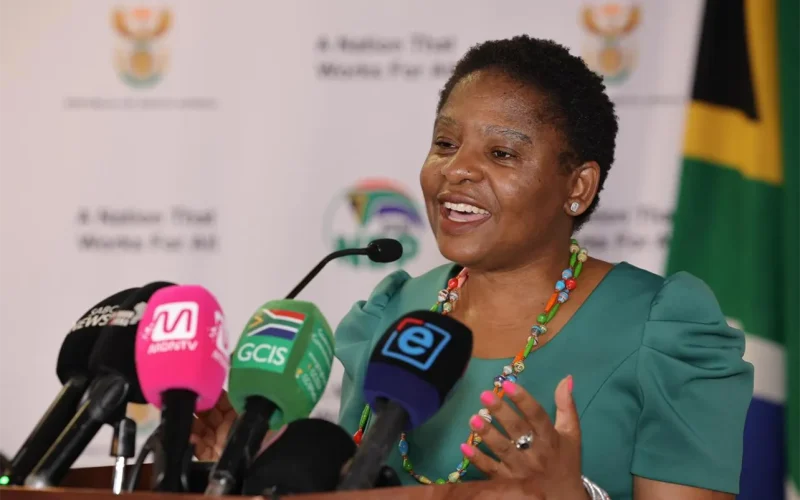
AFTER the most recent meeting of the South African Cabinet, Minister in the Presidency Khumbudzo Ntshavheni stepped before the cameras and the language she used was deliberate: the Revised White Paper on Citizenship, Immigration and Refugee Protection had been approved – not for further study, not for another round of consultation, but for implementation. It was the signal that South Africa’s migration regime, long characterised by institutional incoherence and policy drift, is entering a new era.
The document that the Cabinet has now cleared represents years of iterative policy development. The original White Paper on Citizenship, Immigration and Refugee Protection was approved in April 2024, itself the product of a years-long consultation process. A revised draft was published in the Government Gazette on 12 December 2025, incorporating recommendations from Operation Vulindlela’s visa reform programme and the Department of Home Affairs’ digital transformation agenda. Public comment closed in February 2026. Cabinet has now given the revised version its imprimatur – the policy framework that will guide the drafting of a single, consolidated statute merging the Citizenship Act, the Immigration Act and the Refugees Act into one legislative instrument.
The scale of ambition is not in dispute. The question is whether the implementation will match it.
The ‘First Safe Country’: Shutting the Door on Asylum Shopping
Perhaps no provision has generated more immediate commentary than what the White Paper calls the ‘First Safe Country Principle’ – and for good reason. The policy empowers the Department of Home Affairs to deny asylum to any person who has passed through a country considered safe before arriving in South Africa.
The rationale, as articulated by Ntshavheni, is blunt geography. South Africa shares no border with a country at war. The neighbouring states – Botswana, Zimbabwe, Lesotho, Mozambique, Namibia, and further afield, Zambia and Malawi – are, in the government’s framing, safe countries. A Sudanese national fleeing conflict, for instance, would be expected to seek asylum in the nearest safe country along the route, not to travel thousands of kilometres to arrive at Beit Bridge and claim protection in Johannesburg. The minister was candid about the political risk of this position: ‘I’ll be accused of xenophobia,’ she told reporters – and then proceeded to defend the principle regardless.
The policy goes further than a mere declaration of principle. The Minister of Home Affairs will be required to publish an annual list of designated safe third countries – limited to states that have ratified the 1951 Convention relating to the Status of Refugees. The designation can be withdrawn if conditions in a country deteriorate. Crucially, the government will be mandated to conclude bilateral agreements with those safe third countries, so that the burden of refugee management is shared more equitably across the region.
The White Paper acknowledges that flight is rarely orderly. It retains the right to claim asylum at the point of entry precisely because, as Ntshavheni put it, people flee ‘with nothing but the clothes on their backs’ — a recognition that the principle must be applied with sufficient flexibility to avoid refoulement, the international law prohibition on returning a person to a country where they face persecution. The policy aligns, the government argues, with the UNHCR’s route-based approach to migration management, which seeks to move away from country-by-country refugee processing toward the governance of entire migration corridors.
The practical effect, if implemented as written, would be a significant restriction on who qualifies for asylum in South Africa — a country that has historically processed some of the highest volumes of asylum applications on the continent, many from economic migrants using the refugee system as an alternative immigration route.
Reserved Occupations: The Return of Economic Demarcation
The second transformative provision, and one that has received less immediate attention, is the White Paper’s authorisation for relevant government departments to legally designate trades, occupations and professions that are reserved solely for South African citizens. This is a form of labour market reservation that, while politically charged in the context of South Africa’s apartheid history — the apartheid ‘job reservation’ system reserved skilled trades for white workers — is now being recast as a tool of citizen economic protection.
The policy is careful to note that this does not eliminate the rights of documented asylum seekers and refugees to work and sustain themselves. But it draws a meaningful boundary: certain jobs, certain economic activities, can be ring-fenced by ministerial designation. This sits alongside the separately approved National Labour Migration Policy (NLMP) White Paper of May 2025, which introduced sectoral employment quotas for foreign nationals across agriculture, hospitality, tourism and construction. Together, the two frameworks amount to a significant structural shift in how South Africa governs the intersection of migration and the labour market.
The Employment Services Amendment Bill, which accompanies the NLMP and provides the legislative machinery to enforce quotas and sector restrictions, is currently before Parliament. Once enacted, it will give the Minister of Employment and Labour authority to set, monitor and enforce limits on foreign national employment — limits that can be sector-specific, occupational, or even geographically defined.
One Law to Rule Them All: The Consolidated Legislative Framework
At its architectural core, the White Paper proposes collapsing the Citizenship Act, the Immigration Act and the Refugees Act into a single piece of legislation. The rationale is operational: three separate statutes create inconsistencies, gaps and institutional turf wars. A single, unified framework — with multiple chapters covering each domain — is intended to bring coherence to a system that has long been characterised by fragmentation.
The consolidated bill has not yet been introduced to Parliament; the White Paper, as a policy document, precedes legislation. But the direction of travel is clear, and the timeline is deliberate. Minister of Home Affairs Dr Leon Schreiber, who published the revised draft for public comment in December 2025, has made the consolidation a centrepiece of his reform agenda.
Citizenship Reimagined: From Time-Based to Merit-Based
The White Paper proposes one of the most fundamental changes to citizenship acquisition in South Africa’s democratic history: the replacement of a time-based system with a merit-based, points-based framework. Under the current system, the duration of lawful residence is the primary gateway to naturalisation. Under the proposed Points-Based System (PBS), applicants will be scored on skills and qualifications, economic contribution, investment capacity and social integration.
A new Citizenship Advisory Panel (CAP) will be established to assess applications and make formal recommendations to the Minister. Ministerial discretion will be retained for exceptional cases — strategic national interest, outstanding economic contribution, humanitarian grounds or security considerations — but it will require a CAP recommendation as a prerequisite. The dual citizenship principle is affirmed for qualifying applicants, in line with recent Constitutional Court jurisprudence.
Non-economic pathways to citizenship — through marriage to a South African citizen, or as a recognised refugee — remain available, but will require five years of permanent residence and will be subject to more rigorous checks designed to prevent abuse. The White Paper also proposes an annual window period for applications, to prevent the administrative backlogs that have historically crippled the naturalisation process.
For South Africans who voluntarily relinquished their citizenship, the White Paper offers a reprieve: a streamlined online portal for applications to reinstate citizenship, aimed at recapturing high-skilled members of the diaspora.
New Visas, New Categories: Modernising the Work Permit Regime
The White Paper proposes a significant rationalisation of South Africa’s visa architecture. The existing Critical Skills Visa and General Work Visa — two instruments that immigration practitioners have long criticised for complexity and inflexibility — will be merged into a single Skilled Worker Visa. The new visa will be open to workers across education and experience levels, directly addressing the criticism that the existing system has been too heavily weighted toward NQF level 7 and 8 qualifications, effectively excluding experienced artisans and technically skilled workers who have not followed a formal academic pathway.
New visa categories will be introduced for remote workers, start-up entrepreneurs, and sports and arts professionals. Corporate visas will be replaced by sectoral work visas calibrated to specific industries. Foreign spouses holding relatives’ visas — currently prohibited from working — will be permitted to seek employment through a streamlined PBS-based authorisation process.
A points-based system will also be extended to permanent residency applications, with annual caps on the number of approvals to align immigration with national capacity and labour market conditions.
The Digital State: Biometrics, ETA and the Intelligent Population Register
The White Paper is as much a digitalisation project as it is an immigration one. It proposes the replacement of the current National Population Register with an Intelligent Population Register (IPR) — a biometric database that will capture the details not only of South African citizens but of every foreign national residing in the country. The IPR will form the foundation for a National Digital ID system, to be detailed in a standalone digital identity policy currently under development.
The Electronic Travel Authorisation (ETA) system, already being rolled out for G20 nations, will be extended to tourist visas and other categories, automating border entry and exit processes. Asylum processing, currently conducted through a network of Refugee Reception Offices, will shift toward digital platforms — remote interviews via secure digital channels, electronic submission of documentation, online scheduling, and the use of machine learning for triage, fraud detection and workflow management. Refugee Reception Offices will, as a long-term objective, be relocated to ports of entry.
Universal mandatory digital birth and death registration — for both citizens and foreign residents — will underpin the IPR, ensuring that civil registration is comprehensive for the first time.
Children of the Border: Statelessness and the ‘Special Visa’
One of the more sensitive provisions concerns children born in South Africa to foreign nationals. Under the current section 4(3) of the Citizenship Act, certain children born in South Africa have an accessible pathway to citizenship. The White Paper proposes to replace automatic access for children of migrants with a formal statelessness determination process — administered by the Department of Social Development, the Children’s Court, an Independent Statelessness Committee and the Citizenship Advisory Panel.
Pending the outcome of that determination, the child will be issued a ‘special visa’ — an automatic document that holds status while investigations proceed. Only children who are genuinely stateless, with no verifiable ties to another nationality, would qualify for citizenship under the proposed framework. The change is designed to close what the government regards as an exploitable gap in the current law — but it has already attracted criticism from civil society organisations who warn that it risks leaving vulnerable children in a prolonged administrative limbo.
The Coherence Question
Academic researchers at the African Centre for Migration & Society have raised a structural concern that cuts beneath the policy’s ambitions: South Africa is redesigning its migration architecture through two parallel institutional logics — the Home Affairs framework focused on status and control, and the Employment and Labour framework focused on labour market regulation — and those logics are not obviously compatible.
The NLMP assumes that migrant workers can be governed as workers — that they can come forward to labour inspectors, file complaints, and be protected by labour law. But if the immigration system is simultaneously tightening status controls and increasing enforcement pressure, workers with insecure or ambiguous status will withdraw from visibility. Complaints will go unmade. Employers will gain leverage from fear. Informality will deepen. The two reform streams, taken together, could produce a paradox: more control in one part of the system generating less governability in another.
That is a challenge not of ambition but of architecture — and it is the defining question that legislators and implementing departments will have to answer as the consolidated bill takes shape.
KEY CHANGES AT A GLANCE
• First Safe Country Principle: Home Affairs may deny asylum to applicants who passed through a designated safe third country before arriving in South Africa.
• Reserved Occupations: Relevant departments may legally designate trades, professions and occupations reserved solely for South African citizens.
• Consolidated Legislation: The Citizenship Act, Immigration Act and Refugees Act will be merged into a single statute.
• Points-Based Citizenship: Naturalisation shifts from time-based to merit-based criteria — skills, investment and social contribution — overseen by a new Citizenship Advisory Panel.
• Skilled Worker Visa: The Critical Skills and General Work visas are merged into one instrument, open to all skills levels.
• New Visa Categories: Remote work, start-up, sports and arts visas introduced; sectoral work visas replace corporate visas.
• Intelligent Population Register: A biometric national register will cover all persons in South Africa — citizens and foreign nationals alike.
• Digital Asylum Processing: Remote interviews, electronic submissions and machine learning triage will replace in-person processing.
• Statelessness Determination: Children born in South Africa to foreign nationals will undergo a formal process to determine citizenship eligibility, with a ‘special visa’ issued pending that determination.
• Sectoral Employment Quotas: The companion National Labour Migration Policy caps foreign national employment in agriculture, hospitality, tourism and construction.
© The African Mirror | A Publication of the Global South Media Network | www.gsmn.co.za