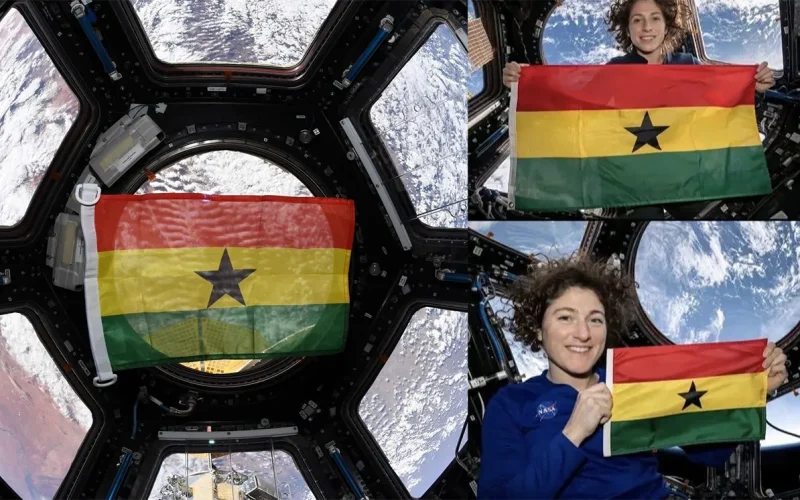
THERE is a version of history that is written in fire and steel – in rocket plumes and re-entry plasma, in the roar of a Space Launch System at dawn. And then there is another kind of history, quieter and more intimate: the kind that lives in an exchange student’s notebook in a university classroom in Legon, Ghana, in 1999. Last week, both versions of history converged in the cold black of deep space, 252,756 miles from Earth, when Christina Koch became the first woman in human history to journey beyond low Earth orbit and swing around the Moon.
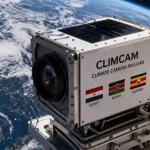
She had Ghana’s flag with her.
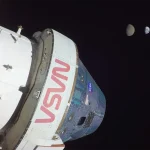
Artemis II lifted off from Launch Pad 39B at NASA’s Kennedy Space Centre in Florida at 6:35 p.m. EDT on 1 April 2026, marking humanity’s first crewed mission to the Moon since Apollo 17 in December 1972. On board the Orion spacecraft — named Integrity — were four astronauts: NASA Commander Reid Wiseman, pilot Victor Glover, mission specialist Christina Koch, and Canadian Space Agency astronaut Jeremy Hansen.
Six days into the mission, on 6 April, the crew achieved what no human beings before them had ever done. At 1:56 p.m. EDT, the Orion capsule surpassed the 248,655-mile distance record set by Apollo 13 in April 1970 — a record that had stood for 56 years. The crew pressed further still, reaching a maximum distance of 252,756 miles from Earth: 4,111 miles beyond any human who had ever lived.
It was Canadian astronaut Jeremy Hansen who gave voice to the weight of the moment, transmitting from Integrity: “From the cabin of Integrity, as we surpass the furthest distance humans have ever travelled from planet Earth, we do so honouring the extraordinary efforts and feats of our predecessors in human space exploration. We will continue our journey even further into space before Mother Earth pulls us back into everything that we hold dear.”
“We most importantly choose this moment to challenge this generation and the next to make sure this record is not long-lived.”
NASA Astronaut Christina Koch, aboard Orion, 6 April 2026
Those words, radioed from behind the Moon to a planet holding its breath, were as much a call to Africa as to any other corner of the world. Because somewhere in the crew cabin, a Ghanaian flag was floating in zero gravity — a small rectangle of red, gold and green that had found its way from the banks of the Volta to the edge of the solar system.
THE LEGON CONNECTION
The story of how Ghana’s flag got to the Moon does not begin with rockets. It begins with a bus journey to the University of Ghana campus in Accra in 1999, and a young American studying astrophysics on an exchange programme.
Christina Koch was not yet an astronaut. She was not yet the woman who would go on to set the record for the longest single spaceflight by a woman — 328 days aboard the International Space Station — or the first woman to conduct an all-female spacewalk. She was a curious, intellectually restless young scientist who had chosen, of all the places in the world she could have gone, to study in Ghana.
And she did not merely attend lectures. According to President John Dramani Mahama, Koch immersed herself fully in Ghanaian academic and cultural life, enrolling in courses that ranged from the History of Ghana and the History of Africa to Rural Sociology, Music, and even Twi for Beginners. These were not the choices of a tourist collecting passport stamps. They were the choices of someone who genuinely wanted to understand a people, a continent and a civilisation.
That investment of curiosity and humility, made in a classroom a quarter-century ago, returned to orbit this week in the most spectacular fashion imaginable.
A PRESIDENT SPEAKS FOR A CONTINENT
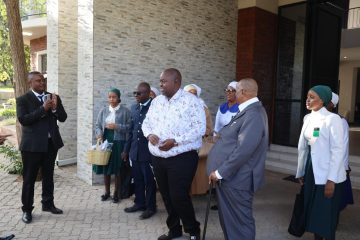
Ghana’s President John Dramani Mahama was among the first heads of state to mark the moment, issuing a statement that moved swiftly from institutional pride to something altogether more personal and more profound.
Writing from the State House, President Mahama declared:
“I join the University of Ghana and the entire nation in celebrating NASA Astronaut Christina Koch on her historic membership of the Artemis II mission. It is a point of immense pride to learn that Christina, the only woman on this pioneering lunar mission, was once an exchange student at our very own University of Ghana during the 1999/2000 academic year.”
H.E. John Dramani Mahama, President of Ghana
President Mahama was careful to separate Koch’s time at Legon from a mere biographical footnote. Her sojourn in Accra, he argued, was formative — not incidental. In language that deserves to be read slowly, he wrote:
“Her time at Legon was not just a passing visit; she truly immersed herself in our culture and heritage. By studying the History of Ghana, the History of Africa, Rural Sociology, Music, and even Twi for Beginners, she built a foundation of global citizenship right here in Accra.”
On the act of hoisting the Ghanaian flag in outer space, Mahama offered this:
“Her gesture of hoisting the Ghanaian flag in outer space was a deeply touching moment for every Ghanaian. It is a testament to the fact that no matter how far one travels, even into the vastness of space, the friendships made and the lessons learned stay with you.”
He concluded with a charge that resonated well beyond Ghana’s borders:
“Christina’s journey from the classrooms of the University of Ghana to the frontiers of space exploration serves as a powerful inspiration to every young Ghanaian. It reminds us that our educational institutions continue to produce and shape global leaders who break barriers and reach for the stars.”
H.E. John Dramani Mahama, President of Ghana
Mahama signed off with a farewell that carried the warmth of a nation genuinely moved: “On behalf of a proud nation, I wish Christina Koch and the entire Artemis II crew godspeed on your return journey to earth. May your success continue to inspire generations across Ghana, Africa, and the world to believe that there’s no height that is insurmountable. Congratulations, Christina. Ghana is proud of you!”
WHAT ARTEMIS II ACTUALLY ACHIEVED: THE MILESTONES
It is worth pausing to register, in their full technical and historical gravity, exactly what the Artemis II crew accomplished in their ten days in deep space. Africa’s name was not attached to a minor episode. It was attached to one of the defining feats in the history of human civilisation.
| ARTEMIS II: MISSION AT A GLANCE | |
| Launch | 1 April 2026, 6:35 p.m. EDT — Kennedy Space Center, Pad 39B |
| Spacecraft | NASA Orion capsule, named “Integrity”, atop SLS rocket |
| Crew | Reid Wiseman (Cmdr), Victor Glover (Pilot), Christina Koch, Jeremy Hansen (CSA) |
| Distance Record | 252,756 miles from Earth — farthest humans have ever travelled |
| Previous Record | 248,655 miles, Apollo 13, April 1970 (stood 56 years) |
| Closest to Moon | 4,067 miles above the lunar surface during flyby |
| Lunar Observation | Seven-hour flyby of near and far sides of the Moon |
| Historic First | Christina Koch: first woman to travel beyond low Earth orbit |
| Solar Eclipse | Crew witnessed solar eclipse from behind the Moon; studied solar corona |
| Meteor Flashes | Six meteoroid impact flashes observed on the lunar surface |
| Return | Splashdown off San Diego coast, approximately 10 April 2026 |
| First since Apollo | First crewed lunar mission since Apollo 17, December 1972 |
The crew did more than simply travel far. During the seven-hour lunar observation period, the astronauts paired up at Orion’s windows to photograph and describe geologic features — ancient lava flows, impact craters, and surface ridges — on both the near and far sides of the Moon. NASA’s lunar science team noted that shades of brown and blue visible to human eyes can help reveal mineral composition and the age of surface features in ways that robotic probes cannot replicate.
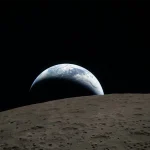
During a planned 40-minute communications blackout as Orion passed behind the Moon, the crew reported witnessing “Earthset” and then “Earthrise” — the Earth appearing to sink behind the lunar horizon and then re-emerge. Koch described the overwhelming emotional power of “having the first glimpses of Earth again after being out of communication for about 45 minutes”. She added, with characteristic directness: “Everything we need, the Earth provides, and that is in itself something of a miracle, and one that you can’t truly know until you’ve had the perspective of the other.”
The astronauts also observed the solar corona during a nearly hour-long eclipse, reported six meteoroid impact flashes on the Moon’s surface, and made what is believed to be the first ship-to-ship radio call between a deep space mission and the International Space Station.
When NASA Administrator Jared Isaacman asked the crew to describe their journey in a single word, Koch answered: “humility”. She elaborated: “We would never be here if it weren’t for so many people that came before us — starting with Neil Armstrong, Katherine Johnson, civil rights movement leaders — everyone who worked on this spacecraft before we got here.”
THE DEEPER SIGNIFICANCE FOR AFRICA
For African governments, universities and young people watching the Artemis II mission unfold, the Koch-Legon connection is not merely heartwarming. It is instructive, and it demands an honest accounting of what it reveals.
African institutions educated a future record-breaking astronaut. Not incidentally. Meaningfully. The history of Ghana that Koch studied, the music she absorbed, the Twi she attempted — these shaped a scientist who chose the word “humility” to describe standing at the edge of the known universe. There is a direct line between the breadth of a Ghanaian education and the character of the woman who drew Earth’s eye to the Moon this week.
That line matters because it pushes back, with quiet force, against a persistent and pernicious narrative: that Africa is a place scientists leave, not a place that makes them. The University of Ghana did not simply host Christina Koch. It contributed to her. And she honoured that contribution by carrying a flag that the cosmos had never before seen.
President Mahama understood the stakes. His statement was not diplomatic boilerplate. It was a deliberate assertion of African intellectual and cultural contribution to one of history’s greatest achievements. Every young Ghanaian — every young African — who reads that statement is entitled to feel that the Moon flyby belongs, in some small and real way, to them.
History is frequently miserly with Africa. The continent’s contributions to science, philosophy, mathematics and civilisation are routinely footnoted, omitted or attributed elsewhere. The Artemis II story offers a rare corrective — and it arrives not through protest or politics, but through the quiet fidelity of a flag folded into a spacecraft and the loyalty of a woman who remembered where she had been shaped.
When the Orion capsule named Integrity splashed down off the coast of San Diego, it carried back to Earth more than scientific data and historic records. It carried the proof that knowledge has no borders, that education transcends geography, and that a classroom in Legon, in 1999, reached all the way to the dark side of the Moon.
Ghana was proud. Africa should be, too. And those who design the continent’s educational and scientific policies should take careful note of exactly what quality of investment produced this moment — and what it would mean to produce many more like it.