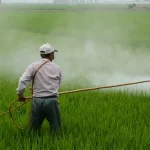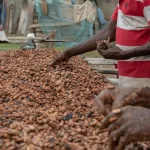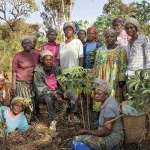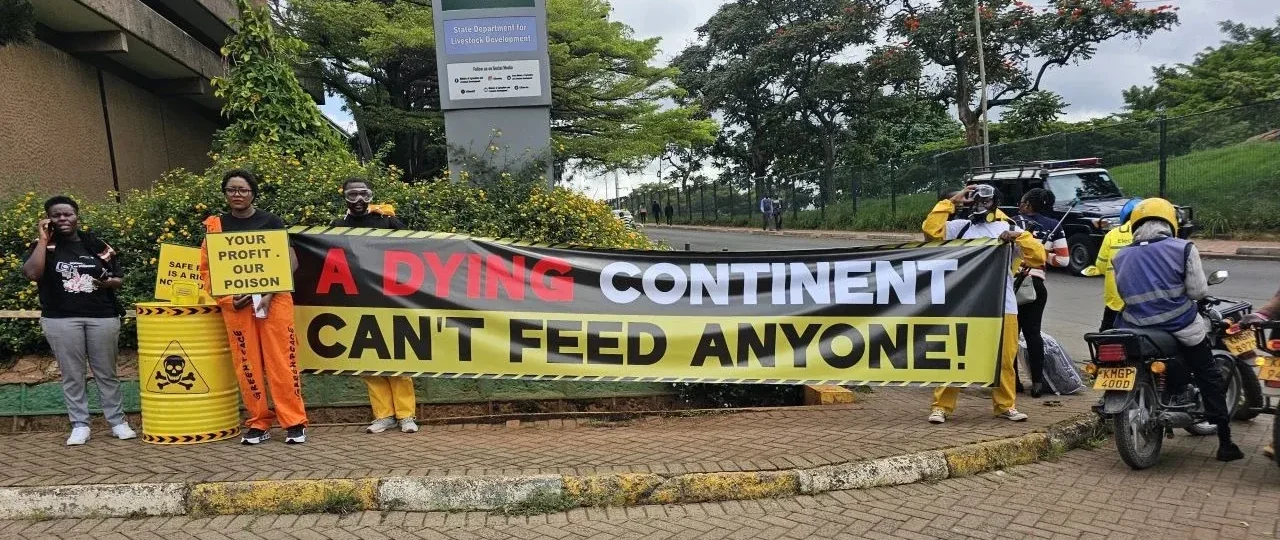

IN the fertile fields of rural Africa, where food should nourish life, a quiet danger is taking root. From Kenya’s vegetable farms to West Africa’s cocoa fields, millions of smallholder farmers are increasingly reliant on highly hazardous pesticides, chemicals so toxic that many have already been banned in Europe. Yet, paradoxically, they continue to flow into African markets in large volumes, raising urgent questions about food safety, global inequality, and environmental justice.
A recent investigation by Greenpeace Africa reveals how dozens of pesticides deemed unsafe for human health elsewhere are still widely used across the continent.
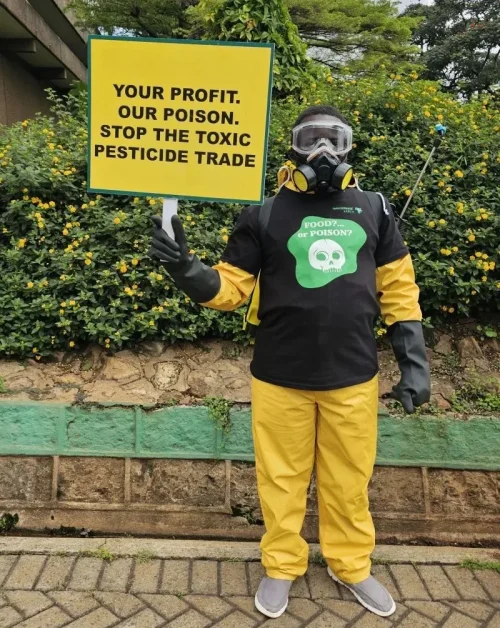
In 2024 alone, nearly 9,000 tonnes of such chemicals were slated for export from Europe to Africa.
The report titled“Food or Poison? The Cost of Highly Hazardous Pesticides to Afrca’s Food Security” documents a silent environmental crisis unfolding across Kenya, Ghana and South Africa where toxic pesticides, including chlorpyrifos, glyphosate, imidacloprid, and atrazine, are being detected across entire river systems, accumulating in soils, and wiping out the pollinators and soil organisms that agriculture depends on.
Elizabeth Atieno, Food Campaigner, Greenpeace Africa, said Africa is poisoning the natural systems that our food depends on. The bees, the soil, and the rivers are the foundation of every farm in Kenya. When we lose them, we lose farming itself.
“What this report shows is that the damage is already happening, and almost no one is measuring it. The government has taken a first step with the partial ban, but a ban without monitoring tells us nothing about whether we are actually recovering,” said Atieno.
Evidence from the three case-study countries reveals that HHPs are pervasive in water, soil, and food products. In Kenya, for example, study findings show that 60% of soil samples contained pesticide residues, with many concentrations high enough to harm soil life. Similarly, in Ghana and South Africa, research has detected toxic “cocktails” of multiple pesticides in waterways, which can lead to secondary problems like increased mosquito resistance to malaria control and the fueling of diseases like Bilharzia by killing natural snail predators. The report emphasises that these chemicals do not stay where they are sprayed; they drift through the air and wash into rivers, even contaminating protected wildlife areas like the Maasai Mara.
A daily gamble for farmers and consumers
Silke Bollmohr, Report Author and Researcher for Greenpeace Africa, said the pesticides are not just staying on farms but spreading into waterways, accumulating in bee products, and contaminating household dust that children breathe every day.
“What makes this even more alarming is that most countries have no systematic monitoring in place, so the true scale of contamination remains largely invisible. We are making decisions about Africa’s food future in the dark,” he said.
According to Jeff Kahuho, Senior Program Officer, PELUM Kenya, smallholder farmers are caught in a trap. They are sold the idea that chemicals are the only way to protect their crops, yet the same chemicals are degrading the very soil and water that farming depends on.
For many African farmers, pesticides are not a choice but a matter of survival. Market pressures, crop losses, and aggressive marketing by agrochemical companies have entrenched their use, but the cost is devastating.
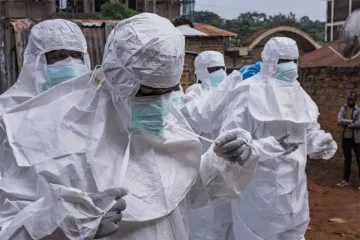
Farmers often handle these chemicals without protective gear, exposing themselves to acute poisoning, long-term illness, and even death. Consumers, meanwhile, unknowingly ingest pesticide residues in everyday foods. In Kenya, studies have found fruits and vegetables on local markets containing chemical residues above safe limits.
“These pesticides stay in the soil and are absorbed by crops,” notes Greenpeace. “Eventually, they end up on our plates.”
At the heart of the crisis lies a stark double standard. Chemicals prohibited in Europe for being “too dangerous” are still manufactured there and exported to African countries with weaker regulatory systems.
This has led critics to describe Africa as a dumping ground for hazardous agrochemicals, where profit is prioritised over public health.
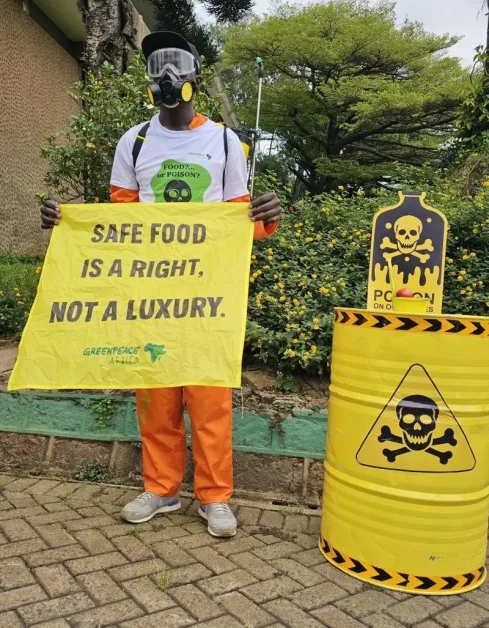
“The question we can’t ignore,” Greenpeace argues, “is why substances considered unsafe in one part of the world are still deemed acceptable elsewhere.”
Weak regulation, strong dependence
Part of the problem is regulatory gaps. Many African countries lack the capacity to monitor pesticide residues, enforce bans, or educate farmers on safe alternatives.
At the same time, economic realities trap farmers in dependency. Cheap, accessible, and heavily marketed, pesticides are often seen as insurance against crop failure—even when they pose long-term risks.
The result is a vicious cycle: rising pesticide use, declining soil health, and growing vulnerability among already fragile farming communities.
Kenya’s recent ban on 77 HHPs is a step forward. But the report warns that critical loopholes remain. Chlorpyrifos is still permitted for termite control. Imidacloprid remains allowed in greenhouses. Without strict enforcement, clear timelines, and farmer support for safer alternatives, the ban risks becoming symbolic.
The report calls for continental phase-out timelines for all HHPs, a ban on the export to Africa of pesticides prohibited in the EU, investment in agroecological farming practices, and the establishment of regional monitoring frameworks across the continent.
To secure Africa’s future, the report recommends a transition toward agroecology: farming practices that work with nature rather than against it. Key recommendations include establishing national phase-out timelines for HHPs, strengthening enforcement of existing bans, and increasing regional coordination. It also calls for better investment in research and monitoring systems for soil health and pesticide residues, alongside providing farmers with training and access to organic inputs. Ultimately, the report concludes that phasing out these toxic chemicals is a fundamental fight for the continent’s health, justice, and long-term food security.