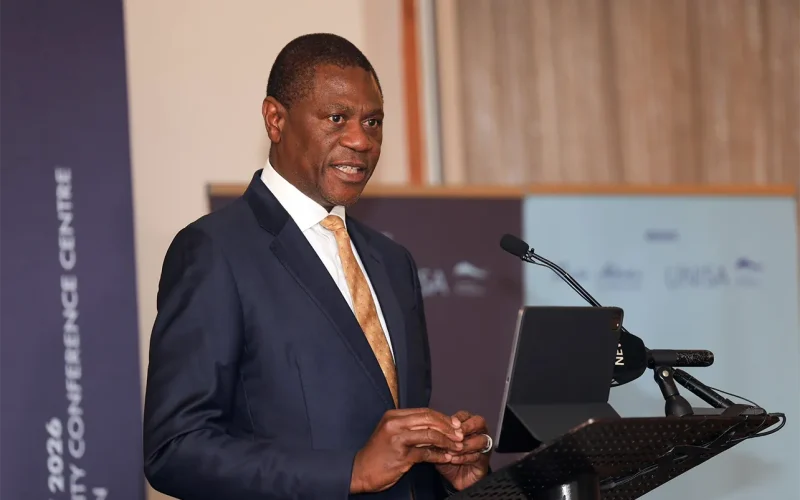
DEPUTY President Shipokosa Paulus Mashatile opened a high-level address marking twenty-five years of NEPAD with an uncomfortable detour: a direct and unambiguous condemnation of the wave of anti-immigrant violence that has swept parts of South Africa in recent weeks, even as he stood before an audience assembled to celebrate the continent’s development architecture.
The juxtaposition was striking. NEPAD was conceived as Africa’s own pledge to itself — a framework of continental integration, mutual accountability, and shared prosperity. Yet Mashatile was compelled to begin by acknowledging that the host country of that aspiration had, in the weeks preceding the anniversary event, recorded scenes of mob violence directed at foreign nationals on its own streets.
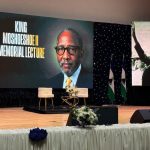
“While acknowledging concerns about illegal foreign nationals involved in crime, we strongly condemn the anti-migrant protests and xenophobic violence and urge law enforcement to address these issues through legal means, not mob violence,” Mashatile told delegates at the Century City Conference Centre in Cape Town, where the gathering was attended by former President Thabo Mbeki — the intellectual architect of NEPAD itself.
The Deputy President echoed President Cyril Ramaphosa’s earlier characterisation of the violence, describing the attacks as “shameful” and inconsistent with government policy or the values of South Africans broadly. He called for a united front — government, traditional authorities, civil society, and migrant communities — to confront what he framed as a crisis of dignity.
“These violent acts are shameful and do not reflect the views of South Africans or government policy.”
The remarks carry particular political weight. NEPAD was built on the premise of African solidarity — the idea, championed by Mbeki, that the continent’s challenges are interconnected and must be addressed collectively. Xenophobic violence against fellow Africans on South African soil cuts directly against that founding compact, and Mashatile’s public repudiation of it in this setting amounted to an acknowledgement that the contradiction cannot be papered over.
But having stated it, the Deputy President moved swiftly to the broader continental agenda — a pivot that itself reveals the dual pressures South Africa’s leadership must manage: domestic political volatility on the one hand, and its self-appointed role as champion of pan-African development on the other.
A Continent at 25: Progress Claimed, Gaps Conceded
The anniversary event was convened under the auspices of AUDA-NEPAD — the African Union Development Agency — and brought together ministers, private sector leaders, development finance institutions, and regional economic body representatives. Mashatile delivered the keynote address, with AU Commission Chairperson H.E. Mahmoud Ali Youssouf represented by Phillipus Katamelo, Deputy Speaker of the Namibian National Assembly.
AUDA-NEPAD CEO H.E. Nardos Bekele-Thomas and UNISA Vice-Chancellor Professor Puleng LenkaBula were among the dignitaries present, as was Mbeki — whose role in founding NEPAD in Abuja in 2001 alongside Olusegun Obasanjo of Nigeria, Abdelaziz Bouteflika of Algeria, Hosni Mubarak of Egypt, and Abdoulaye Wade of Senegal gave the occasion its historical texture.
Mashatile did not shy from acknowledging that the vision’s delivery record has been uneven. “Progress has not always occurred at the pace or scale required to transform the material conditions of our people,” he conceded, citing persistent gaps in infrastructure, industrialisation, energy access, digital connectivity, and regional economic integration.
The data points he marshalled were sobering. Intra-African trade accounts for only approximately 15 percent of total African trade — a figure he called insufficient for a continent seeking genuine economic sovereignty. Closing Africa’s energy deficit would require an estimated R3.16 trillion annually, yet in 2023, renewable energy investment on the continent totalled only R247.5 billion — a mere 2.3 percent of global renewable energy investment.
Food insecurity is compounding the picture: many African countries remain net food importers despite agricultural potential, while urban consumers pay approximately 35 percent more for food than their rural counterparts — a structural consequence, Mashatile argued, of failing to treat food production as an industrialisation question.
AfCFTA: The Centrepiece That Must Now Deliver
The African Continental Free Trade Area was the centrepiece of Mashatile’s prescription for the next phase of NEPAD’s agenda. Describing AfCFTA as “one of the most catalytic opportunities available to the continent today,” he called for the strengthening of regional value chains, the expansion of industrial production, and the deliberate circulation of African wealth within the continent.
He went further than rhetoric, proposing concrete operational steps: AUDA-NEPAD should digitise and harmonise border customs procedures in partnership with the AfCFTA Secretariat, with compliance timelines and penalties established to enforce implementation.
“Africa cannot continue exporting raw materials while importing finished products at a higher value — this model exports jobs, industrial capacity, and opportunity outside the continent.”
Mashatile’s framing of the challenge was direct: Africa must move up the value chain, producing more of what it consumes and processing more of what it extracts. He called for productive transformation anchored in beneficiation, manufacturing, logistics integration, energy cooperation, and digital industrialisation.
South Africa’s own role in this vision was explicitly articulated. Positioning the country’s automotive sector, mineral beneficiation capabilities, renewable energy transition, financial institutions, agro-processing capacity, and digital economy as potential anchors for regional integration, Mashatile argued that South Africa must champion an African development model that moves decisively beyond commodity extraction.
Global Peace, Reform of Finance Architecture
In a section that ranged well beyond the continent, the Deputy President used the platform to reiterate South Africa’s calls for peace in Ukraine, the Middle East, Afghanistan, Pakistan, and the DRC — framing these not as distant diplomatic positions but as integral to a world order in which Africa’s development aspirations can be realised.
On global financial architecture, Mashatile advocated for fairer representation within the IMF and World Bank, debt restructuring mechanisms appropriate to Global South realities, and financing models that recognise Africa’s developmental vulnerabilities. He argued that African development must be financed on African terms, with stronger coordination between governments, development finance institutions, private investors, and regional institutions.
Drawing on South Africa’s NEDLAC model — which brings government, business, labour, and civil society together — Mashatile proposed this spirit of structured dialogue as a template for continental consensus-building: “Just as NEDLAC connects diverse voices to build a common path for national progress, so too must Africa connect its regions, its economies, and its people.”
He also disclosed that in his capacity as special envoy to South Sudan, he has directly observed the peace process on the ground — describing what he called a palpable yearning for stability among South Sudanese citizens that he characterised as a compelling call to action for the broader African leadership.
The Tension That Remains
The address — ambitious in scope, technically detailed, and Pan-Africanist in register — nonetheless opened and closed under the shadow of the contradiction Mashatile raised in his opening. A South Africa that condemns the violence being visited upon African migrants on its own streets, while simultaneously positioning itself as the continent’s indispensable development partner, faces questions of credibility that rhetoric alone will not resolve.
What the NEPAD@25 gathering did produce was a sharper articulation of where the Deputy President — and, by extension, the Ramaphosa administration — wants the next decade of continental architecture to go: from policy aspiration to scaled delivery, from commodity dependence to industrial transformation, and from fragmented bilateral relationships to a unified African voice in a multipolar world.
Whether South Africa can make that case convincingly while managing a domestic political environment capable of producing mob violence against the very Africans it claims to stand with will define, as much as any summit communiqué, the credibility of its pan-African leadership.