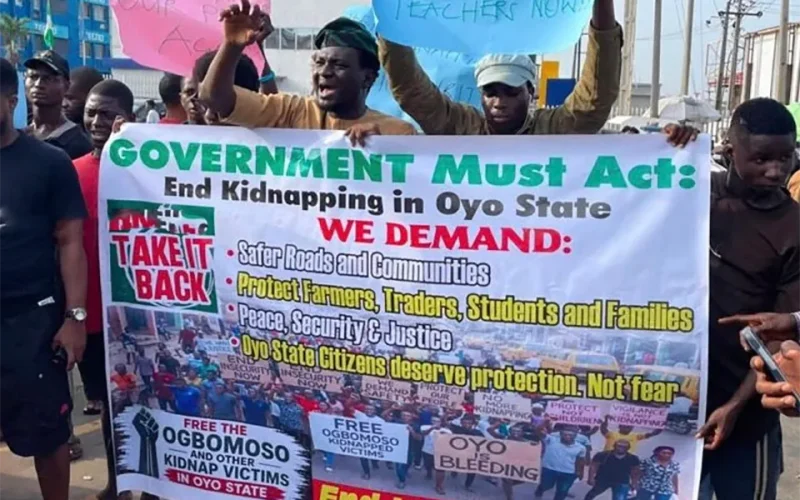
IN the Yoruba-speaking heartland of south-western Nigeria – a region long considered insulated from the kidnap economy that has ravaged the country’s north – the unthinkable has now twice become the thinkable. On the morning of 15 May 2026, twelve gunmen arrived on six motorcycles at the Ahoro-Esinele and Yawota communities in Oriire Local Government Area of Oyo State. They were dressed in military-style camouflage. Eyewitnesses say they communicated in a fluid mix of Yoruba, Hausa, and Pidgin – the vernacular of Nigeria’s borderless banditry – and that for a brief, terrible moment, residents mistook them for security personnel.
They were not. Within minutes, three schools – Community Grammar School, Baptist Nursery and Primary School, and L.A. Primary School – had been simultaneously overrun. Shots were fired into the air. Children scattered. Michael Oyedokun, a mathematics teacher who placed himself between the attackers and his pupils, was seized. He would later be beheaded in captivity – a deliberate message. The vice-principal of Community High School, Mrs. Folawe Alamu, was dragged away with seven colleagues. A motorcyclist who refused to surrender his bike was shot dead. An assistant headmaster, Mr. Adesiyan, was also killed. When security personnel later moved in to pursue the kidnappers, they detonated improvised explosive devices planted along the forest tracks.
When the gunfire stopped, 46 people were missing: 39 students – including a two-year-old child – and seven teachers. The youngest victim, not yet old enough for formal schooling, has now spent nearly three weeks in an Oyo forest.
“The victims were abducted despite earlier warnings and appeals for strengthened school security.”
Nigeria Union of Teachers — National Leadership Circular, 29 May 2026
The Strike: A Nation’s Teachers Lay Down Tools
Seventeen days after the attack, the Nigeria Union of Teachers had run out of patience. On 1 June 2026, the NUT’s Oyo State Wing, under Chairman Comrade Hassan Fatai, directed all public primary and secondary school teachers in the state’s 33 local government areas to withdraw their services – indefinitely and without condition – until the abducted colleagues and learners were freed. Academic activities across Oyo came to a standstill.
But the national leadership went further. In a circular dated 29 May and signed by NUT President Audu Amba and Secretary Clinton Ikpitibo, the union directed every state chapter across the federation to stage solidarity rallies on 2 June 2026, marching to government houses where union leaders would address the press. The directive described the conditions endured by the captives as “horrifying, inhumane and nightmarish.”
The response was nationwide. Teachers in Enugu, Akwa Ibom, Borno, and other state capitals took to the streets on Tuesday. In Borno – itself a permanent frontline in Nigeria’s long insurgency – NUT members gathered outside the government house to protest abductions that have become a defining feature of that state’s daily reality. In Akwa Ibom, NUT officials explicitly paralleled the moment to the union’s national school shutdown following the Chibok abduction of April 2014. The comparison was not made lightly: it acknowledged that twelve years had passed and nothing had fundamentally changed.
The Oyo State strike also cast into sharp relief a parallel – and often overlooked – crisis in the Federal Capital Territory, where teachers had already been on indefinite strike since 20 April 2026 over entirely separate grievances: the non-implementation of a welfare committee report submitted in August 2025, trapped promotions, and unpaid entitlements. As activist Aisha Yesufu noted at the time, “when teachers are pushed to the wall, what suffers first is not government pride – it is the future of children.” Nigeria’s teachers, it appears, are being pushed from multiple directions at once.
| The Oriire Abduction: Key Facts | |
| Date of Attack | 15 May 2026, approximately 08:00–09:00 hrs |
| Location | Oriire LGA, Oyo State — Ahoro-Esinele / Yawota communities |
| Schools Targeted | Community Grammar School; Baptist Nursery & Primary School; L.A. Primary School |
| Victims Abducted | 46 total: 39 pupils/students (including a 2-year-old); 7 teachers incl. Vice-Principal Mrs. Folawe Alamu |
| Killed in Attack | Mathematics teacher Michael Oyedokun (beheaded in captivity); Asst. Headmaster Adesiyan; 1 motorcyclist; 1 security operative (IED) |
| Attackers | ~12 gunmen, 6 motorcycles, military camouflage; communicated in Yoruba, Hausa, Pidgin |
| Days in Captivity | 19 days as of 3 June 2026 |
| Strike Declared | 1 June 2026 — indefinite, all public schools, Oyo State |
| Nationwide Rallies | 2 June 2026 — all NUT state chapters, terminating at Government Houses |
Tinubu’s Response: A Delegation, 1,000 Forest Guards, and Questions
The Presidency’s response, when it came, was to send a high-powered delegation. On Sunday, 31 May 2026 – sixteen days after the attack – National Security Adviser Nuhu Ribadu, Inspector General of Police, House Speaker Abbas Tajudeen Gbajabiamila, and the Defence Minister visited Ogbomoso. They met with community leaders and the families of the captives. They promised. Presidential spokesman Bayo Onanuga announced that President Bola Tinubu had approved two specific measures: the recruitment of 1,000 forest guards to be deployed in collaboration with the Oyo State Government, and the deployment of a specialised rescue unit.
A third request from community leaders – the establishment of a permanent military base in the area – was said to have been “transmitted to the President for consideration and approval.” The delegation conveyed the NSA’s assurance that “no stone would be left unturned.” Ribadu told the grieving families that “the kidnapping of a two-year-old infant is nothing but evil.”
Governor Seyi Makinde of Oyo State, to his credit, moved faster. He visited the communities personally, six suspects including alleged informants were arrested, and a joint rescue operation involving soldiers, police, and local vigilantes was mounted – only to be hampered by the IEDs planted by the kidnappers. Makinde was also the first official to confirm, publicly and painfully, that teacher Michael Oyedokun had been murdered in captivity.
The critique that hangs over both levels of government is structural rather than personal. Sixteen days elapsed between the abduction and the federal delegation’s arrival. The 1,000 forest guards must still be recruited, trained, and deployed. The communities of Oriire sit on the edge of a forested belt that kidnappers have been exploiting since May 15; those forests have not grown safer. And however sincere the commitments made on 31 May, the NUT’s point – that warnings about school security in the area had been ignored before the attack – has not been answered.
“We decided not to shut down our schools entirely because that has been the objective of Boko Haram from the beginning — to discourage education and deny children access to learning.”
Oyo NUT Chairman Comrade Hassan Fatai
Twelve Years of Classrooms Under Fire: A History
To understand why Nigerian teachers are marching in every state capital, it is necessary to hold the full weight of the country’s school abduction crisis – a crisis that predates the Tinubu administration, the Buhari administration, and indeed the return of democratic governance in the South-West to meaningful stability.
The modern epidemic dates to the night of 14 April 2014, when Boko Haram militants stormed the Government Girls Secondary School in Chibok, Borno State, and seized 276 students. The attack detonated a global movement – #BringBackOurGirls – and triggered the NUT’s first national school shutdown in solidarity. Twelve years later, more than 90 of the Chibok girls remain unaccounted for. The movement is still active. The girls are still missing.
What followed Chibok was not a turning point but a template. In February 2018, a Boko Haram faction abducted 110 schoolgirls from a science college in Dapchi, Yobe State. In December 2020, more than 300 boys were taken from a boarding school in Kankara, Katsina. The Kankara abduction was jarring in a specific way: it happened in President Buhari’s home state, and the boys were released within days – a speed that raised uncomfortable questions about the terms of their return.
The year 2021 was catastrophic. In the first six months alone, nearly 1,000 schoolchildren were kidnapped across Nigeria. In February, 27 students were seized from Government Science College, Kagara, Niger State. Later that same month, over 300 girls were taken from Government Girls Secondary School in Jangebe, Zamfara, and released within days — again, after apparent ransom negotiations. In March, 39 students were taken from the Federal College of Forestry Mechanisation, Afaka, Kaduna. In April, five students of Greenfield University, Kaduna, were murdered — killed, reportedly, because ransom negotiations were moving too slowly. In July, over 120 students were dragged from their dormitory beds at Bethel Baptist High School, Chikun, Kaduna. Of the 153 abducted, 125 reportedly remain unaccounted for.
The crisis did not end with a change of administration. Under President Tinubu, who took office in May 2023, nearly 600 schoolchildren have been abducted. In March 2024, 287 students were taken from a school in Kuriga, Kaduna, in a single raid. In November 2025, gunmen attacked St. Mary’s Catholic School and seized 315 children, of whom 253 reportedly remain in captivity. That same month, 25 students were abducted from a school in Maga, Kebbi State.
In total, as of June 2026, at least 2,531 students have been kidnapped across more than 31 school attacks since 2014. The numbers, as civil society organisation EiE Nigeria observed in late 2025, “are not statistics — they represent children robbed of their futures, families shattered, and communities living in perpetual fear.”
The May 2026 attacks in Oyo and neighbouring Borno State — where a simultaneous abduction took place in Askira-Uba LGA — mark a geographical metastasis. The conventional geography of this crisis placed it firmly in the north: in Borno, Kaduna, Katsina, Zamfara, Kebbi, and Niger. Oyo State’s suffering shatters that assumption, as security analysts at the Ogun Security Research Service bluntly put it: “The South West has historically been spared the worst of Nigeria’s mass abduction crisis. That assumption has now collapsed.”
| School Abduction Timeline: Nigeria 2014–2026 | |
| April 2014 | Chibok, Borno — 276 girls abducted by Boko Haram. 90+ still missing. |
| February 2018 | Dapchi, Yobe — 110 schoolgirls abducted. Most returned; 1 killed. |
| December 2020 | Kankara, Katsina — 344 boys abducted. Released after 6 days. |
| Feb–Aug 2021 | Multiple attacks: Kagara (27), Jangebe (317), Afaka (39), Greenfield (5 killed), Bethel Baptist (153). ~1,000 abducted in 6 months. |
| March 2024 | Kuriga, Kaduna — 287 students. Most released after rescue intervention. |
| November 2025 | St. Mary’s Catholic School — 315 abducted; 253 reportedly still held. |
| November 2025 | Maga, Kebbi — 25 students abducted. |
| May 2026 | Oriire LGA, Oyo — 46 teachers/pupils incl. a 2-year-old. 1 teacher beheaded. |
| May 2026 | Askira-Uba, Borno — Simultaneous abduction of schoolchildren. |
| TOTAL (2014–2026) | 2,531+ students abducted across 31+ school attacks. |
The Structural Question the Government Has Not Answered
The pattern across twelve years is consistent: attack; outcry; delegation; promises; partial releases; forgetting. When new attacks occur, the cycle restarts. The machinery of accountability rarely turns. The NSA tells grieving families no stone will be left unturned. The cycle prepares to turn again.
What has changed in Oyo is the geography of terror — and with it, the political calculus. The South-West is Tinubu’s political stronghold. Oyo State elected and re-elected Governor Makinde of the opposition PDP, but the region remains broadly significant to presidential legitimacy. If kidnappers can operate with impunity in Oriire LGA, the implicit guarantee of security that the federal government extended to its core support base has been broken.
There are also deeper structural questions about the nature of the attackers. Security analysts note that the Oriire gunmen communicated in three languages, wore military camouflage, and planted IEDs — a level of operational sophistication that goes beyond opportunistic banditry. The kidnapping of a two-year-old is not economically rational as a ransom strategy; it is terror as spectacle, designed to maximise fear and demonstrate total impunity.
Nigeria’s forest cover — expanding in strategic belts across the Middle Belt and now into the South-West — has become an operational highway for non-state armed actors. The 1,000 forest guards Tinubu has approved will need to be recruited, trained, equipped, and deployed into terrain the kidnappers already know intimately. Whether this constitutes a credible security response, or whether it is a visible gesture made under the pressure of a national teachers’ strike, remains an open question.
For the NUT, the answer will come only when the 46 captives are free. For the families in Ahoro-Esinele and Yawota, counting the days since 15 May, the answer is long overdue. For the youngest victim — a two-year-old child somewhere in an Oyo forest — no strategic calculation matters at all. What matters is a mother’s arms. What matters is rescue. What matters is that the Nigerian state, which has presided over 31 school attacks and 2,531 abductions in twelve years, finally decides that enough is enough — and acts as if it means it.