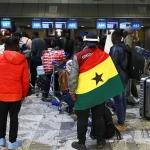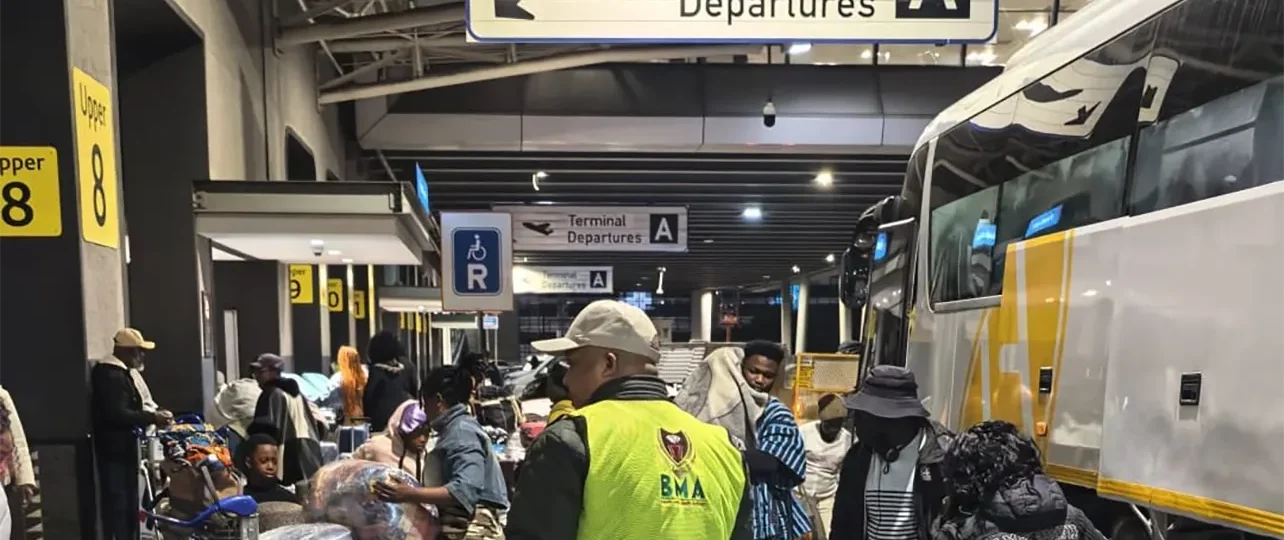

ON a Sunday morning at OR Tambo International Airport, 340 Ghanaian nationals boarded a chartered flight home — not as tourists, not as returning migrants enriched by their sojourn in the south, but as the latest passengers on Africa’s growing repatriation express. Some had overstayed their welcome by more than a month. Others had withdrawn asylum applications they presumably once held with some desperation. Thirty-seven were children, born on South African soil, leaving it on emergency travel certificates they would not have chosen for themselves.
That single operation, conducted on 7 June 2026, tells the story of a continent in profound, accelerating motion — and of governments scrambling, with varying degrees of mercy and menace, to manage the consequences.
“If they continue to fail their citizens at home, they may soon find that there are fewer and fewer places left for those citizens to run to.”
Africa is no longer merely a place from which people flee toward Europe or the Gulf. It is increasingly a continent that generates, absorbs, detains and expels its own displaced citizens, often with brutal efficiency, sometimes with diplomatic grace, rarely with anything resembling a coherent continental strategy. The migration crisis, for so long framed as Africa’s contribution to Europe’s political anxieties, has now turned fully inward.
South Africa: Enforcement at Scale
South Africa’s position as the continent’s most industrialised economy has made it an unavoidable magnet. Estimates of the undocumented population vary wildly — a 2022 figure suggested as many as 15 million undocumented foreign nationals in a country of roughly 62 million — though demographers caution that such numbers are inherently unreliable. What is not in dispute is the political temperature.
The numbers from the Department of Home Affairs are stark in their trajectory. Deportations rose 30 percent in 2024/25, climbing from 39,672 to 51,560. The following year saw a further 12 percent increase, to 57,784. Taken together, the country deported 109,344 people in just two financial years — a cumulative 46 percent surge that Home Affairs Minister Dr Leon Schreiber has framed as the “fruits of reforms.”
“Our message remains clear: If you are in South Africa illegally, self-deport now before we find you and ban you from ever entering our country legally in future,” Schreiber has warned, signalling that the intensification is intentional policy, not an administrative accident.
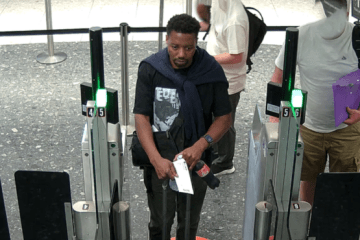
The Border Management Authority, established in 2023, has become the operational instrument of this policy shift. In the second quarter of the 2025/26 financial year alone, BMA officers processed more than 9.2 million traveller movements — a 23 percent increase from the prior year — while recording 8,135 apprehensions, including 4,092 undocumented individuals. Since Border Guards were first deployed in July 2022, more than 505,000 people have been stopped from entering the country illegally.
The Ghanaian repatriation of 7 June is a case study in how the enforcement machinery now operates. Of the 331 Ghanaians brought to OR Tambo by their own High Commission, 170 were found to have overstayed their permitted period by 30 days or more, and were consequently declared undesirable under Section 30 of the Immigration Act. Twenty-five had previously claimed asylum — and had since chosen to withdraw those claims, a decision that speaks to either the deteriorating experience of the asylum process in South Africa, or a pragmatic calculation that the repatriation route had become the easier path home. The BMA Commissioner, Dr Masiapato, commended the operation as a model of bilateral cooperation. On the evidence, it was precisely that.
“The successful processing of these repatriation movements reflects the importance of coordinated efforts between foreign missions and South African authorities.”
BMA Commissioner Dr Masiapato
But the wider political context in which such operations take place is far less orderly. Anti-migrant movements — among them Operation Dudula and March and March — have staged protests across several cities, setting June 30 as a self-imposed deadline by which they demand undocumented foreigners depart. Reports from civil society organisations document a pattern of intimidation, unlawful evictions, workplace discrimination, extortion by police officers, and in some cases physical assault. President Cyril Ramaphosa has announced a Comprehensive Approach for Migration Management — including dedicated immigration courts, biometric population registers, tougher penalties for employers hiring undocumented workers, and the scaling up of Electronic Travel Authorisations — while explicitly warning that there is “no space for xenophobia” in South Africa. The political responses to his address have been sharply divided, with parties ranging from those calling for stricter enforcement and faster deportations to others decrying xenophobia as a symptom of governance failure.
Tunisia: Where Africa’s Crisis Meets Europe’s Anxiety
If South Africa represents one pole of Africa’s internal migration reckoning, Tunisia represents another — and a darker one. Protesters gathered outside the UNHCR headquarters in Tunis on Saturday, 7 June, demanding the deportation of undocumented sub-Saharan African migrants and calling on the United Nations refugee agency to leave the country altogether. The demonstration carried the unmistakable mark of organised political energy, with activists seen coordinating the crowd before it dispersed under heavy security.
Tunisia’s anti-migrant politics have deep, ugly roots that were fertilised by presidential rhetoric. In February 2023, President Kais Saied publicly claimed that “hordes of illegal migrants” from sub-Saharan Africa posed a demographic threat to the Arab-majority country — language that triggered racially motivated attacks and set in motion a sustained campaign of expulsions that continues to this day.
The Human Rights Watch World Report 2026 documented that Tunisian authorities expelled at least 12,000 people between January and April 2025 alone — including unaccompanied children — through a combination of arbitrary arrests, collective expulsions to desert border areas with Algeria and Libya, ill-treatment, and in some cases, torture and sexual violence. Amnesty International documented security forces using teargas and tasers on asylum seekers camped outside UNHCR offices, including against children. Some were forcibly returned to the Libyan border, an apparently unlawful collective deportation under international law.
Those expelled to the desert borderlands faced conditions that rights groups have described as life-threatening. In the summer of 2023, when the first major wave of expulsions to the Algerian and Libyan borders occurred, at least a hundred people were reported to have died. The Mediterranean remains the ultimate destination for many of those who survive. More than 97,000 people crossed the Mediterranean from Tunisia to Italy in 2023 alone — and the numbers have not abated.
Tunisia is estimated to hold between 20,000 and 50,000 sub-Saharan migrants at any given time, many of them from Cameroon, Ghana, Guinea and Côte d’Ivoire, working in informal jobs to fund their European ambitions. The tightening of security has progressively restricted their access to healthcare, education, transport and housing. Civil society organisations that once provided a safety net have been systematically targeted: 14 organisations have partially suspended or reoriented their work following a government crackdown, while five have shut down altogether.
Libya: The Corridor That Cannot Close
Libya remains the bloodiest chapter in this continental story. On 31 May 2026, the 690th Infantry Battalion of Libya’s Border Guard Branch apprehended 107 undocumented migrants of Sudanese and Egyptian nationalities in the Tobruk area, transferring all to DCIM (Directorate for Combating Illegal Migration) custody. The episode is unremarkable precisely because it is so routine — a weekly, sometimes daily occurrence along a coastline that has become the world’s deadliest migration corridor.
Libya functions less as a destination than as a compressor: a space in which migrants from across sub-Saharan Africa, the Horn, and the Sahel are squeezed between the states that expelled them and the sea that may or may not carry them to Europe. DCIM detention centres have been documented by human rights organisations as sites of abuse, extortion, forced labour and in some cases killing. The absence of a functioning central government means that governance of migration flows is fragmented across militia networks, formal military units and criminal smuggling syndicates that are often indistinguishable from one another.
“We can only solve the migration crisis at the root, in the countries of departure.”
Libyan Prime Minister Abdul Hamid Dbeibah, Trans-Mediterranean Migration Forum 2024
From January 2020 to May 2024, 7,115 people died or went missing in the Mediterranean Sea, while a further 1,180 perished crossing the Saharan Desert to reach it. That collective death toll exceeds the global terrorism death count for 2024. The figures are not metaphors. They are the arithmetic of governance failure.
Nigeria: West Africa’s Emerging Enforcement State
Nigeria — itself a country that periodically receives unwanted migrants from across the porous boundaries of West Africa — has quietly become a more active deportation state. In 2024, the Nigerian Ministry of Interior deported 828 illegal immigrants as part of an effort to combat irregular migration and improve national security. In February 2025, the Nigeria Immigration Service arrested and deported 155 foreigners who had crossed illegally from Cameroon, Chad and Niger. By April 2025, a further 62 people — detained for illegal entry from Mali — had been repatriated.
The trajectory matters. Nigeria, with its own enormous economic pressures, high unemployment and the security crisis in the north driven by Boko Haram and its offshoots, is increasingly framing undocumented migration as a national security issue. The instability of the Sahel — where four countries have now experienced coups since 2020 — has sent ripples of displacement across the region’s porous borders, creating a situation in which the distinction between economic migrant, displaced person, and potential security threat has become functionally impossible to maintain.
The Structural Argument: Governance First
The protest in Tunis and the charter flight from Johannesburg are, at their root, the same story told from different ends. Both are symptoms of the same underlying condition: the failure of African states to create the conditions — economic opportunity, physical security, functional institutions, rule of law — that would make emigration a choice rather than a compulsion.
The data is unsparing. An estimated 34 percent of Africans live in extreme poverty. Of the world’s 28 poorest countries, 23 are in Africa. The continent’s GDP is projected to grow by approximately 4 percent annually — a figure that sounds encouraging until it is measured against a population adding 12 million new labour market entrants every year, with only 3 million formal jobs created annually to absorb them. The arithmetic of desperation is not difficult to calculate.
By 2050, Africa is projected to add a net 740 million people to its population. If the structural conditions that drive migration are not addressed, the human flows of the current era will appear modest by comparison. The question that no African summit, no bilateral repatriation agreement, and no border management authority has yet answered is this: what is the plan for those 740 million people?
The protesters in Tunis, the anti-migrant activists in Johannesburg, and the Libyan coast guard intercepting Sudanese nationals off Tobruk are all, in their different ways, responding to the same political reality: that the receiving end of migration is exhausted, frightened, and in some cases radicalised. What none of them can do is address the conditions at the sending end. That requires governance — and governance is precisely what too many African countries have failed to deliver.
The African Editors’ Verdict
Africa cannot deport its way to prosperity, any more than it can protest its way to it. The repatriation of 340 Ghanaians from OR Tambo on a Sunday afternoon is, taken in isolation, an orderly administrative event. Placed within the context of 109,344 deportations in two years, mass expulsions in the Tunisian desert, 107 detained migrants in Tobruk, and a protest crowd demanding the eviction of the UNHCR, it becomes something else entirely: a continent in the process of closing its doors on itself.
South Africa’s efforts to build a rule-of-law-based migration management system — biometrics, dedicated courts, bilateral cooperation with foreign missions — deserve recognition as the right instinct. But they are necessary, not sufficient. They manage symptoms. The disease is elsewhere: in the palaces of Abuja, Accra, Bamako, Kinshasa and Nairobi, where the choices of those who govern — and of those who plunder — determine whether their citizens will one day board a voluntary homecoming flight, or a forced repatriation charter.
The scenes unfolding across the continent carry an urgent message for every African head of state. The exits are closing. The desert is waiting. And the Mediterranean is not as far away as it once seemed.