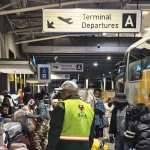
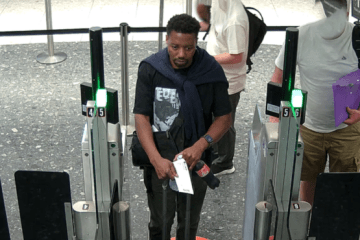
OF the 300 Ghanaian nationals processed for departure from OR Tambo International Airport on Tuesday, 295 boarded the chartered aircraft arranged by the Ghanaian government and flew home. Five did not. Their reasons for being grounded – each distinct, each grounded in a different provision of South African and international law – tell a more complex story than the headline numbers of the week’s repatriation operation suggest.
The Border Management Authority (BMA), whose Commissioner Dr Michael Masiapato confirmed the operation’s outcome, characterised the refusals as procedurally correct and consistent with its legal mandate. The African Mirror examines each case in turn.
Case One: The Man South Africa Is Legally Prohibited from Expelling
The most legally significant of the five refusals involves a Ghanaian national who holds a valid asylum seeker permit – a document that, under both South African domestic law and the 1951 United Nations Refugee Convention, fundamentally alters the state’s obligations toward him.
Unlike the majority of the 300 passengers processed at ORTIA – most of whom were found to be undocumented or in violation of their permitted stay – this individual had an active protection application before South African authorities. That pending claim triggers what international refugee law terms the principle of non-refoulement: the prohibition against returning any person to a country where they may face persecution, serious harm, or other threats to their life or freedom.
The BMA was explicit: he could not be permitted to board the aircraft without first formally cancelling his application for protection in South Africa. That cancellation – a legal act that must be initiated by the applicant – had not taken place. To have placed him on the plane regardless would have exposed South Africa to a refoulement finding, with potential consequences before international human rights bodies.
The BMA’s position is legally sound. But it also opens a question that the repatriation operation did not answer: what becomes of an asylum seeker from Ghana — a country not conventionally regarded as a source of political refugees — who finds himself, following a xenophobia-driven crisis, in a South African immigration processing queue alongside compatriots being sent home? Whether his protection claim has merit is a separate matter. What Tuesday’s operation confirmed is that South Africa’s own legal framework prevented his removal without due process.
He was handed to the Ghanaian High Commissioner pending future repatriation, should he choose to withdraw his application or should his claim be adjudicated and rejected through the proper channels.
Case Two: The Passport That Had Expired — and the Certificate That Never Came
The second refusal is, on its face, the most administratively straightforward – and perhaps the most avoidable.
A Ghanaian national arrived at the departure gate in possession of an expired passport. In ordinary circumstances, this would have been remedied by the Ghanaian Embassy issuing an Emergency Travel Certificate — the single-page, one-way document that the BMA confirmed was issued to approximately 270 others in the same processing queue who lacked valid travel documents.
In this instance, however, the Embassy had not issued an ETC for this particular traveller. The reasons for that omission are not stated in the BMA’s account – whether it was an administrative oversight, a processing error, a disagreement over identity verification, or some other factor is not publicly known.
What is clear is that the traveller arrived at the point of departure with no valid document of any kind: neither a current passport nor an emergency certificate. Under South African immigration law and standard international aviation requirements, no carrier may board a passenger without a valid travel document. The BMA had no legal basis to permit departure.
His situation raises a pointed question about the management of the operation on the Ghanaian government’s side: if the High Commission was responsible for mustering and processing its own nationals for the charter flight, the failure to ensure this individual had valid documentation before he was transported to the airport represents a gap in the coordination between the Ghanaian diplomatic mission and the repatriation operation it was co-managing.
Case Three: Two Children, a Woman Who Is Not Their Mother, and No Papers to Prove Otherwise
The third and fourth and fifth refusals involve a single case: a woman who arrived at OR Tambo with two minor children she claimed belonged to her sister — and who could produce no documentation to support that claim.
South Africa’s law governing the movement of minors across its borders is among the strictest on the continent, having been significantly tightened in 2015 in response to child trafficking concerns. A child travelling with an adult who is not their biological parent or legal guardian is required to be accompanied by a number of documents: an unabridged birth certificate, written consent from the absent parent or legal guardian, and – in cases of travel with a non-parent – documentation establishing the relationship and authority of the accompanying adult.
The woman in question had none of these. She could not demonstrate any documented relationship to the children, and she carried no consent authorization from the alleged sister. The BMA correctly refused her departure with the minors.
The circumstances raise questions that the BMA’s official account does not answer. Where are the children’s parents? Are they in South Africa, in Ghana, or elsewhere? Were the children registered as part of the repatriation cohort in their own right, or were they brought to the airport solely at the initiative of this woman? And critically: what is the children’s status now that they have been handed back to the Ghanaian High Commissioner alongside the adults refused departure? Are they Ghanaian nationals, South African-born, or do they hold dual status?
Child protection law is unambiguous: the state cannot permit the movement of unaccompanied or improperly documented minors regardless of the stated intention of the accompanying adult. The BMA was right to stop this departure. But the case is a reminder that repatriation operations involving mixed cohorts – including families, dependents, and children – require documentation processes that begin well before passengers arrive at an airport gate.
The Wider Picture: Five Cases, One Operation, Multiple Systemic Signals
Taken together, the five refusals are not merely administrative footnotes to an otherwise successful repatriation. They are windows into the legal complexity that lies beneath the surface of any mass migration operation conducted at speed, under diplomatic pressure, and involving a population whose documentation status is – as the BMA itself confirmed – overwhelmingly irregular.
The fact that roughly 90 percent of the 300 passengers were undocumented, requiring emergency travel certificates issued on the spot by their own embassy, speaks to the conditions in which many Ghanaian nationals have been living in South Africa: outside the formal documentation framework, without valid permits, in many cases overstaying by more than a year. The five who could not board the flight represent the outer edge of that complexity — the cases where the irregularity intersects with asylum law, documentation failure, or child protection obligations in ways that a charter flight cannot simply overfly.
The BMA processed 300 people over eight hours. It got 295 of them home. The five it did not are now in the care of the Ghanaian High Commissioner, their futures uncertain, their cases unresolved – left behind in a country that, this week, made clear it wanted them to leave, but could not legally compel all of them to go.