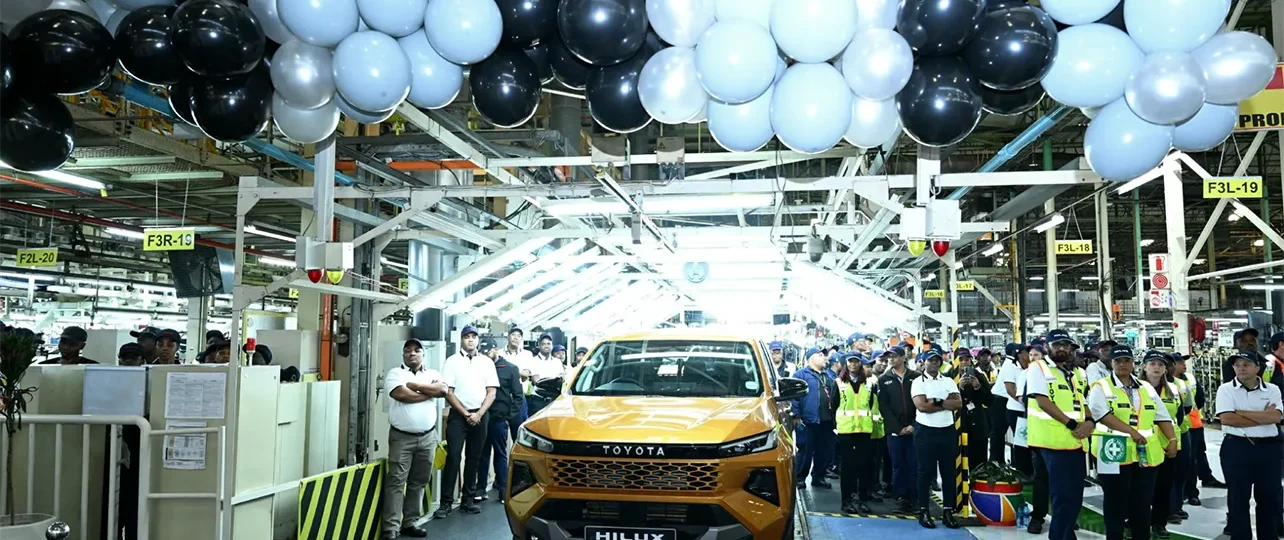

SOUTH Africa’s automotive sector has delivered one of its clearest economic wins of the year, as Toyota South Africa Motors marked the official line-off of the ninth-generation Hilux at its Prospecton plant in eThekwini, backed by a R10.4 billion investment programme that President Cyril Ramaphosa held up as proof the country can convert promises of capital into tangible, working factories.
Speaking at the launch, Ramaphosa framed the milestone as more than a product unveiling. For over fifty years, the Hilux has been woven into everyday South African life, hauling farm equipment, ferrying construction crews and crossing terrain from gravel backroads to mine sites. Despite carrying a global badge, government is treating the model as a homegrown industrial success story: engineered for local conditions, assembled by South African workers and shipped out through South African ports.
THE MULTIPLIER EFFECT
What makes the investment significant is not the assembly line itself but how far its benefits reach. Roughly a third of Toyota’s outlay has gone into strengthening local supplier capacity and tooling, while component suppliers have separately ploughed in an additional R2 billion to expand their own localisation. That two-tier investment structure is designed to deepen South Africa’s domestic manufacturing base rather than simply bolt another model onto an existing line, letting smaller supplier firms grow alongside the main plant and widening the pool of skilled jobs the industry supports.
Ramaphosa used the moment to repeat a line he first delivered at this year’s South African Investment Conference, telling the audience that investors reward execution, not merely commitment. In an environment where governments across the world are competing hard for the same pool of capital, technology and skills, he argued that completed, running factories carry far more weight than announcements alone.
AN INDUSTRY THAT PUNCHES ABOVE ITS WEIGHT
The numbers underline why Pretoria is so invested in the sector’s success. Automotive manufacturing contributes close to five percent of South Africa’s GDP, directly employs more than 115,000 people and supports over half a million jobs once the wider value chain is counted. That scale has pushed South Africa into position as the world’s 21st-largest vehicle producer, an unusually strong showing for an economy of its size, built over decades through cooperation between government, manufacturers, organised labour and suppliers.
Government’s role, Ramaphosa said, is to keep pace with an industry now navigating one of its biggest shifts since the invention of the motor car: the global move toward cleaner mobility, changing consumer demand and shifting trade patterns. He pointed to incentives for component manufacturing, support for developing a domestic battery value chain, and continued investment in new-energy vehicle skills and research as the policy tools government is using to keep South Africa competitive rather than simply reactive. He also flagged the country’s mineral wealth as a long-term advantage, arguing that pairing critical minerals with advanced manufacturing and local beneficiation could position South Africa as a genuine hub for future mobility production.
LOGISTICS AS THE OTHER HALF OF THE EQUATION
None of that industrial ambition works without reliable freight and port infrastructure, and Ramaphosa pointed to recent improvements on that front as encouraging. Transnet’s vehicle terminals in Durban, Gqeberha and East London handled more than 792,000 fully built vehicles in the ten months to February, the strongest throughput the network has recorded in recent years. Government is banking on deeper public-private partnerships in rail and ports to keep that momentum going and to protect South Africa’s standing as an export platform for the continent.
Ramaphosa closed his address by thanking Toyota’s leadership, the Department of Trade, Industry and Competition, the KwaZulu-Natal provincial government, the eThekwini Metropolitan Municipality, organised labour and the plant’s workforce, singling out the men and women of Prospecton whose skill and discipline, he said, travel inside every vehicle that leaves the line.
For an economy working hard to convince global investors it is open for business, the message from Prospecton was straightforward: when government, business and labour pull in the same direction, South African industry can still compete with the best in the world.
AT A GLANCE
| Investment | R10.4 billion in the new-generation Hilux programme |
| Supplier localisation | R2 billion invested separately by component suppliers |
| Sector contribution | ~5% of South Africa’s GDP |
| Direct jobs | 115,000+; over 500,000 across the value chain |
| Global ranking | World’s 21st-largest vehicle producer |
| Port throughput | 792,000+ vehicles handled by Transnet terminals (10 months to Feb 2026) |