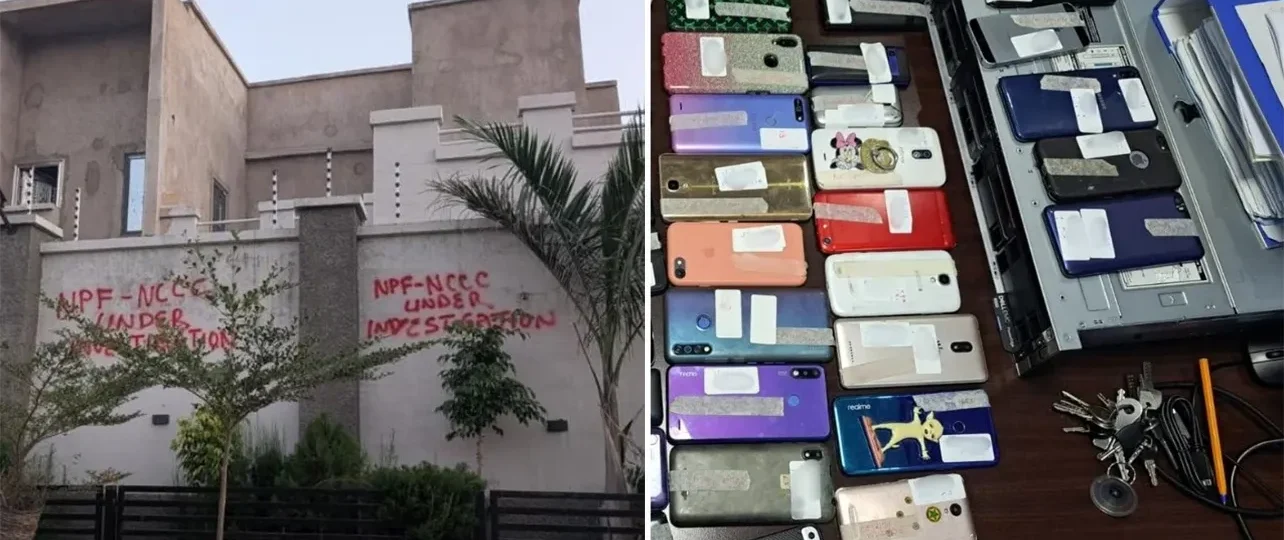

A sweeping international law enforcement operation spanning 16 African nations has dismantled some of the continent’s most prolific online fraud networks, netting 651 arrests and recovering more than $4.3 million in an eight-week blitz that exposed scams responsible for over $45 million in financial losses.
Operation Red Card 2.0, coordinated by INTERPOL and running from December 8, 2025, through January 30, 2026, struck at the heart of criminal syndicates running high-yield investment scams, mobile money fraud and predatory fake loan applications — schemes that investigators say have devastated vulnerable populations across Africa and beyond.
The scale of the operation was unprecedented. Authorities seized 2,341 devices, tore down 1,442 malicious IP addresses, domains and servers, and identified 1,247 victims whose lives and savings had been systematically plundered by fraud rings operating with alarming sophistication.
“These organised cybercriminal syndicates inflict devastating financial and psychological harm on individuals, businesses and entire communities with their false promises,” said Neal Jetton, INTERPOL’s Director of the Cybercrime Directorate. “Operation Red Card highlights the importance of collaboration when combating transnational cybercrime.”
The anatomy of the fraud
The operation laid bare the diverse and ruthless architecture of modern digital crime.
In Nigeria, police dismantled a high-yield investment fraud ring that recruited young people to execute cyber-enabled crimes through phishing, identity theft, social engineering and fake cryptocurrency investment schemes. More than 1,000 fraudulent social media accounts were shut down. Investigators uncovered a residential property — built by the syndicate’s ringleader — that served as the operation’s command centre. In a separate Nigerian breakthrough, six members of a sophisticated cybercrime cell were arrested for infiltrating the internal systems of a major telecommunications provider using stolen staff login credentials, siphoning large volumes of airtime and data for illegal resale.
In Kenya, 27 arrests were made in connection with investment fraud schemes that used messaging apps, social media and fabricated testimonials to lure victims into fake investment vehicles tied to reputable global corporations. The scheme was diabolically simple: victims were encouraged to make small initial deposits — sometimes as little as $50 — with promises of extraordinary returns. They were shown falsified account dashboards showing their “profits” growing. When they tried to withdraw their money, every request was blocked.
In Côte d’Ivoire, 58 arrests were made, and 240 mobile phones, 25 laptops and more than 300 SIM cards were seized in a targeted strike against mobile loan fraud — a crime that preyed on the most financially vulnerable. Victims were lured with promises of quick, unsecured loans through deceptive mobile applications, only to be hit with hidden fees, subjected to abusive debt-collection practices and have their personal and financial data harvested and exploited.
A continental response to a continental crisis
The operation drew law enforcement agencies from Angola, Benin, Cameroon, Côte d’Ivoire, Chad, Gabon, Gambia, Ghana, Kenya, Namibia, Nigeria, Rwanda, Senegal, Uganda, Zambia and Zimbabwe — a coordinated response that signals a new era of cross-border cooperation in the fight against cybercrime.
INTERPOL provided real-time intelligence sharing, digital forensics training and capacity-building support throughout the operation, working alongside private sector partners including Cybercrime Atlas, Trend Micro, TRM Labs and Uppsala Security to deliver actionable intelligence to frontline investigators.
The operation was conducted under the African Joint Operation against Cybercrime (AFJOC), funded by the UK’s Foreign, Commonwealth & Development Office, with additional support from the European Union and Council of Europe’s GLACY-e initiative.
For investigators, the arrests are a major victory. For the victims — 1,247 confirmed, with the real number almost certainly far higher — Operation Red Card is a measure of justice long overdue. For the criminal networks that believed digital borders offered them impunity, it is a clear and resounding warning: the net is closing.