THE man who broke the back of Africa’s most humiliating energy dependency – importing refined petroleum from the very crude Africa exports raw – is now turning his transformative vision eastward. And the continent is watching with barely contained excitement.
Aliko Dangote, the African Energy Chamber’s African Energy Person of the Year 2026, has been crisscrossing East Africa with a proposition that is as audacious as the $19 billion Lagos refinery he built with his own resources when the world’s multilateral financial institutions made it structurally impossible for African governments to do so themselves. He is proposing to build an identical facility in East Africa – a $15 billion to $17 billion oil refinery with a planned capacity of 650,000 barrels of crude oil per day, expected to serve Uganda, Kenya, Tanzania, Ethiopia, South Sudan, the Democratic Republic of Congo, and other regional markets.
The project is no longer a vision. It is a negotiation.
Presidents in the Room
The pivot from ambition to architecture happened at the inaugural Africa We Build Summit in Nairobi on April 23, 2026. Dangote appeared on a panel alongside Kenya’s President William Ruto and Uganda’s President Yoweri Museveni and made a bold statement that caught the room off guard: “My commitment is, if we agree here with the three or four governments, we will lead and make sure that the refinery is built within the next four to five years. Even now, I can give commitment to the two presidents who are here; if they will support the refinery, we will build an identical one to what we have in Nigeria.”
President Ruto did not hesitate. He said East Africa would have a joint refinery in Tanga, Tanzania, to benefit all of the region. “That refinery is going to take on board the oil from DRC, the oil from Kenya, the oil from South Sudan, and the oil from Uganda, and we will just need to build a short pipeline from Tanga to Mombasa, and the finished product will use the pipeline that we already jointly own with Uganda,” he said.
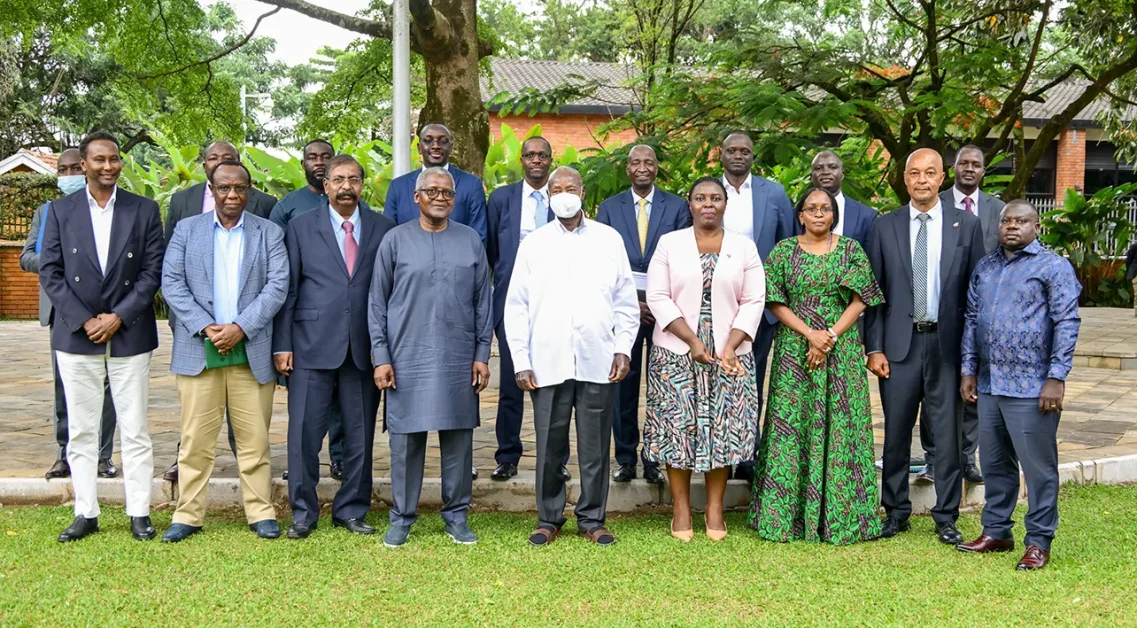
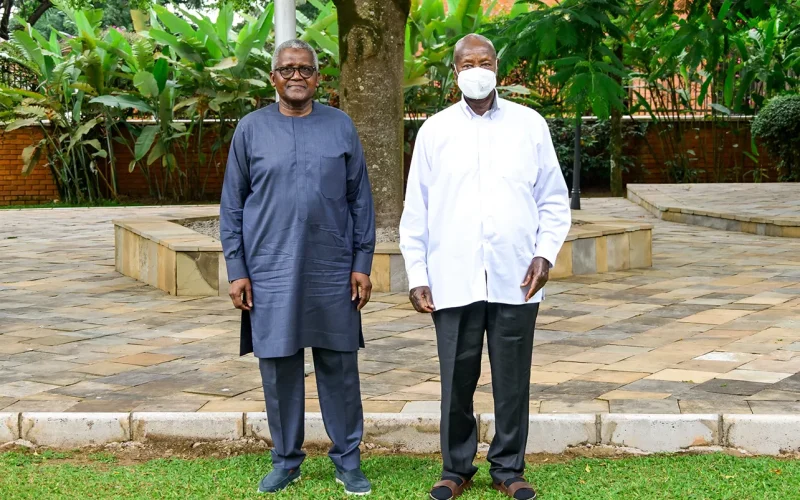
President Museveni, who has been making this argument for decades, was equally direct. Speaking after a bilateral meeting with Dangote at State Lodge Nakasero this weekend, Museveni declared that Uganda had always opposed the export of raw materials without value addition – which is precisely why the country delayed oil production until a refinery plan was in place. “We cannot continue operating in fragmented and weak markets,” Museveni said. “If East Africa works together, such projects become more viable and beneficial to our people.” Uganda, he confirmed, would support the regional refinery initiative while also continuing with the development of its own refinery in Hoima.
The Site Question
The diplomacy of location has added texture to what is otherwise a straightforward industrial proposition. Dangote told the Financial Times on May 10 that he is leaning toward Kenya’s port city of Mombasa rather than Tanzania’s Tanga, where the project had originally been announced. “I’m leaning more towards Mombasa because Mombasa has a much larger, deeper port,” Dangote said. “Kenyans consume more. It’s a bigger economy.” He has since said, pointedly, that whatever President Ruto decides is what he will do – placing the political weight of the choice squarely on Kenya’s shoulders.
A diplomatic wrinkle surfaced when Tanzanian President Samia Suluhu Hassan publicly rebuked her Kenyan counterpart during Ruto’s state visit to Dar es Salaam on May 4, saying she had not been consulted before Ruto and Dangote announced the Tanga project. The spat is a reminder that African integration, for all its rhetorical consensus, still requires the patient architecture of genuine consultation. But Dangote has been careful to reassure Tanzania – he has said government equity ownership will be open to all participating states, and that technical teams will determine the optimal location. In Tanzania earlier, he was categorical: “It doesn’t matter where the location is. And Tanzania, we have offered to Tanzania to also be a part owner of this refinery.”
Why This Matters So Much
East Africa currently imports every liter of refined petroleum it consumes, largely from the Middle East. The US-Israeli war on Iran and the closure of the Strait of Hormuz have hit the region hard, driving fuel prices up and exposing how vulnerable the supply chain is. This is not an abstract geopolitical concern. Families across the region have felt it in cooking gas prices. Businesses have felt it in transport costs. Airlines have felt it in jet fuel availability.
Supply from Dangote’s Lagos refinery has cushioned the impact of the war for Nigeria and neighbouring countries. Neighbours of Nigeria – Cameroon, Togo, Ghana, and even Tanzania – are among the countries that have turned to Nigeria as supplies from the Middle East dry up. The Lagos proof of concept is now East Africa’s most compelling argument for why this project must happen.
The proposed regional refinery is expected to strengthen East Africa’s energy security, support industrialisation, and complement ongoing infrastructure projects such as the East African Crude Oil Pipeline (EACOP) linking Hoima in Uganda to Tanga in Tanzania. Uganda’s oil sector officials recently undertook a study visit to the Dangote Refinery in Lagos, specifically to learn lessons for their own project – on delivery model, financing structure, operational readiness, and workforce development. The knowledge transfer is already underway.
The Opposition and What It Reveals
No transformative African industrial project goes unopposed by those whose profits depend on Africa’s continued industrial weakness. Pushback to a potential 1.2 million-barrel-per-day East African refinery proposal has come from the World Bank and IMF, whose stated concern is that it would hand monopoly power to one company. The irony is breathtaking.
French-owned refineries operate across oil-producing Africa. For decades, African governments were structurally prevented from accessing loans for refineries larger than 400,000 barrels per day – keeping them too small to be optimally profitable. Nigeria’s crude was exported to Europe, refined, and sold back to West Africa under the flags of Shell and Total. It took an African billionaire financing the Lagos refinery from his own resources to begin unwinding that arrangement.
As the African Energy Chamber noted in recognising Dangote as its Energy Person of the Year for 2026, his impact on refining and energy security “continues to redefine what’s possible for the continent’s energy sector.” The recognition reflects a broader continental sentiment: that indigenous African industrial leadership is no longer aspirational – it is actual.
The Outlook
The building blocks of the deal are in place. Multiple heads of state are publicly committed. Dangote has given personal assurances and a four-to-five-year timeline. Technical teams are assessing sites. Uganda is ready to buy equity. Rwanda is engaged. South Sudan and DRC bring crude supply to the table.
Uganda’s Permanent Secretary at the Ministry of Energy and Mineral Development, Eng. Irene Bateebe confirmed that Uganda’s refinery plans remain commercially viable, and that the country would continue engaging stakeholders on both the national refinery project and wider regional energy cooperation initiatives.
What East Africa is building, in real time, is what the continent’s pan-Africanist founders always envisioned: economies that process their own resources, own their own supply chains, and price their own prosperity. The refinery is not merely an industrial project. It is a statement of civilisational intent.
Dangote put it plainly in Nairobi: he can give the commitment. The question now is whether East Africa’s governments can move with the same urgency as the moment demands.