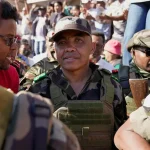
THE crack of gunfire shattered Cotonou’s Sunday morning calm as Benin – long celebrated as West Africa’s beacon of democratic stability – found itself staring down the barrel of its own military. Armed soldiers had seized the state broadcaster, their faces stern beneath military berets as they announced the unthinkable: the dissolution of parliament, the suspension of the constitution, the death of the old order.
“The army solemnly commits to give the Beninese people the hope of a truly new era, where fraternity, justice and work prevail,” Colonel Tigri Pascal declared through the television cameras, eight uniformed figures flanking him in a tableau that has become sickeningly familiar across the region.
But this coup would not succeed. Within hours, the mutiny collapsed like a house of cards.
Interior Minister Alassane Seidou’s swift confirmation that loyalist forces had crushed the attempt brought cautious relief, though the gunfire echoing through neighbourhoods near President Patrice Talon’s residence told a story of how close Benin had come to joining West Africa’s growing roster of military governments. The French embassy’s urgent warnings for residents to shelter in place underscored the gravity of those tense hours before police flooded back onto Cotonou’s streets and normalcy—fragile, uncertain—returned.
A Region on Fire
The timing is chilling. Just weeks earlier, Guinea’s presidential elections—meant to showcase democratic transition—descended into chaos when military forces overthrew the government mid-vote, extinguishing hopes that the ballot box might restore civilian rule. That coup landed like a hammer blow on regional hopes for democratic revival.
Now Benin, a nation that had celebrated multiparty democracy since 1991 without military interference, nearly became the latest domino to fall. The attempted putsch reveals the contagion spreading across West Africa: Niger, Burkina Faso, Mali, Guinea, Guinea-Bissau—all have succumbed to military takeovers in recent years, creating an arc of authoritarian rule stretching across the Sahel.
The Economic Community of West African States (ECOWAS) and the African Union issued swift condemnations, their statements heavy with alarm about “democratic backsliding.” But condemnations ring hollow when soldiers keep seizing power and getting away with it.
The Powder Keg
The coup plotters cited festering grievances: jihadist violence consuming Benin’s northern territories, where militants linked to Al Qaeda have spilt across porous borders from Mali, Burkina Faso, and Niger. Last April’s massacre of 54 soldiers—a wound still raw in the national consciousness—became their rallying cry. They accused the government of abandoning fallen heroes and neglecting the security crisis devouring entire communities.
Yet the coup attempt also arrives amid explosive political tensions surrounding April’s presidential election. President Talon, in power since 2016, recently pushed through constitutional changes extending presidential terms from five to seven years—a move opposition figures denounce as naked power consolidation. When courts disqualified the main opposition candidate while Finance Minister Romuald Wadagni secured the ruling coalition’s nomination, the electoral playing field tilted dangerously.
The soldiers’ proclamation of a “truly new era” where “fraternity, justice and work prevail” drips with bitter irony. Across West Africa, military juntas have wrapped themselves in similar rhetoric of national salvation, only to deliver repression, isolation, and deeper instability.
Democracy’s Narrow Escape
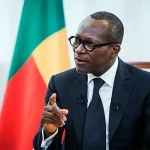
Benin’s swift defeat of the coup attempt demonstrates that democratic institutions can still fight back. Foreign Minister Olushegun Adjadi Bakari’s account to Reuters—loyalist forces swiftly retaking the state broadcaster, shutting down the mutineers’ platform, reasserting control—shows a government that refused to buckle.
But Sunday’s close call exposes uncomfortable truths. Three decades of democratic tradition nearly evaporated in a morning. The gunfire, the scrambling residents, the armed soldiers on state television—these images will haunt Benin as it approaches crucial elections. The country’s hard-won stability, once taken for granted, now feels precarious.
As West Africa lurches from crisis to crisis, Benin’s narrow escape offers both hope and warning. Democracy survived—this time. But the storm battering the region shows no signs of passing, and each new coup attempt, whether successful or thwarted, weakens the foundations holding back the deluge.
The question hanging over Cotonou as calm returns is not whether Benin dodged a bullet—clearly it did. The question is whether, in a region where coups have become almost routine, anyone can dodge them forever.